 layrd.liveLayer by Layer
- 1. Zeroth Law
- 2. First Law
- 3. P–V Diagrams & Cycles
- 4. Cv, Cp and γ
- 5. Iso-processes
- 6. Adiabatic
- 7. Free Expansion
- 8. Polytropic
- 9. Engines & Fridges
- 10. Second Law & Carnot
Adiabatic Process
Pump a tyre fast and the pump gets hot with no heat supplied. That is the adiabatic process, Q = 0. This part derives = constant, shows why the adiabat is γ times steeper than the isotherm, finds the adiabatic work, and ends with the isothermal and adiabatic bulk moduli.
Builds on: Part 4 · Molar Specific Heats: Cv, Cp and γ, Part 5 · Isochoric, Isobaric and Isothermal Processes.
 Video coming soon
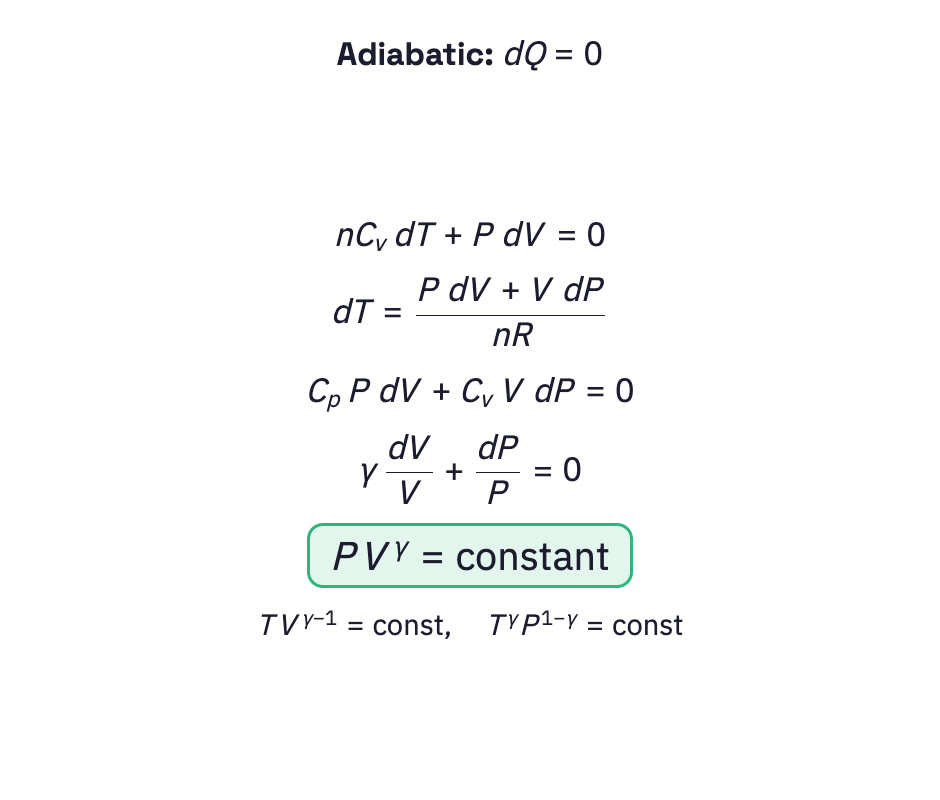
= constant
: . With and : , so = constant, = constant and = constant.
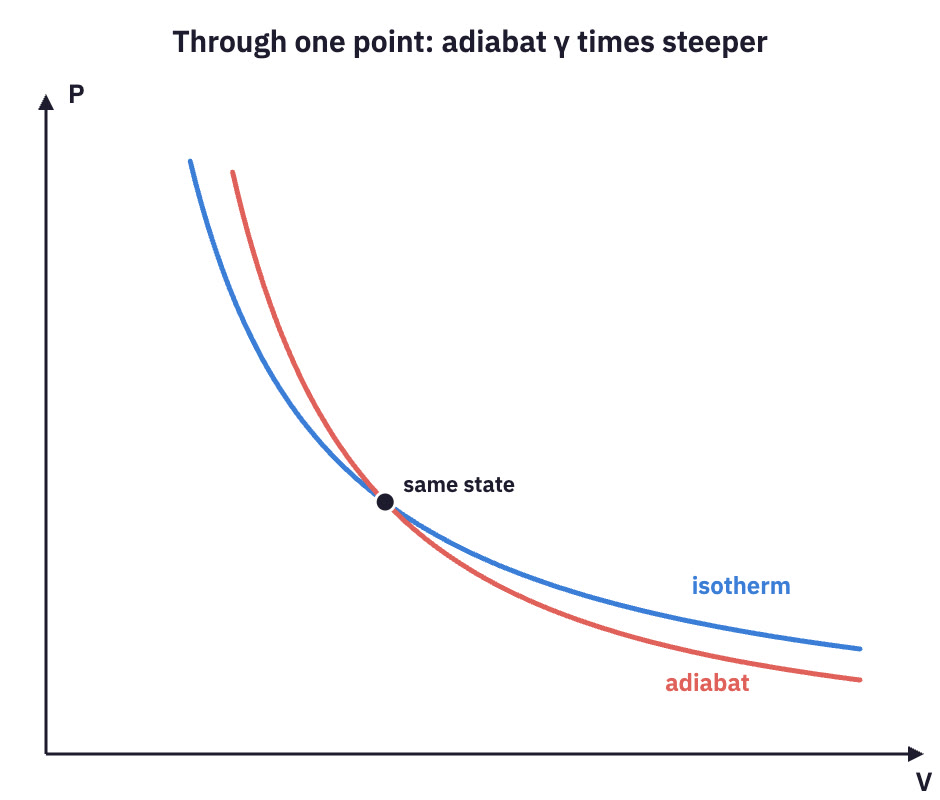
Adiabat γ times steeper
Isotherm: . Adiabat: . Through any point the adiabat falls γ times faster, because an expanding adiabatic gas also cools.
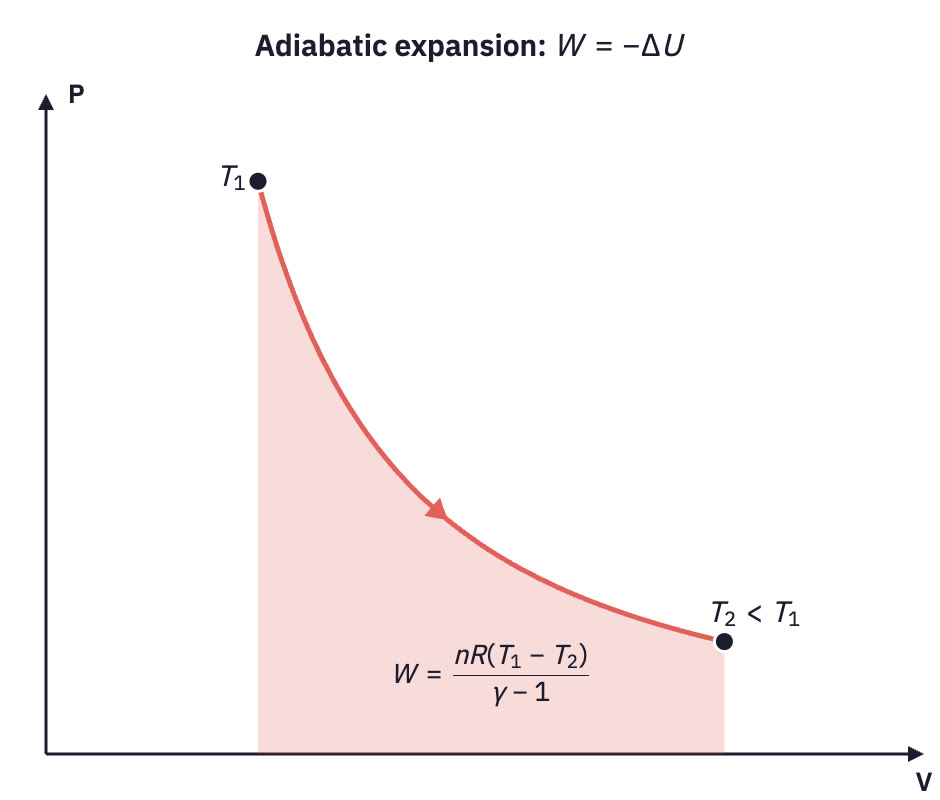
. Expansion: T falls, W > 0. Compression: T rises, W < 0.
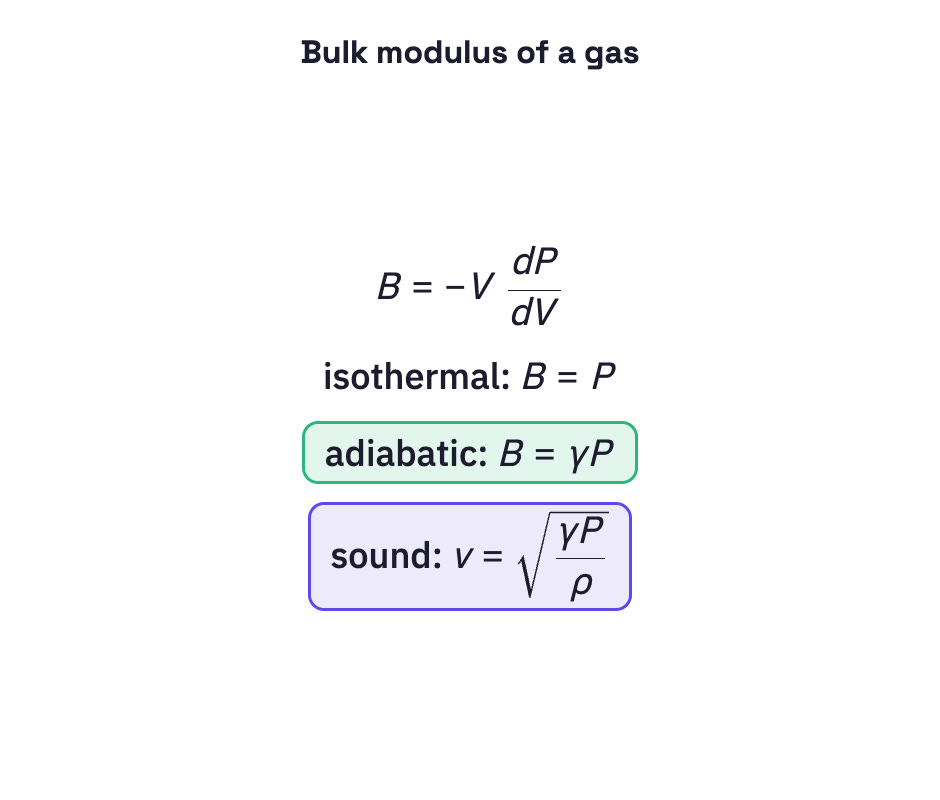
,
. Isothermal: . Adiabatic: . Sound is adiabatic, so .
Key formulas
One for every idea
1. A gas with γ = 1.5 is compressed adiabatically from 16 litres to 12 litres. Find the ratio of final to initial pressure and of final to initial temperature.
- : .
- constant: .
- Both > 1: adiabatic compression heats the gas.
, . (The JSON calls this gas diatomic; a diatomic gas has γ = 1.4, so the video treats it simply as a gas with γ = 1.5.)
Your turn
A monatomic ideal gas at 300 K expands adiabatically to 8 times its volume. Its final temperature is:
Show the answer and the traps
T₂ = T₁(V₁/V₂)^(γ − 1) = 300 × (1/8)^(2/3) = 300/4 = 75 K: option a.
37.5 K drops the power. 9.4 K uses γ instead of γ − 1.
And 300 K forgets that the gas cools as it does work with no heat coming in.
Common mistakes
Try these
1. Air (γ = 1.4) at 27 °C is compressed adiabatically to one-eighth of its volume. Find the final temperature.
K (about 416 °C).
2. 2 mol of a monatomic gas expands adiabatically, cooling from 500 K to 300 K. Find the work done by the gas.
J.
3. A gas at Pa has an adiabatic bulk modulus of Pa. Find γ and its isothermal bulk modulus.
γ = 1.4; Pa.