 layrd.liveLayer by Layer
- 1. Zeroth Law
- 2. First Law
- 3. P–V Diagrams & Cycles
- 4. Cv, Cp and γ
- 5. Iso-processes
- 6. Adiabatic
- 7. Free Expansion
- 8. Polytropic
- 9. Engines & Fridges
- 10. Second Law & Carnot
Polytropic Process
Every standard process is one member of a family, = constant. This stretch part (JEE Advanced, NSEP, INPhO) finds the molar heat capacity of any polytropic process, , recovers the four special cases, and compares slopes on the P–V diagram.
Builds on: Part 5 · Isochoric, Isobaric and Isothermal Processes, Part 6 · Adiabatic Process.
 Video coming soon
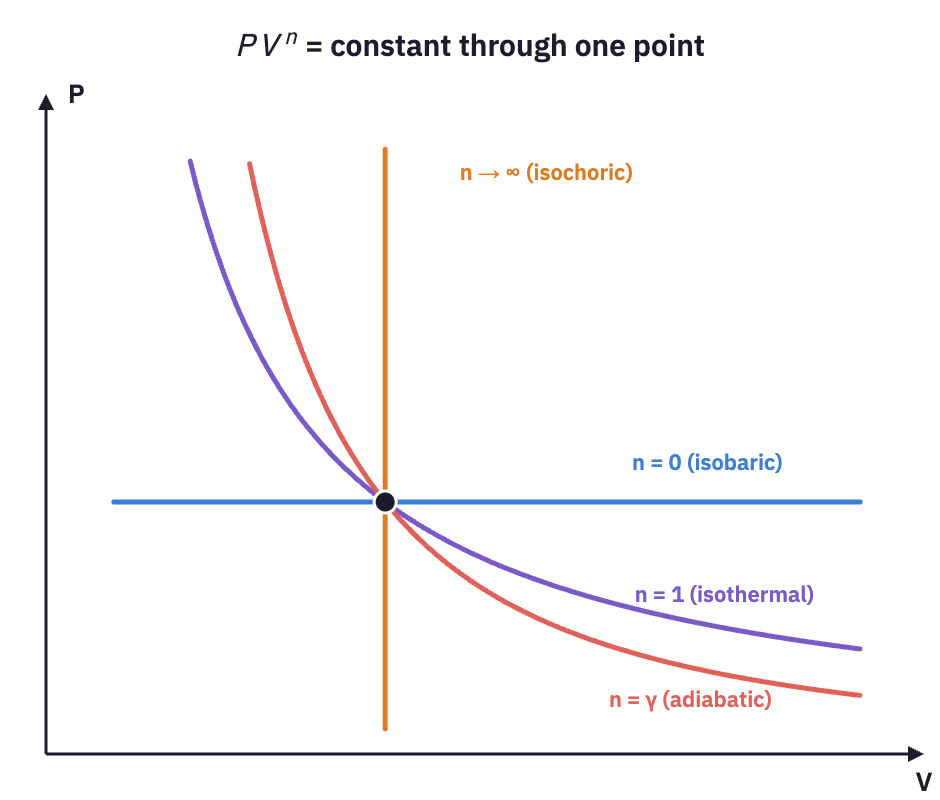
= constant
n = 0 isobaric, n = 1 isothermal, n = γ adiabatic, n → ∞ isochoric. Through a common point the slope grows with n, from flat to vertical.
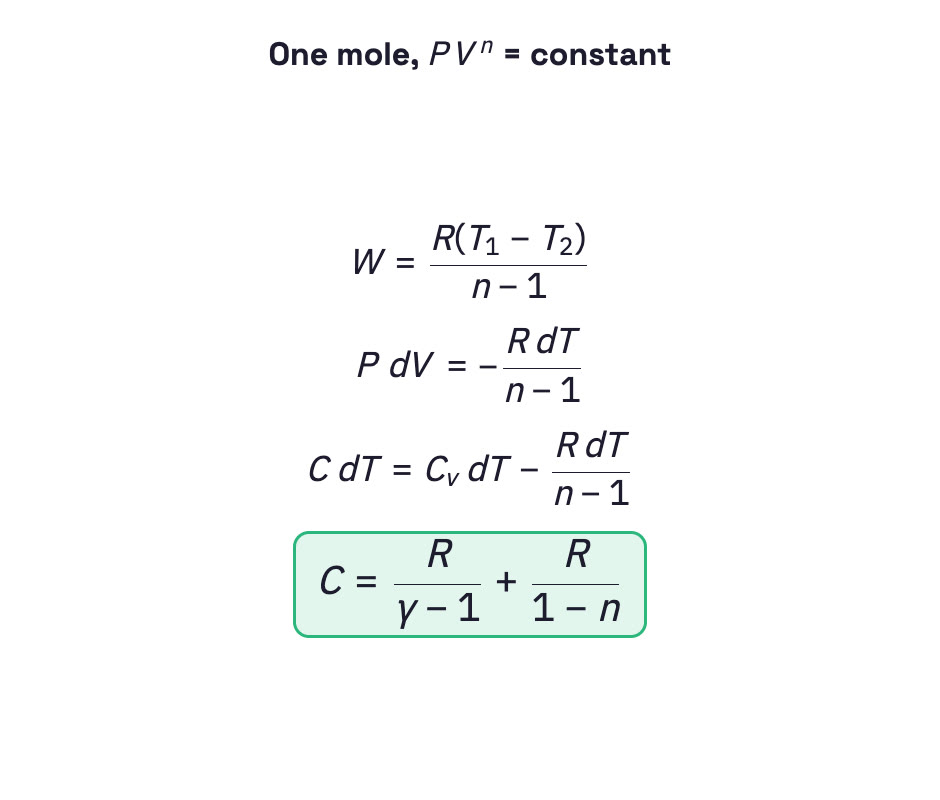
For one mole , so and the first law gives C. Here n is the polytropic index, not the number of moles.
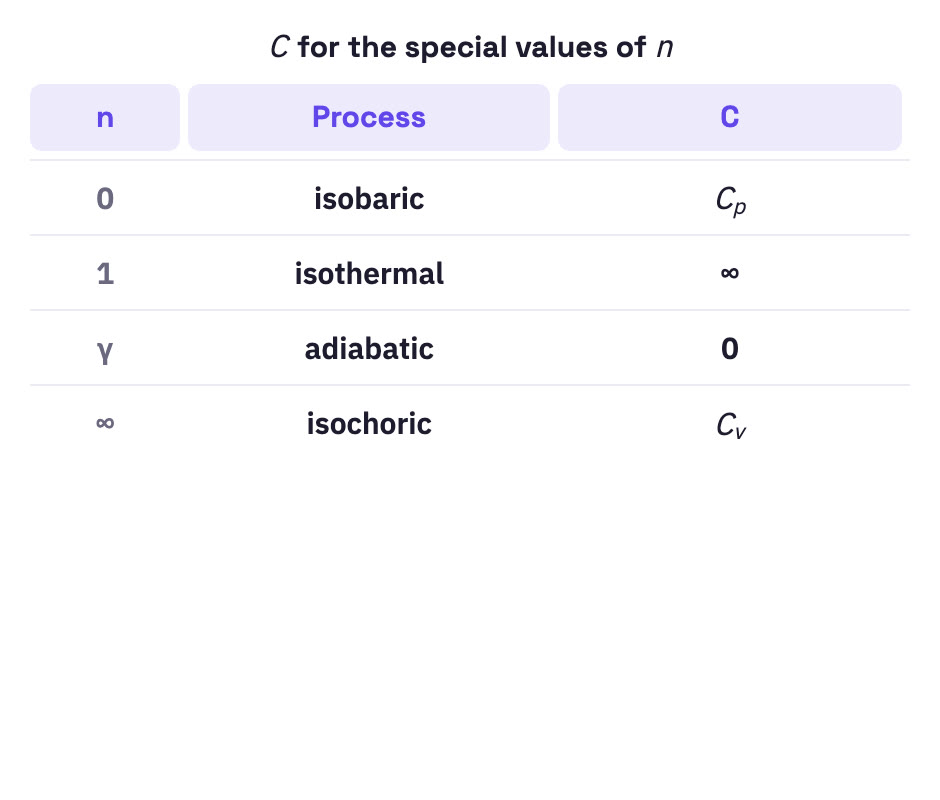
n = 0, 1, γ, ∞
n = 0: . n = 1: C = ∞. n = γ: C = 0. n → ∞: . For 1 < n < γ, C is negative: the gas cools while absorbing heat.
Key formulas
One for every idea
1. A monatomic gas () undergoes a polytropic process with n = 2. Find its molar heat capacity.
- .
- .
J/mol·K.
2. Two polytropic curves pass through the same point on a P–V diagram, with n = 1.2 and n = 1.5. Which is steeper there, and why?
- , and P and V are the same for both at that point.
- So the slope is proportional to n: ratio 1.5/1.2 = 1.25.
The n = 1.5 curve is steeper (1.25 times).
Your turn
One mole of a diatomic ideal gas (γ = 1.4) undergoes the process PV³ = constant. Its molar heat capacity in this process is:
Show the answer and the traps
C = R/0.4 + R/(1 − 3) = 2.5R − 0.5R = 2R: option a.
3R flips the sign of R/(1 − n). 2.5R is just Cv.
And zero is the adiabatic case, n = γ, not n = 3.
Common mistakes
Try these
1. Find the molar heat capacity of a diatomic gas (γ = 7/5) in the process = constant.
.
2. A monatomic gas follows = constant. Find C and say what is unusual about it.
J/mol·K: negative, so the gas cools while absorbing heat.
3. One mole of ideal gas expands along = constant from V to 2V, starting at 400 K. Find the final temperature.
: 200 K.