 layrd.liveLayer by Layer
- 1. Zeroth Law
- 2. First Law
- 3. P–V Diagrams & Cycles
- 4. Cv, Cp and γ
- 5. Iso-processes
- 6. Adiabatic
- 7. Free Expansion
- 8. Polytropic
- 9. Engines & Fridges
- 10. Second Law & Carnot
Molar Specific Heats: Cv, Cp and γ
A gas's specific heat depends on how it is heated. This part derives the two standard ones from the first law, at constant volume and at constant pressure (Mayer's relation), then their ratio γ for one gas and for a mixture.
Builds on: Part 2 · First Law of Thermodynamics.
 Video coming soon
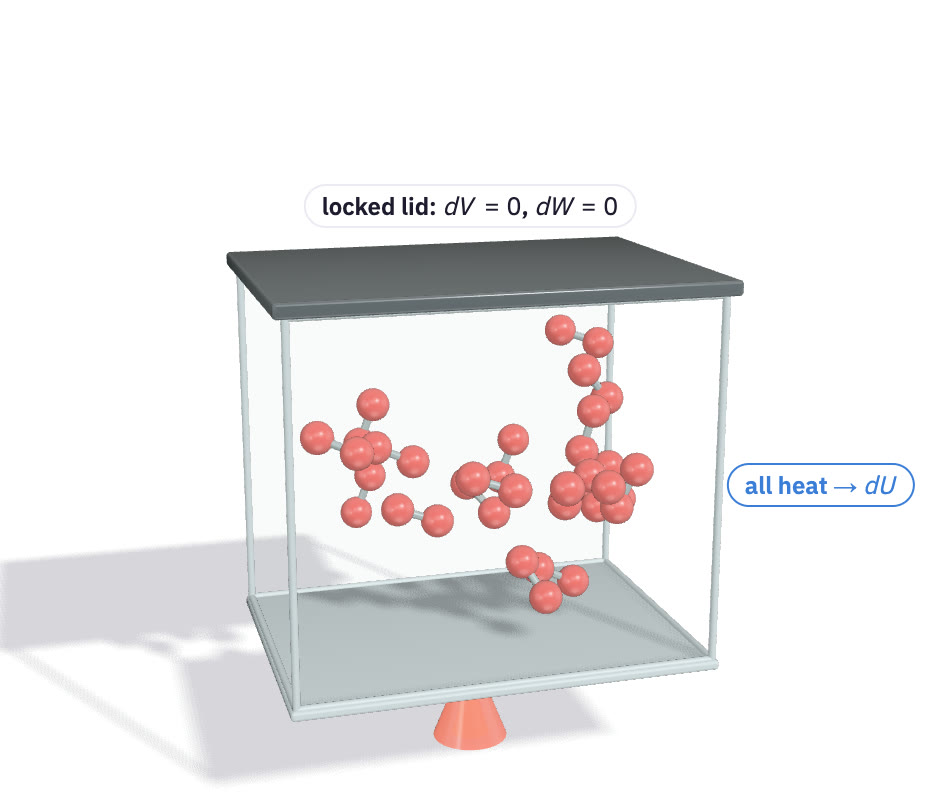
With the volume fixed, , so : , giving ( monatomic, diatomic).
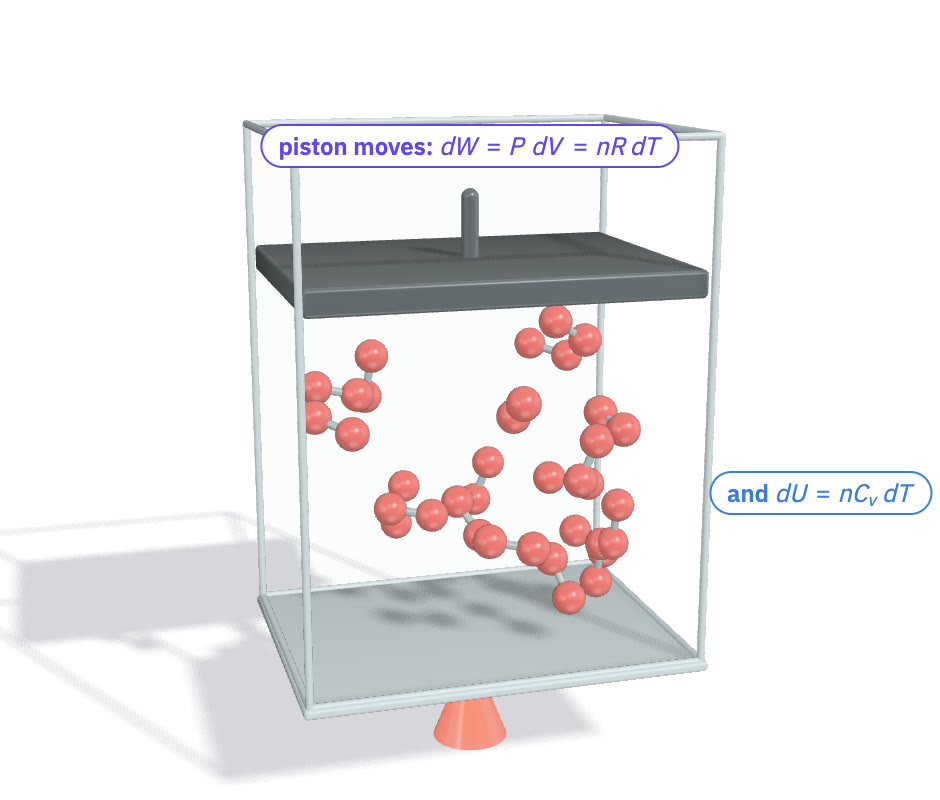
Mayer:
At constant pressure the gas also does work . So and : always bigger than .
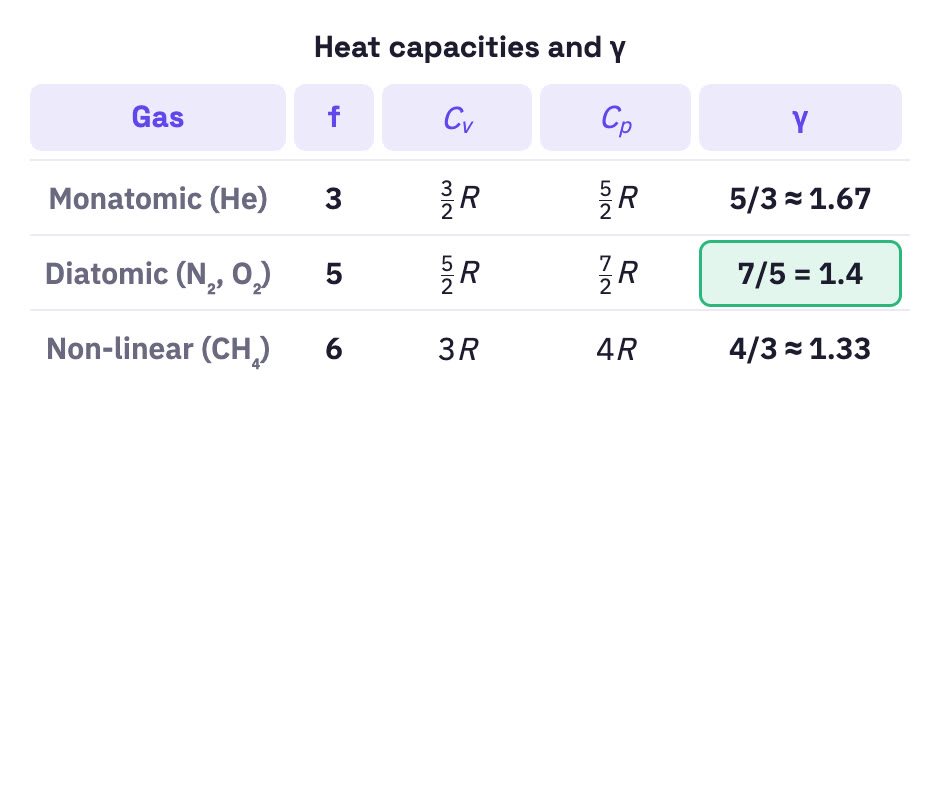
Monatomic 5/3 ≈ 1.67, diatomic 7/5 = 1.4, non-linear polyatomic (f = 6) 4/3. More degrees of freedom, smaller γ; always γ > 1.
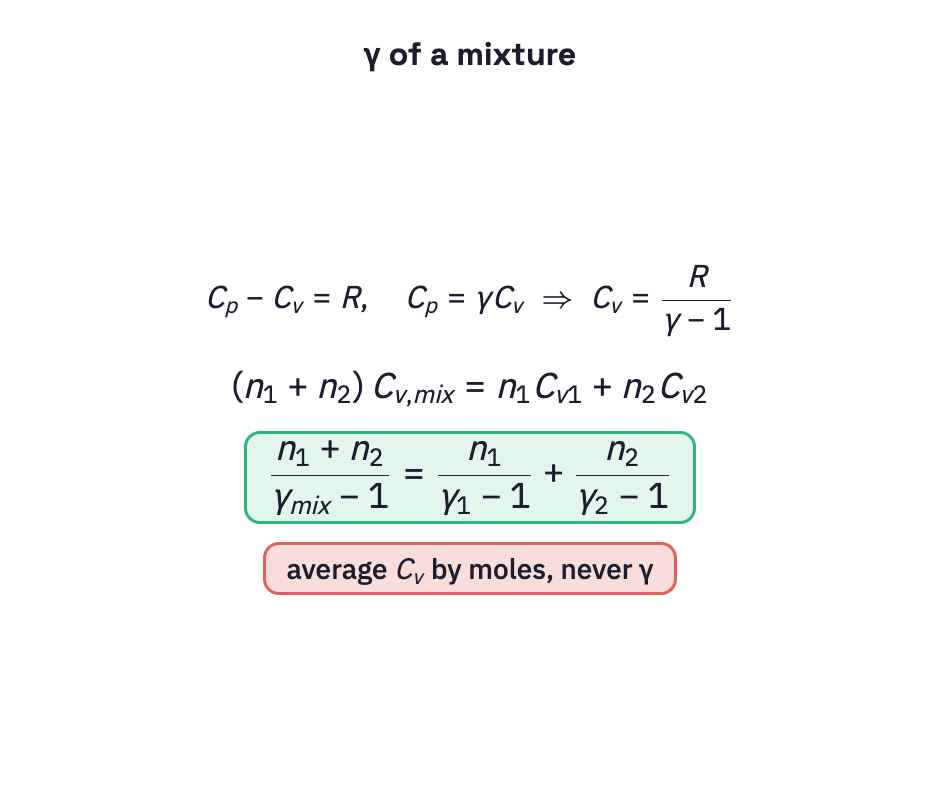
Internal energies add at the common temperature, so values average by moles. With this gives the rule above. Never average γ directly.
Key formulas
One for every idea
1. Find the heat required to raise the temperature of 1 mol of a diatomic gas by 10 K at constant volume ().
- Diatomic: , J/mol·K.
- .
J.
2. A monatomic gas has . Using Mayer's relation, find .
- .
J/mol·K.
3. Find γ for a diatomic gas at ordinary temperature.
- Vibration is frozen: 3 translational + 2 rotational, .
- .
.
4. A mixture contains 2 mol of a monatomic gas () and 3 mol of a diatomic gas (). Find the equivalent γ of the mixture.
- .
- .
- A plain mole-weighted average of γ (1.51) is wrong.
.
Your turn
For an ideal gas, Cp/Cv = 1.4. Its molar heat capacity at constant volume Cv is:
Show the answer and the traps
Cv = R/(γ − 1) = R/0.4 = 2.5R: option b.
1.5R is the monatomic value. 3.5R is Cp, not Cv.
And 1.4R confuses γ, a ratio, with Cv/R.
Common mistakes
Try these
1. Find and γ for a gas with .
, .
2. For a gas, J/mol·K. Find .
J/mol·K (a diatomic gas).
3. A gas has γ = 1.4. Find its degrees of freedom.
.
4. 1 mol of He (γ = 5/3) is mixed with 1 mol of O₂ (γ = 7/5). Find γ of the mixture.
.