 layrd.liveLayer by Layer
- 1. Zeroth Law
- 2. First Law
- 3. P–V Diagrams & Cycles
- 4. Cv, Cp and γ
- 5. Iso-processes
- 6. Adiabatic
- 7. Free Expansion
- 8. Polytropic
- 9. Engines & Fridges
- 10. Second Law & Carnot
Reversible Processes, Heat Engines and Refrigerators
A heat engine repeats a cycle that turns heat into work; a refrigerator runs one backwards. This part starts from reversibility, then uses , efficiency and the refrigerator's coefficient of performance , with a worked example for each.
Builds on: Part 3 · Indicator Diagrams, State Variables and Cycles, Part 7 · Free Expansion of a Gas.
 Video coming soon
Ideal vs real
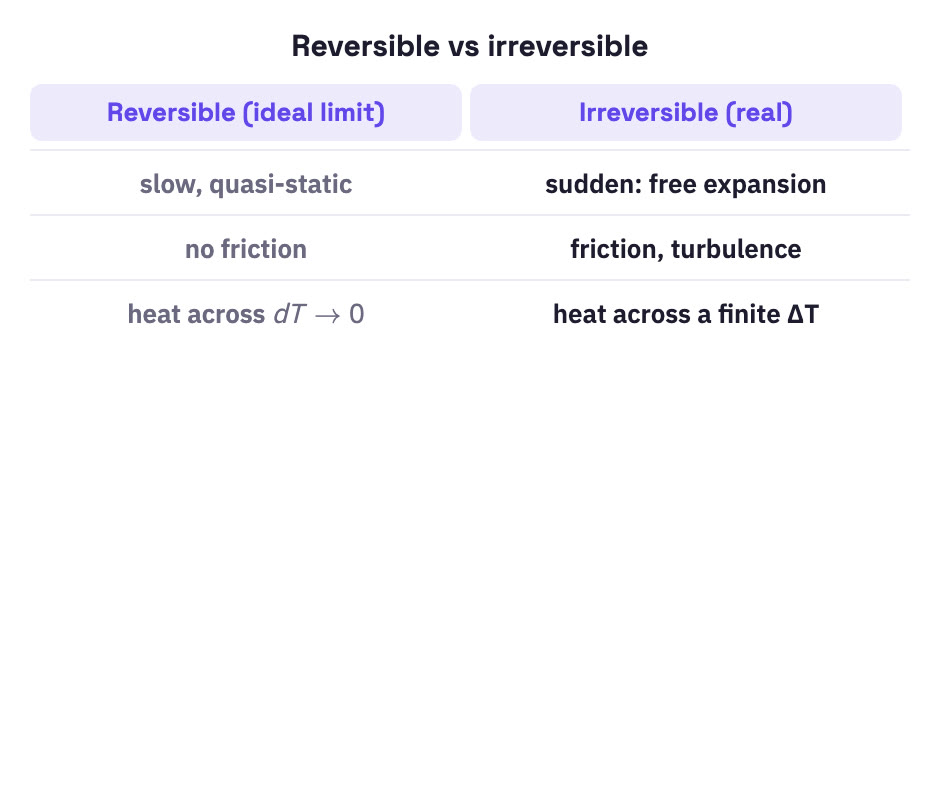
A reversible process can be undone with the system and surroundings restored. It must be quasi-static and free of friction. Real processes (sudden expansion, friction, heat across a finite ΔT) are irreversible.
,
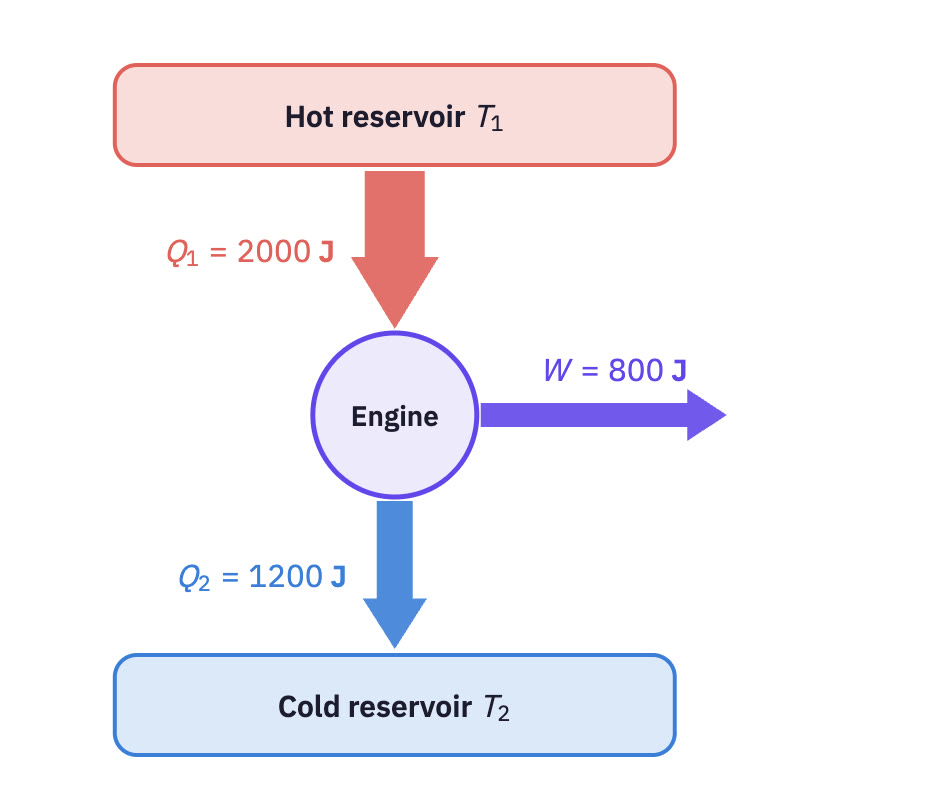
Each cycle takes from the hot reservoir, does work W and rejects to the cold one. ΔU = 0 over a cycle, so and .
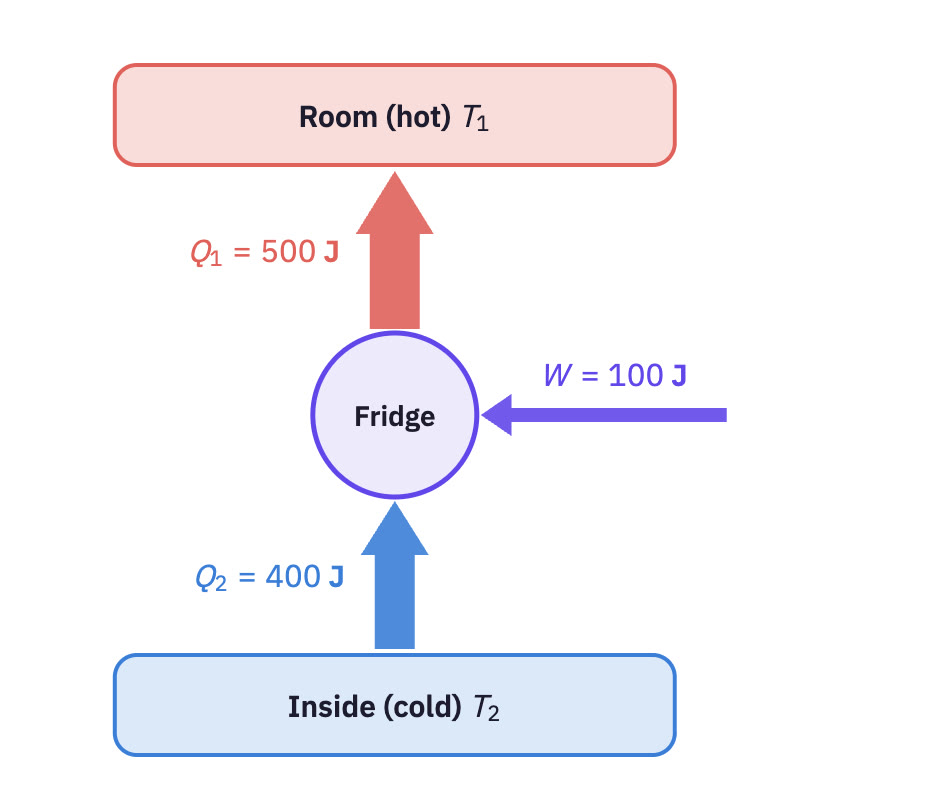
Work W done on it moves out of the cold space and dumps into the room. COP = , usually more than 1.
Key formulas
One for every idea
1. Is the free expansion of a gas into a vacuum a reversible process? Justify your answer.
- To undo it, compress the gas back: work must be done on it.
- To keep T the same, that energy leaves as heat to the surroundings.
- The gas is restored, but the surroundings have lost work and gained heat.
No: free expansion is irreversible.
2. A heat engine absorbs 2000 J from a hot reservoir per cycle and rejects 1200 J to a cold reservoir. Find the work done per cycle.
- ΔU = 0 over a cycle: .
J per cycle.
3. For the same engine ( = 2000 J, = 1200 J, W = 800 J), find its thermal efficiency.
- .
- Check: .
, i.e. 40%.
4. A refrigerator removes 400 J from its cold chamber per cycle while 100 J of work is done on it. Find its COP and the heat rejected to the surroundings.
- .
- .
COP = 4; J.
Your turn
A heat engine of efficiency 25% does 300 J of work per cycle. The heat it rejects per cycle is:
Show the answer and the traps
Q₁ = W/η = 300/0.25 = 1200 J, so Q₂ = Q₁ − W = 900 J: option a.
1200 J is the heat absorbed, not rejected. 75 J multiplies by η instead of dividing.
And 225 J puts (1 − η) on the work instead of on the heat.
Common mistakes
Try these
1. An engine of efficiency 30% absorbs 1500 J per cycle. Find the work done and the heat rejected per cycle.
W = 450 J; = 1050 J.
2. A refrigerator with COP 5 removes 600 J per cycle from the cold space. Find the work needed and the heat rejected.
W = 120 J; = 720 J.
3. Which is approximately reversible: (a) a block sliding to rest by friction, (b) very slow isothermal compression of a gas, (c) two gases mixing, (d) heat flowing from a hot body to a cold one?
(b).