 layrd.liveLayer by Layer
- 1. What Is SHM
- 2. Equation of SHM
- 3. Reading SHM Equations
- 4. Superposition
- 5. Angular SHM
- 6. Simple and Spring Pendulums
- 7. Compound Pendulum
- 8. Effective g
- 9. Spring Combinations
- 10. Phase Difference
- 11. Sudden Changes
- 12. Energy of SHM
- 13. Energy Method
- 14. SHM in a Potential
- 15. Taylor's Method
- 16. Shifted Mean Position
- 17. Reduced Mass and Earth Tunnel
Angular SHM and the Three-Step Method to Find the Time Period
In angular SHM the angle oscillates: θ = θ₀ sin(ωt + α), θ̈ = −ω²θ, and the restoring torque is −Iω²θ. To find the period of any oscillator: find the equilibrium, displace it slightly, and reduce the restoring force to F = −kx (or τ = −kθ); then ω = √(k/m) (or √(k/I)) and T = 2π/ω.
Builds on: Part 2 · Equation of SHM, Phase, Velocity and Acceleration.
 Video coming soon
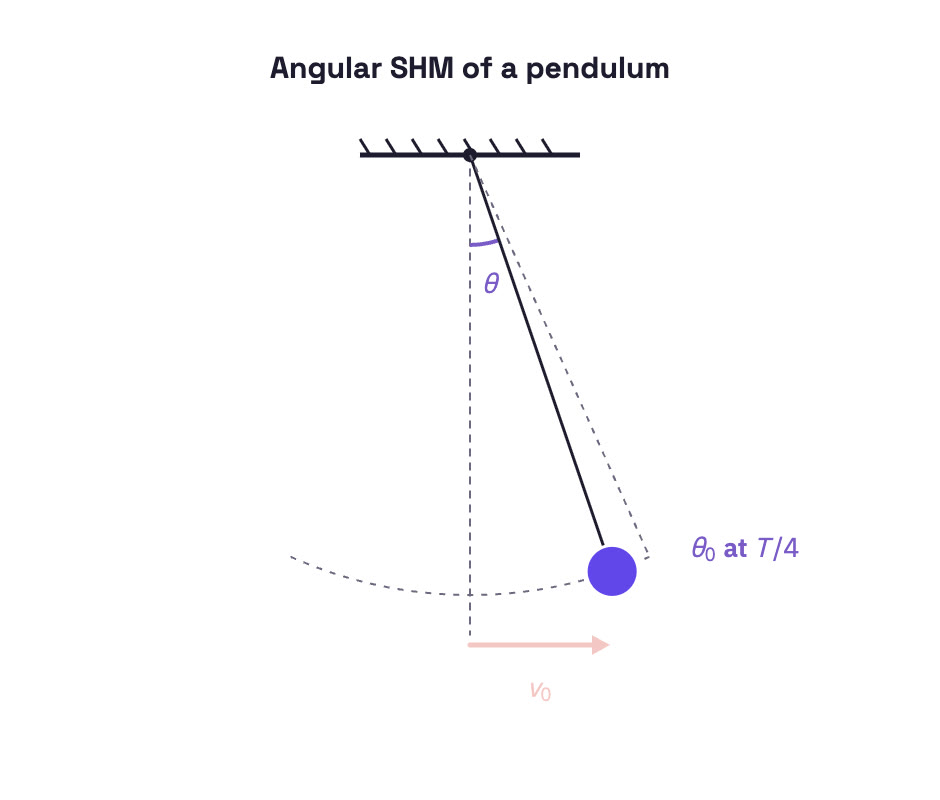
Pendulum thrown from the bottom
, ; the bob reaches at .
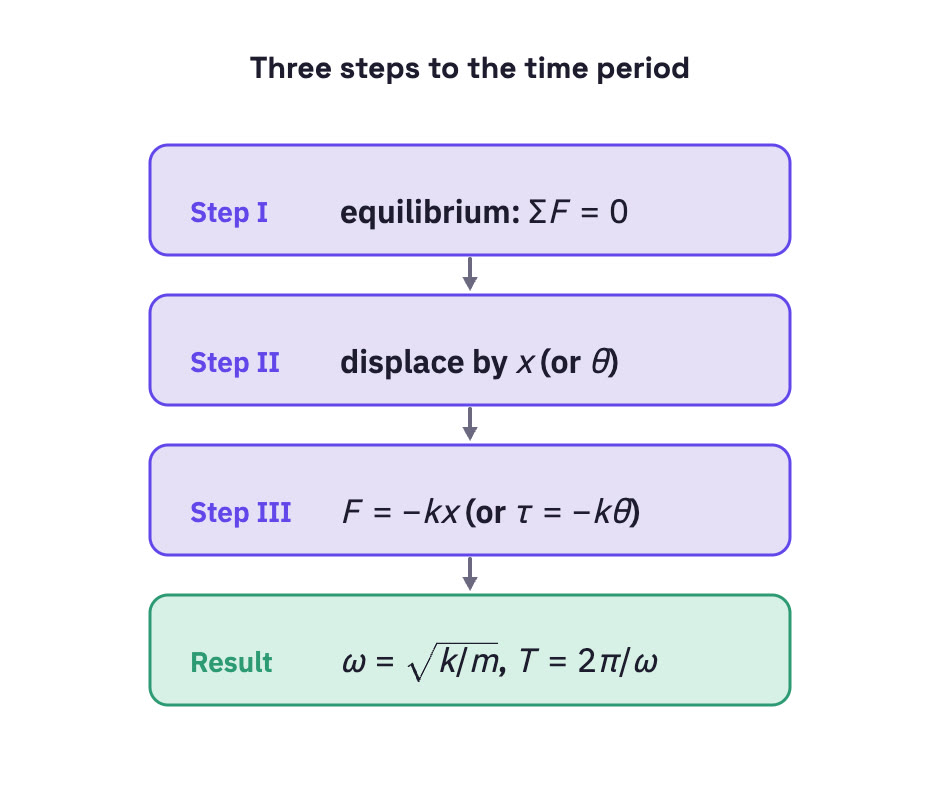
Three steps to the period
Equilibrium → displace by → → .
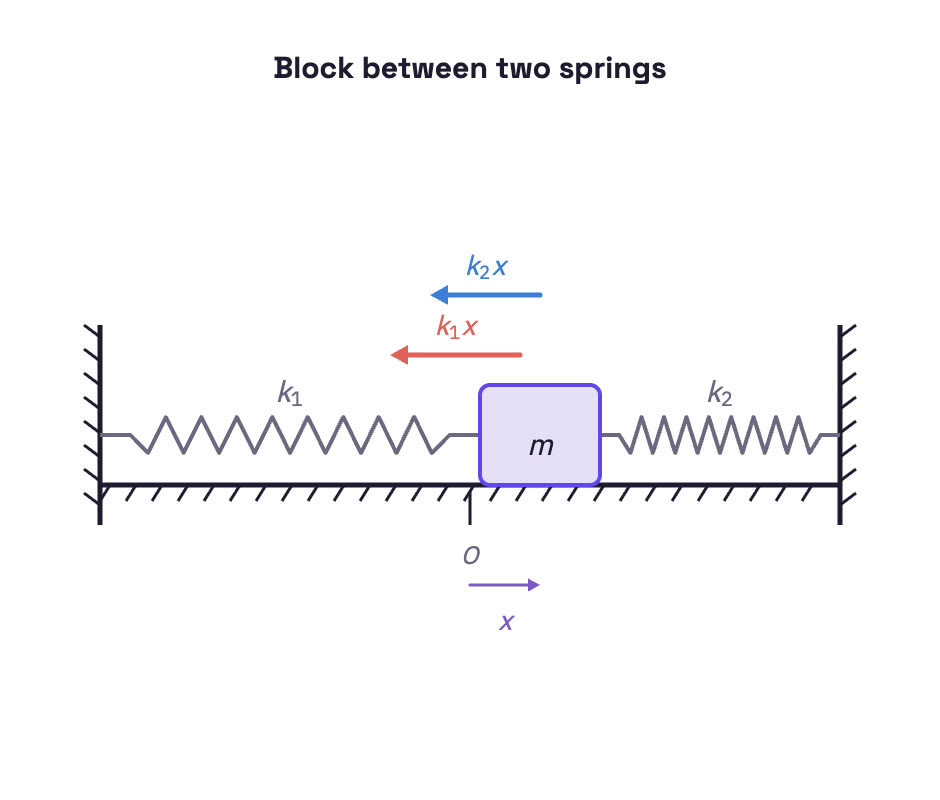
Block between two springs
Both springs push the block back: .
Key formulas
From the video
1. The bob of a 0.40 m simple pendulum, at rest, is given a speed of 0.30 m/s at its lowest point. Find the linear and the angular amplitude (g = 9.8 m/s²).
- rad/s.
- At the mean : m.
- .
A ≈ 6.1 cm, θ₀ ≈ 0.15 rad ≈ 8.7° (small enough for SHM).
2. A 0.5 kg block on a smooth floor sits between two springs of 30 N/m and 20 N/m fixed to walls on either side. Find its period of small oscillations.
- Displace by : the left spring pulls back with , the right pushes back with .
- , so rad/s.
T = 2π/10 = π/5 ≈ 0.63 s.
Your turn
A body turns so that d²θ/dt² + 25θ = 0. Its period of oscillation is:
Show the answer and the traps
Answer: 2π/5 s. Compare with d²θ/dt² + ω²θ = 0: ω² = 25, ω = 5 rad/s, and T = 2π/ω.
Not 2π/25 s: that uses ω² in place of ω.
Not 5/2π s: that is the frequency in hertz, turned into seconds.
Not π/5 s: that is only half the period.
Common mistakes
Try these
1. A 1 m pendulum at rest is given 0.2 m/s at its lowest point (g = 9.8 m/s²). Find its angular amplitude.
ω = √9.8 ≈ 3.13 rad/s, A ≈ 0.064 m, θ₀ ≈ 0.064 rad.
2. A 2 kg block sits between springs of 100 N/m and 300 N/m fixed to opposite walls. Find its period.
k = 400 N/m, ω = √200 ≈ 14.1 rad/s, T ≈ 0.44 s.
3. A body moves as θ̈ = −16θ with angular amplitude 0.1 rad. Find its largest angular velocity.
θ̇max = ωθ₀ = 4 × 0.1 = 0.4 rad/s.
4. A restoring torque τ = −0.5θ N m acts on a body with I = 0.02 kg m². Find its period.
ω = √(0.5/0.02) = 5 rad/s, T ≈ 1.26 s.