 layrd.liveLayer by Layer
- 1. What Is SHM
- 2. Equation of SHM
- 3. Reading SHM Equations
- 4. Superposition
- 5. Angular SHM
- 6. Simple and Spring Pendulums
- 7. Compound Pendulum
- 8. Effective g
- 9. Spring Combinations
- 10. Phase Difference
- 11. Sudden Changes
- 12. Energy of SHM
- 13. Energy Method
- 14. SHM in a Potential
- 15. Taylor's Method
- 16. Shifted Mean Position
- 17. Reduced Mass and Earth Tunnel
SHM About a Shifted Mean Position: Constant Forces and Lifts
d²y/dt² + ω²y = C is still SHM, about ym = C/ω² instead of the origin. A constant force F on a spring-block moves the equilibrium to F/k without changing ω: started from rest at natural length, the block oscillates with amplitude F/k up to an extension 2F/k. When a lift's acceleration starts or stops, the equilibrium jumps by ma/k, and that jump is the amplitude.
Builds on: Part 12 · Energy in SHM: Potential Well, Kinetic and Potential Energy.
 Video coming soon
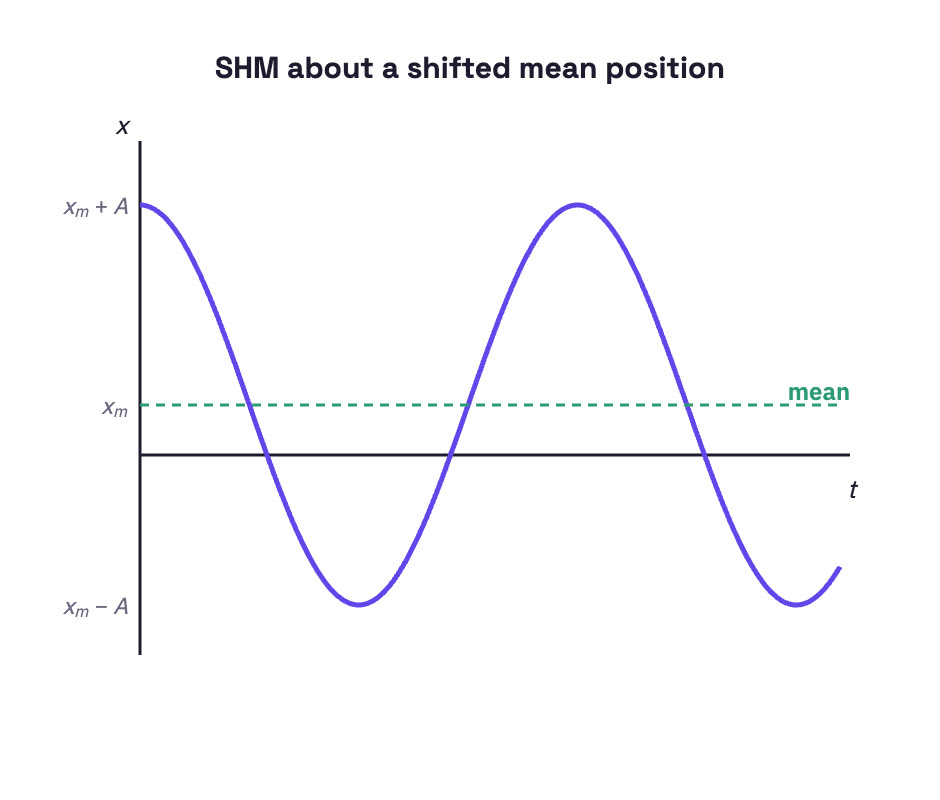
SHM about xm
: the curve oscillates about the line .
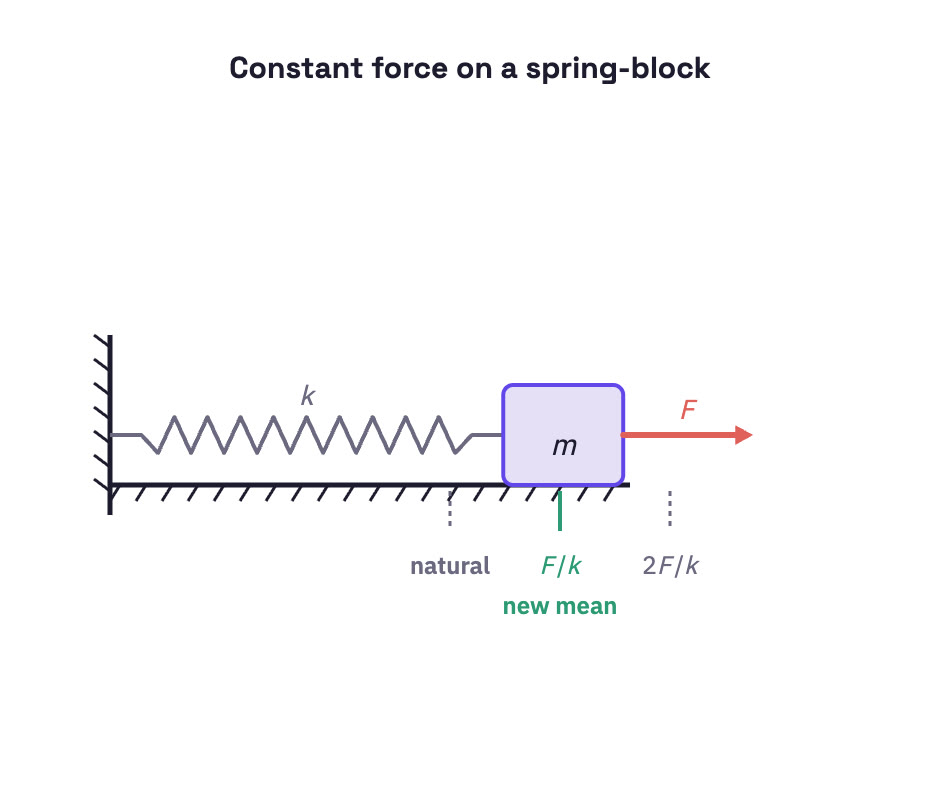
New mean at F/k
Amplitude , extension from 0 to ; unchanged.
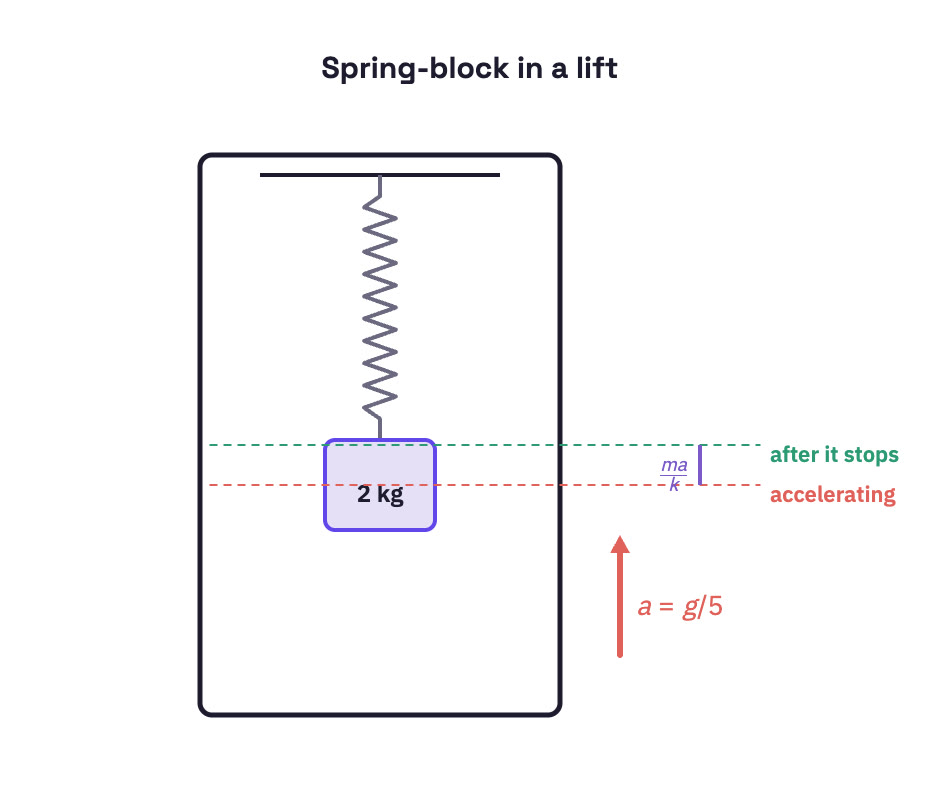
Equilibrium jumps by ma/k
When the acceleration stops, the block starts from its new equilibrium.
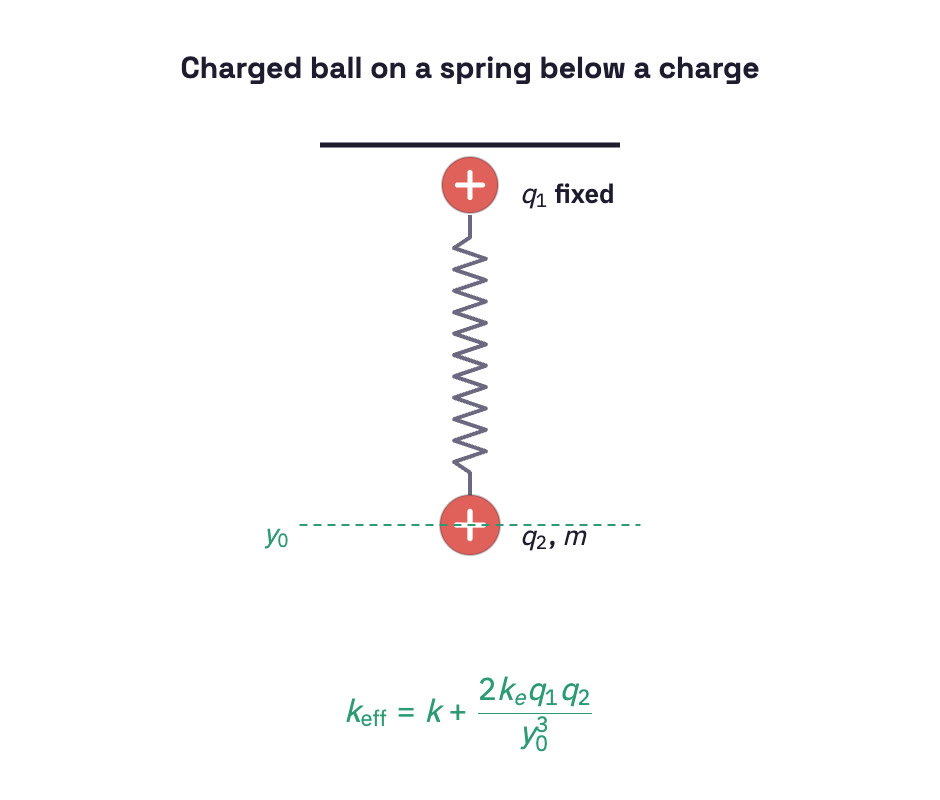
Ball below a fixed charge
.
Key formulas
From the video
1. A force f = −20x + 4 newtons acts on a 0.2 kg particle, released from rest at x = 1 m. Find the mean position, amplitude, period and equation of motion.
- : SHM about m with rad/s.
- Released from rest at 1 m (an extreme): m; .
Mean 0.2 m, A = 0.8 m, T = π/5 s, x = 0.2 + 0.8 cos 10t.
2. A 2 kg block hangs at rest on a 200 N/m spring in a lift accelerating upward at g/5. The acceleration suddenly stops. Find the amplitude of the resulting oscillations (g = 10 m/s²).
- While accelerating: extension m.
- New equilibrium: m; the block starts at rest 0.02 m from it.
A = ma/k = 2 cm.
Your turn
A block rests on a smooth floor with its spring (constant k) relaxed. A constant force F is suddenly applied along the spring. The maximum extension of the spring is:
Show the answer and the traps
Answer: 2F/k. The new mean is at F/k, the block starts F/k from it, so it swings to F/k + F/k = 2F/k.
Not F/k: that is the new mean, where the block moves fastest.
Not F/2k: work-energy, F × x = ½kx², gives x = 2F/k, not half of F/k.
Not √2 F/k: there is no square root; the oscillation is symmetric about F/k.
Common mistakes
Try these
1. A particle has a = −25x + 50 (SI) and is released from rest at x = 0. Find the mean position, amplitude and maximum speed.
xm = 2 m, A = 2 m, ω = 5 rad/s: vmax = 10 m/s.
2. Find the mean position and ω for d²y/dt² + 16y = 32.
ym = 32/16 = 2, ω = 4 rad/s.
3. A constant 10 N force acts on a 1 kg block on a relaxed 100 N/m spring. Find the amplitude and the maximum speed.
A = F/k = 0.1 m; vmax = F/√(mk) = 1 m/s.
4. A 0.5 kg block hangs at rest on a 50 N/m spring in a lift. The lift suddenly starts accelerating downward at 2 m/s². Find the amplitude.
A = ma/k = 0.02 m.
5. A 0.1 kg ball on a 10 N/m spring hangs y₀ = 0.2 m below a fixed charge, with ke q₁q₂ = 0.008 N m². Find ω.
keff = 10 + 2(0.008)/0.008 = 12 N/m: ω = √120 ≈ 11 rad/s.