 layrd.liveLayer by Layer
- 1. What Is SHM
- 2. Equation of SHM
- 3. Reading SHM Equations
- 4. Superposition
- 5. Angular SHM
- 6. Simple and Spring Pendulums
- 7. Compound Pendulum
- 8. Effective g
- 9. Spring Combinations
- 10. Phase Difference
- 11. Sudden Changes
- 12. Energy of SHM
- 13. Energy Method
- 14. SHM in a Potential
- 15. Taylor's Method
- 16. Shifted Mean Position
- 17. Reduced Mass and Earth Tunnel
Sudden Changes in SHM: Collisions, Added Mass and Elastic Walls
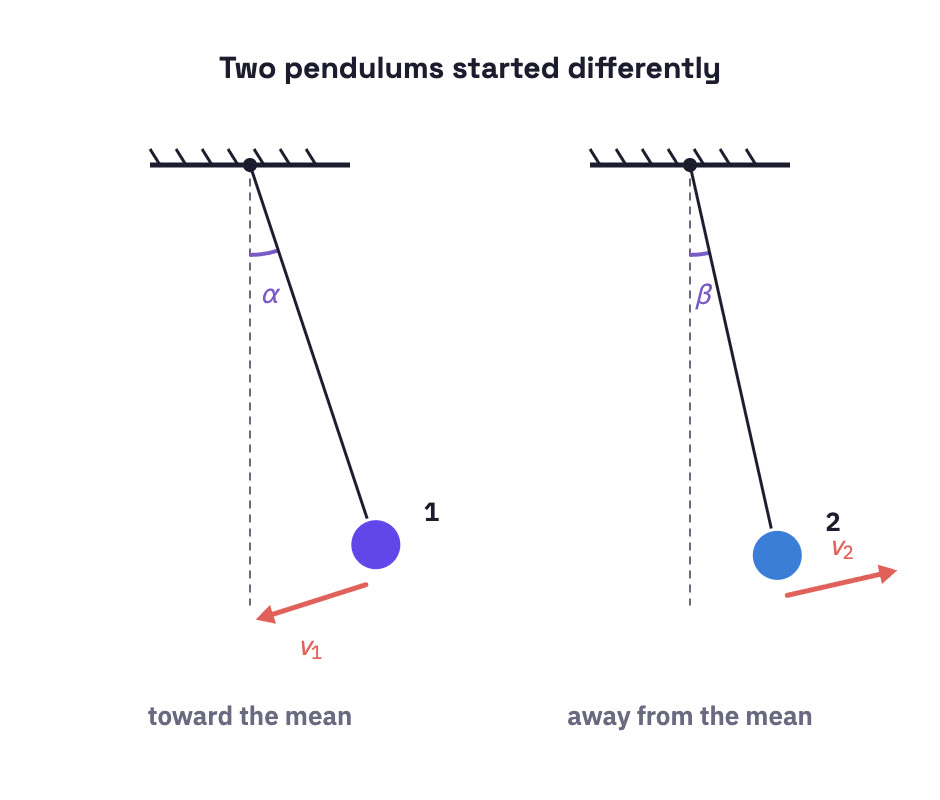
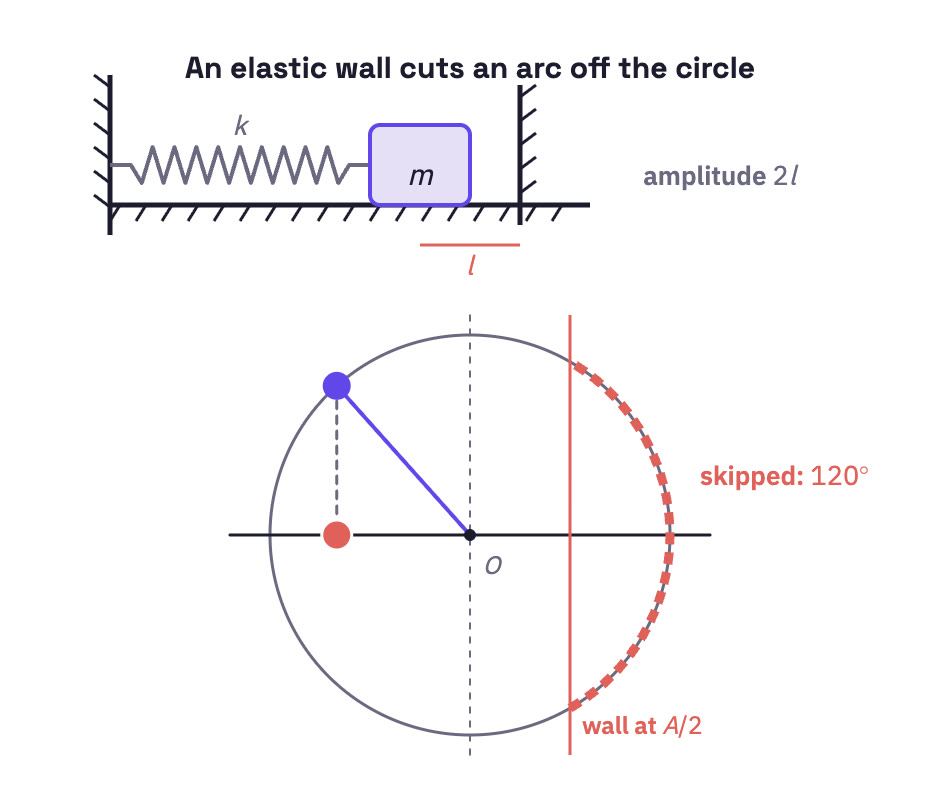
Identical pendulums keep the phase difference they start with; each one's amplitude comes from both its displacement and its speed. In a sudden change (a sticky collision, a mass placed on top, an impulse) momentum is conserved in the instant; then find the new ω and mean position, and A′ = √(x² + v′²/ω′²). An elastic wall inside the amplitude cuts an arc off the reference circle: subtract its time from the period.
Builds on: Part 10 · Phase Difference and Time Between Two Positions in SHM.
 Video coming soon
Pendulums started differently
; toward the mean: .
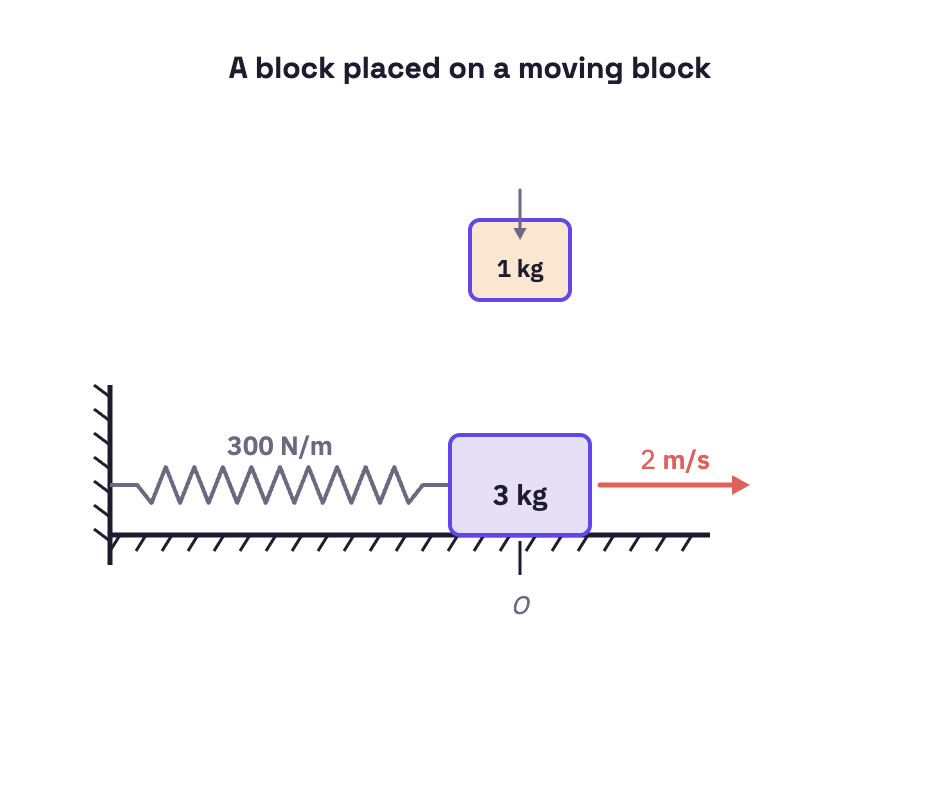
Block placed on a moving block
, .
Cut-off oscillation
.
Key formulas
From the video
1. A 3 kg block on a 300 N/m spring oscillates on a smooth floor with amplitude 20 cm. As it passes the mean position, a 1 kg block is placed on it and sticks. Find the new amplitude.
- rad/s; at the mean m/s.
- Momentum: , m/s; rad/s.
- .
A′ ≈ 0.173 m = A√(3/4) ≈ 17.3 cm.
2. A block on a spring has amplitude 2l, but an elastic wall stands a distance l from the mean position. Find the period of the motion.
- The wall at cuts the reference circle either side of its direction: is skipped.
- The particle sweeps per cycle: .
T = (4π/3)√(m/k), two thirds of the free period.
Your turn
A particle in SHM with amplitude A passes x = A/2, and an impulse suddenly doubles its speed. The new amplitude is:
Show the answer and the traps
Answer: (√13/2)A. At A/2, v = (√3/2)Aω; doubled, v = √3 Aω. A′² = A²/4 + 3A² = 13A²/4.
Not 2A: doubling the speed doesn't double the amplitude, because the particle isn't at the mean.
Not (√7/2)A: that doubles v², not v.
Not A: the impulse adds energy, so the amplitude must grow.
Common mistakes
Try these
1. A 1 kg block on a 100 N/m spring has amplitude 10 cm. At an extreme, a 3 kg block is placed on it. Find the new amplitude and ω.
Amplitude unchanged, 10 cm; ω falls from 10 to 5 rad/s.
2. The same 3 kg block is instead placed on it as it passes the mean. Find the new amplitude.
A′ = A√(1/4) = 5 cm.
3. A wall stands at A/√2 from the mean of a spring-block of amplitude A. Find the period.
T = √(m/k)[π + 2 × π/4] = (3π/2)√(m/k).
4. A 1 m pendulum leans on a wall at α = 2° and is released from β = 2√2°. Find its period (g = π² m/s²).
T = 2√(l/g)[π/2 + sin⁻¹(1/√2)] = (2/π)(3π/4) = 1.5 s.
5. Two identical pendulums are started together: one released from rest at an angle, the other given a push at the mean. Find their phase difference.
One starts at an extreme, the other at the mean: π/2.