 layrd.liveLayer by Layer
- 1. Electric Flux
- 2. Gauss's Law
- 3. Conductors
- 4. Concentric Conductors
- 5. Lines, Spheres, Cylinders
- 6. Sheets and Plates
- 7. Parallel Plates
- 8. Electrostatic Pressure
- 9. Solid Angle
- 10. Cavities
Electric Flux: Area Vector, Curved Surfaces and Integration
Electric flux counts how much field crosses a surface: Φ = EA cos θ with θ measured from the normal. Curved surfaces in a uniform field take E times their projected area, a closed surface in a uniform field carries zero net flux, and a varying field needs ∫E⃗·dA⃗.
 Video coming soon
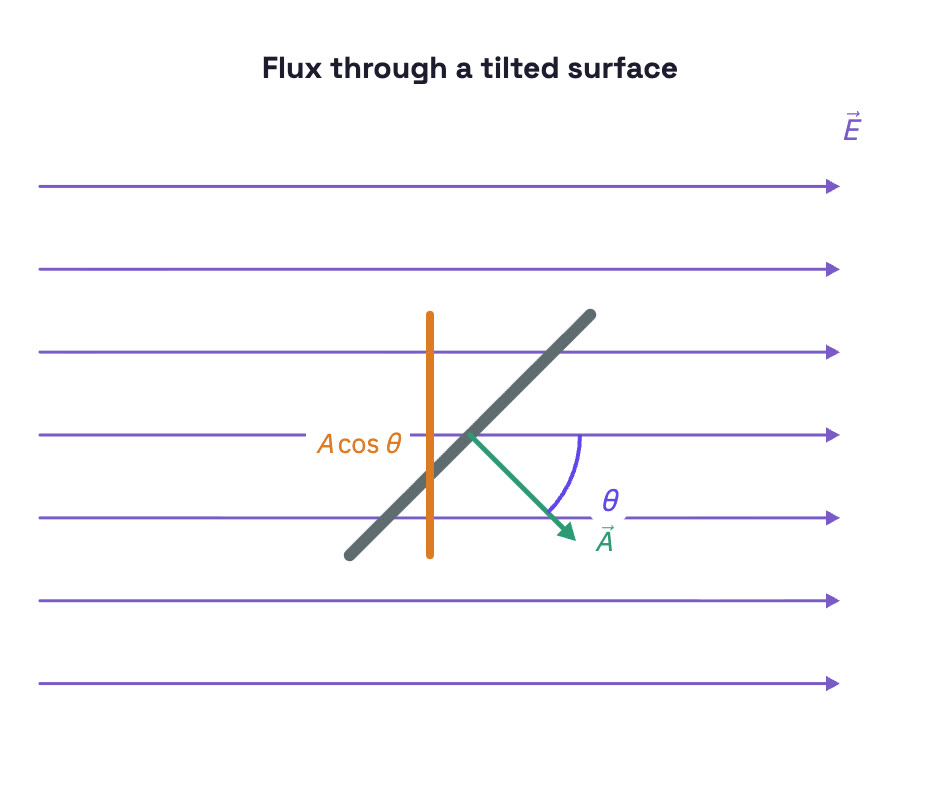
A tilted surface
Only the projection catches field lines, so .
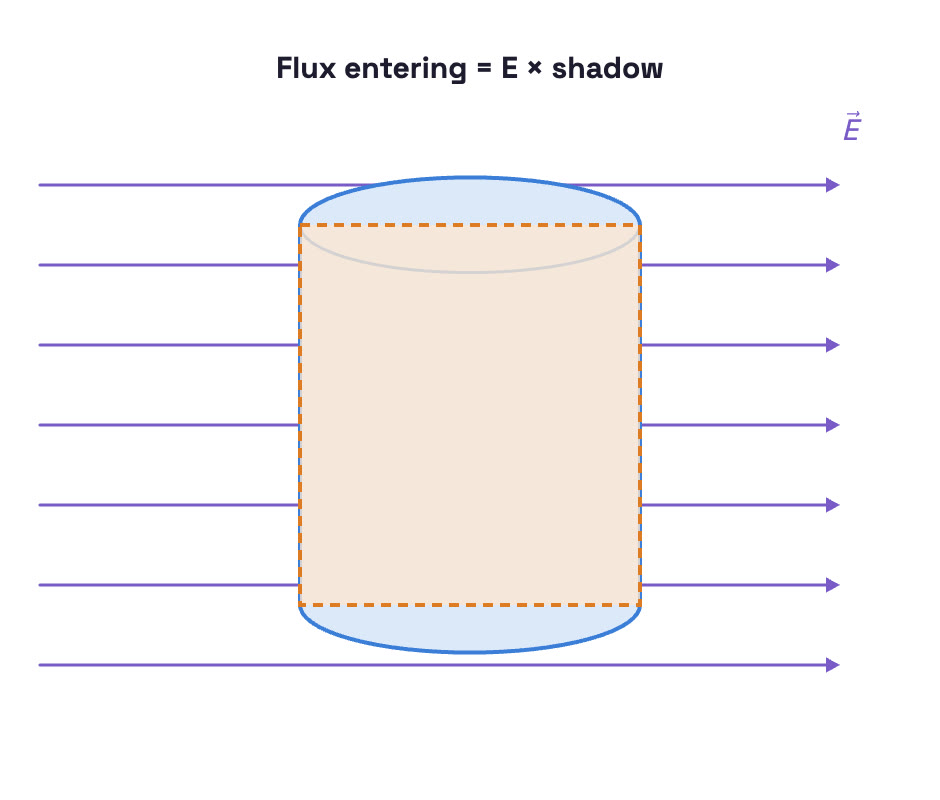
Flux by projection
The flux entering a body equals times its shadow on a plane perpendicular to .
Key formulas
From the video
1. A 10 cm × 25 cm rectangle sits in a uniform field of 800 N/C, its plane at 30° to the field. Find the flux.
- The plane is at 30° to , so the normal is at .
- m²; .
N m² C⁻¹ (using 30° directly would give 17.3).
2. A closed cylinder (radius 5 cm, height 20 cm) stands in a horizontal field of 400 N/C. Find the flux entering it upright, and with its axis tilted 30° from the vertical.
- Upright: shadow m², so N m² C⁻¹.
- Tilted: .
8 N m² C⁻¹ upright and about 8.5 N m² C⁻¹ tilted; the net flux is zero both times.
Your turn
A field E = (2i + 5j + 3k) × 10² N/C crosses a flat area of 0.4 m² lying in the xy-plane. The flux through the area is:
Show the answer and the traps
Answer (a), 120. The xy-plane's normal is k, so only Ez = 300 N/C counts: 300 × 0.4.
80 uses Ex, the flux through an area in the yz-plane.
200 uses Ey, the flux through the xz-plane.
246 is |E|A: it forgets that only the normal component crosses.
Common mistakes
Try these
1. A uniform field of 600 N/C crosses a square of side 10 cm whose normal is at 37° to the field. Find the flux.
4.8 N m² C⁻¹.
2. A hemisphere of radius 5 cm sits in a uniform 1000 N/C field along its axis. Find the flux through its curved surface.
EπR² ≈ 7.85 N m² C⁻¹.
3. A cube of side 10 cm is in a uniform field E = (300î + 400ĵ) N/C. Find the net flux through it.
Zero.
4. A cone (base radius 4 cm, height 6 cm) sits in a uniform field of 500 N/C perpendicular to its axis. Find the flux entering it.
ERh = 1.2 N m² C⁻¹.