 layrd.liveLayer by Layer
- 1. Electric Flux
- 2. Gauss's Law
- 3. Conductors
- 4. Concentric Conductors
- 5. Lines, Spheres, Cylinders
- 6. Sheets and Plates
- 7. Parallel Plates
- 8. Electrostatic Pressure
- 9. Solid Angle
- 10. Cavities
Charged Sheets and Conducting Plates
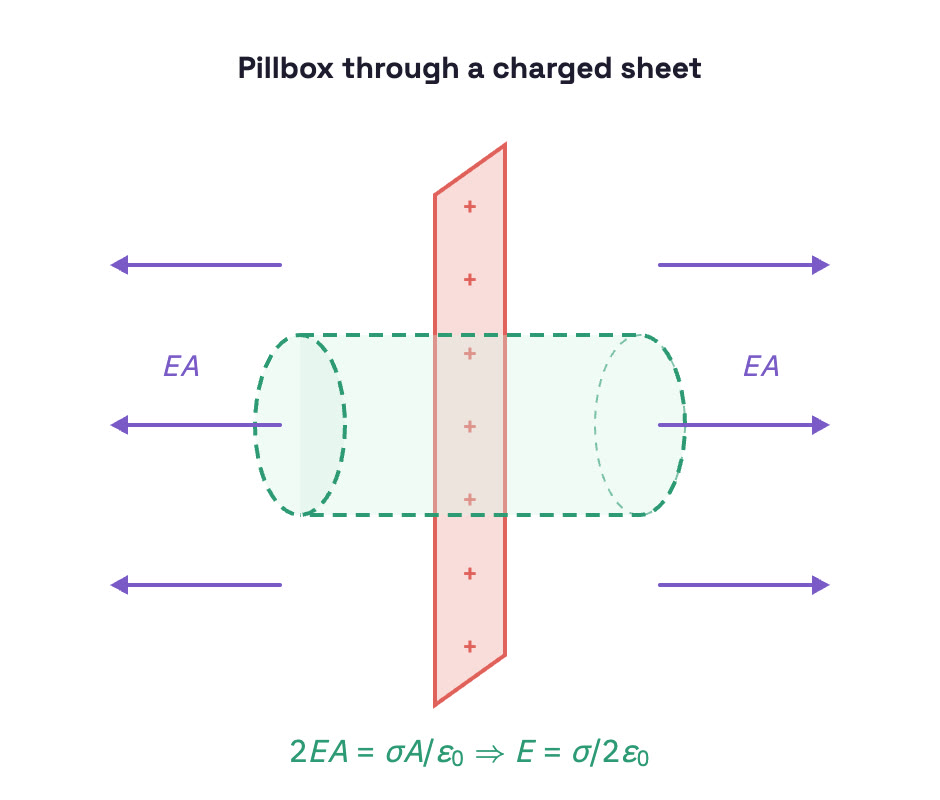
A thin infinite sheet gives E = σ/2ε₀ on both sides, at any distance. An isolated metal plate splits its charge equally between its faces; in an external field the faces carry Q/2 ∓ ε₀EA.
Builds on: Part 2 · Gauss's Law: Enclosed Charge and Flux by Symmetry, Part 3 · Conductors, Charged Shells and Charge in a Cavity.
 Video coming soon
Pillbox through a sheet
Flux leaves through each end: .
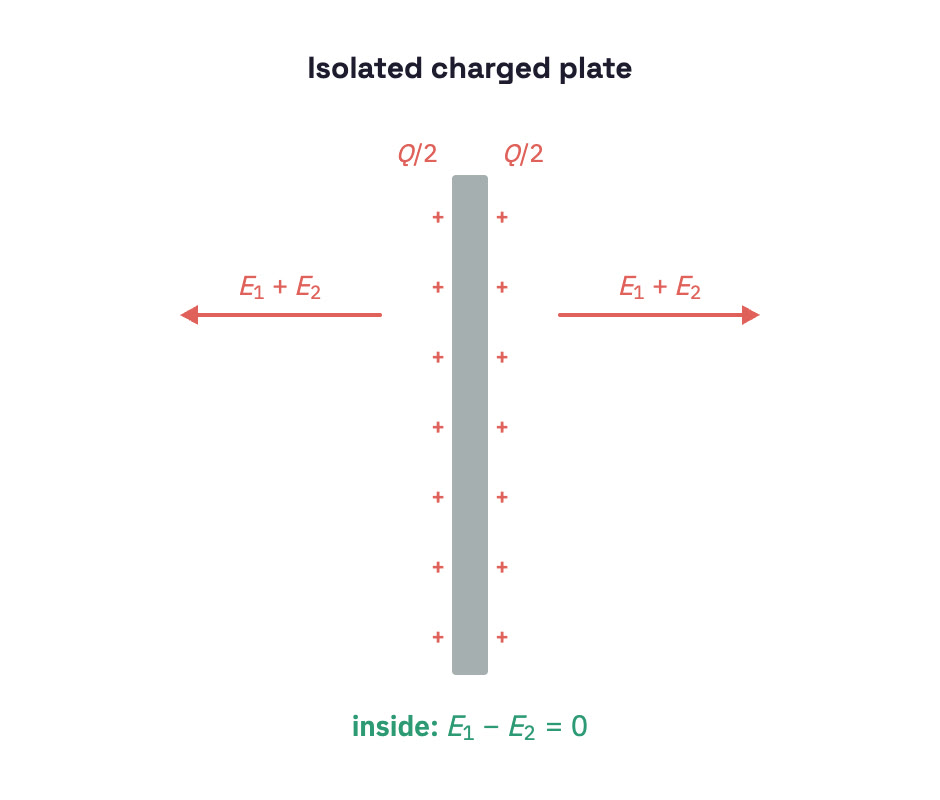
Isolated charged plate
on each face: the fields add outside and cancel inside.
Key formulas
From the video
1. A large metal plate of area 0.2 m² carries 6 μC. It is placed in a uniform field of 2 × 10⁵ N/C perpendicular to its faces. Find the charge on each face.
- μC.
- Field-entering face: ; far face: .
2.65 μC and 3.35 μC (they add to 6 μC).
Your turn
A large thin non-conducting sheet carries a uniform charge of 17.7 nC/m². The electric field 5 cm from it is:
Show the answer and the traps
Answer (a), 1000 N/C. E = σ/2ε₀ = 17.7 × 10⁻⁹ / (2 × 8.85 × 10⁻¹²), the same at any distance.
2000 is σ/ε₀, the field outside a conductor's face.
500 halves the answer again.
Zero: a sheet does have a field on both sides.
Common mistakes
Try these
1. Find the field near a large sheet with σ = 8.85 μC/m².
5 × 10⁵ N/C.
2. An isolated metal plate of area 0.5 m² carries 8.85 μC. Find the charge on each face and the field outside.
4.425 μC each; 10⁶ N/C.
3. An uncharged metal plate is placed normal to a field of 10⁵ N/C. Find the induced surface charge density on each face.
∓8.85 × 10⁻⁷ C/m².
4. The field is 4 V/m on one side of a sheet and 10 V/m on the other, both the same way. Find σ.
ε₀(10 − 4) ≈ 5.31 × 10⁻¹¹ C/m².