 layrd.liveLayer by Layer
- 1. Electric Flux
- 2. Gauss's Law
- 3. Conductors
- 4. Concentric Conductors
- 5. Lines, Spheres, Cylinders
- 6. Sheets and Plates
- 7. Parallel Plates
- 8. Electrostatic Pressure
- 9. Solid Angle
- 10. Cavities
Electrostatic Pressure: Force on a Charged Surface
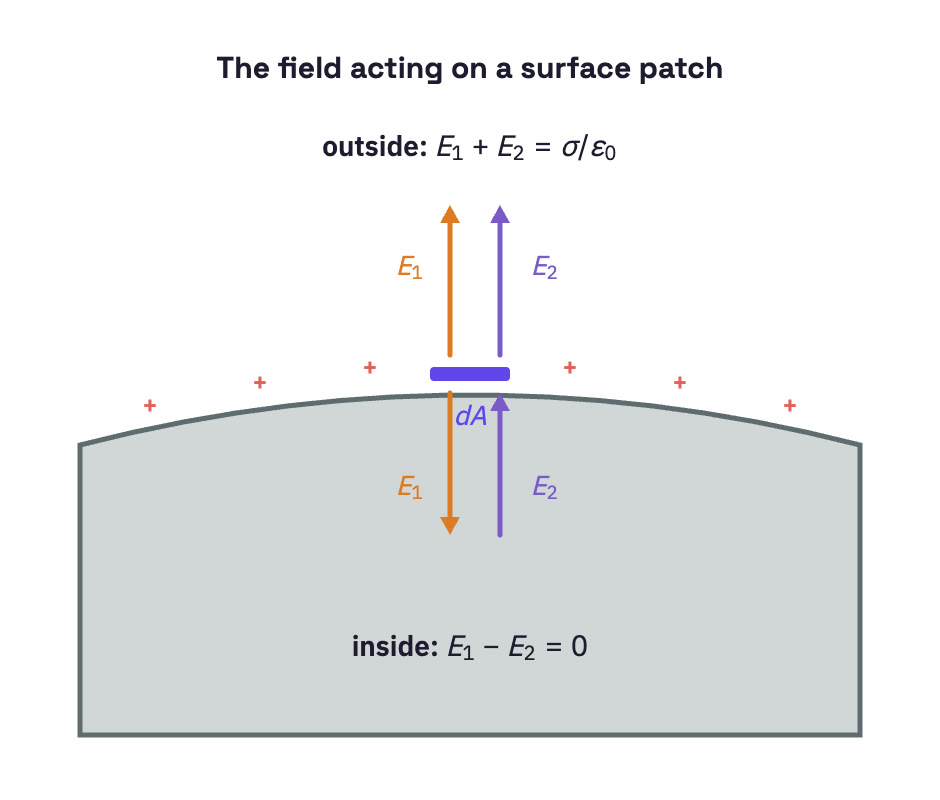
A patch of charged surface feels only the field of the other charges, half the field just outside, so the outward pressure is σ²/2ε₀ = ε₀E²/2. The two halves of a charged sphere repel with Q²/32πε₀R².
Builds on: Part 3 · Conductors, Charged Shells and Charge in a Cavity, Part 6 · Charged Sheets and Conducting Plates.
 Video coming soon
Field acting on a patch
The patch's own field doesn't push it; the rest gives .
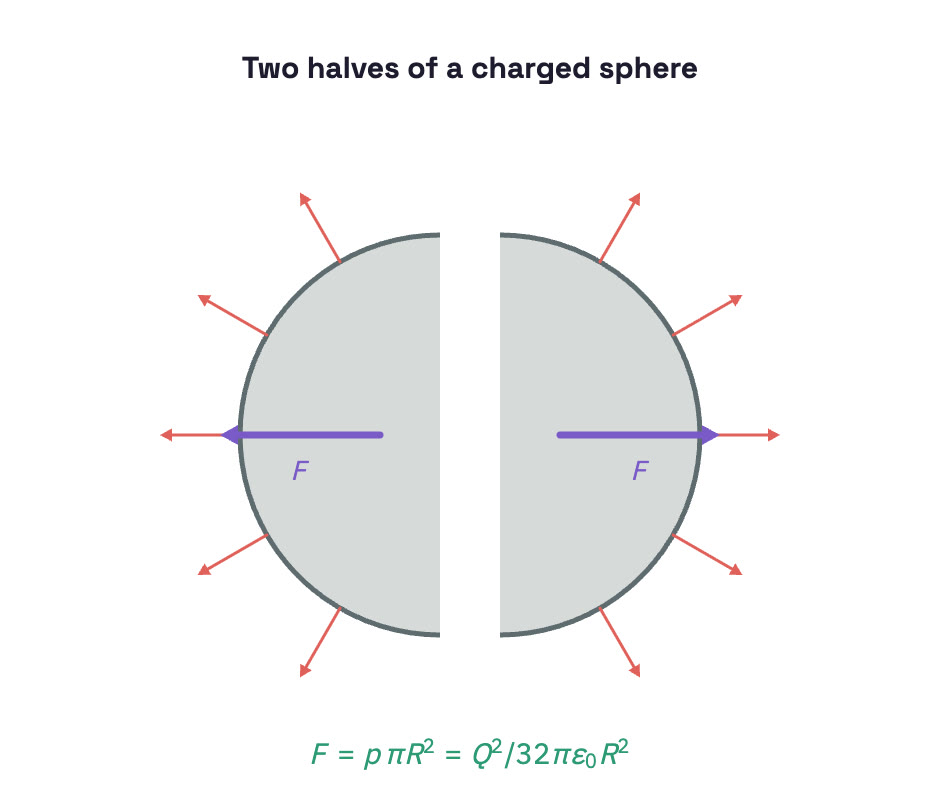
Halves of a charged sphere
Only the axial part survives: .
Key formulas
From the video
1. A metal sphere of radius 20 cm holds 2 μC. Find the pressure on its surface and the force pushing its halves apart.
- C/m².
- N/m².
F = p πR² ≈ 0.11 N (the flat cross-section, not the curved area).
Your turn
The radius of a charged conducting sphere is doubled while its charge stays the same. The electrostatic pressure on its surface becomes (p = the original pressure):
Show the answer and the traps
Answer (a), p/16. σ = Q/4πR² drops to a quarter, and p goes as σ², so p falls 16 times.
p/4 forgets to square σ.
p/2 treats p as falling with R.
4p turns the change upside down.
Common mistakes
Try these
1. Find the pressure on a conductor where σ = 8.85 μC/m².
≈ 4.42 N/m².
2. The field just outside a conductor is 3 × 10⁵ N/C. Find the pressure.
ε₀E²/2 ≈ 0.398 N/m².
3. A shell carries +4 μC. What is the least charge −q₀ at its centre that keeps its halves together?
q₀ = 2 μC.
4. The charge on a conducting sphere is doubled. By what factor does the surface pressure change?
×4.