 layrd.liveLayer by Layer
- 1. Principal Branch
- 2. Graphs & Principal Values
- 3. Domain, Range & Inequalities
- 4. Extreme Values & [x]
- 5. sin⁻¹(sin x), cos⁻¹(cos x)
- 6. tan⁻¹(tan x) & Graphs
- 7. Reference Triangle
- 8. Substitution
- 9. f⁻¹(−x) and f⁻¹(1/x)
- 10. sin⁻¹x + cos⁻¹x = π/2
- 11. Ranges & Extremes
- 12. tan⁻¹ Addition Formula
- 13. 2tan⁻¹x & Equations
- 14. Telescoping Series
- 15. sin⁻¹ and cos⁻¹ Sums
- 16. Multiple-Angle Formulas
- 17. Multiple Angles in Action
Why Inverse Trig Needs a Principal Value Branch
A trig function repeats forever, so it has no inverse on all of . Cut it down to one piece where it is one-one and onto, invert that piece, and you get the inverse trig functions. The piece everyone agrees on is the principal value branch.
 Video coming soon
Only a bijection can be reversed
Reverse the arrows of a function. If two arrows share an image, that image gets two outputs; if an element of B is never hit, it gets none. Only the bijective case gives a function , with the domain and range swapped.
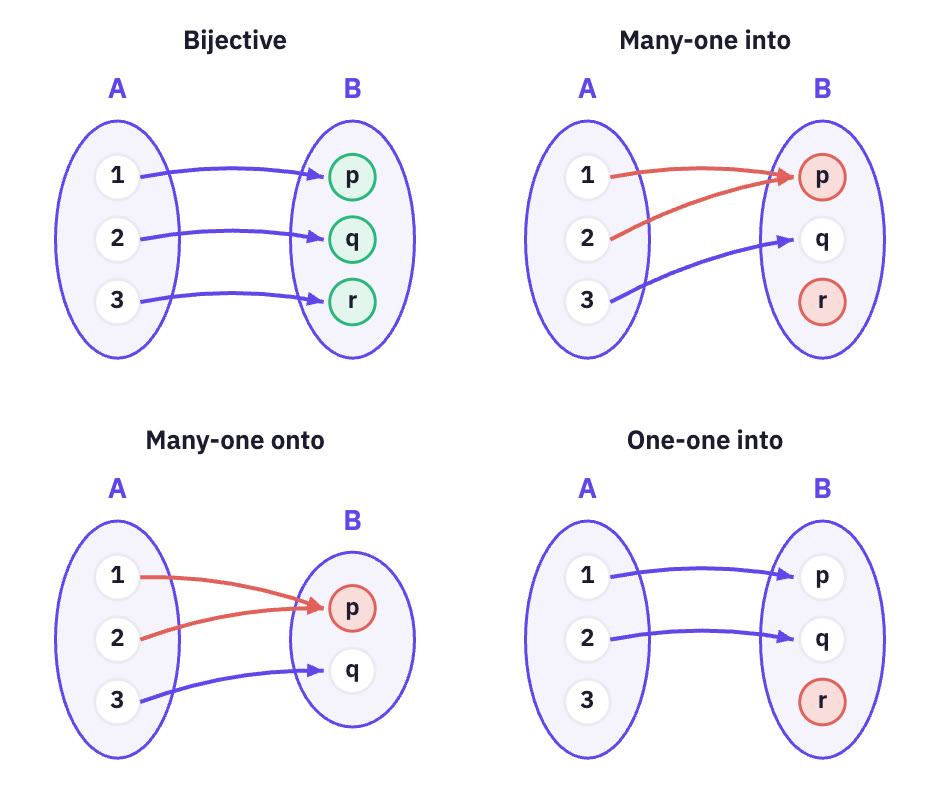
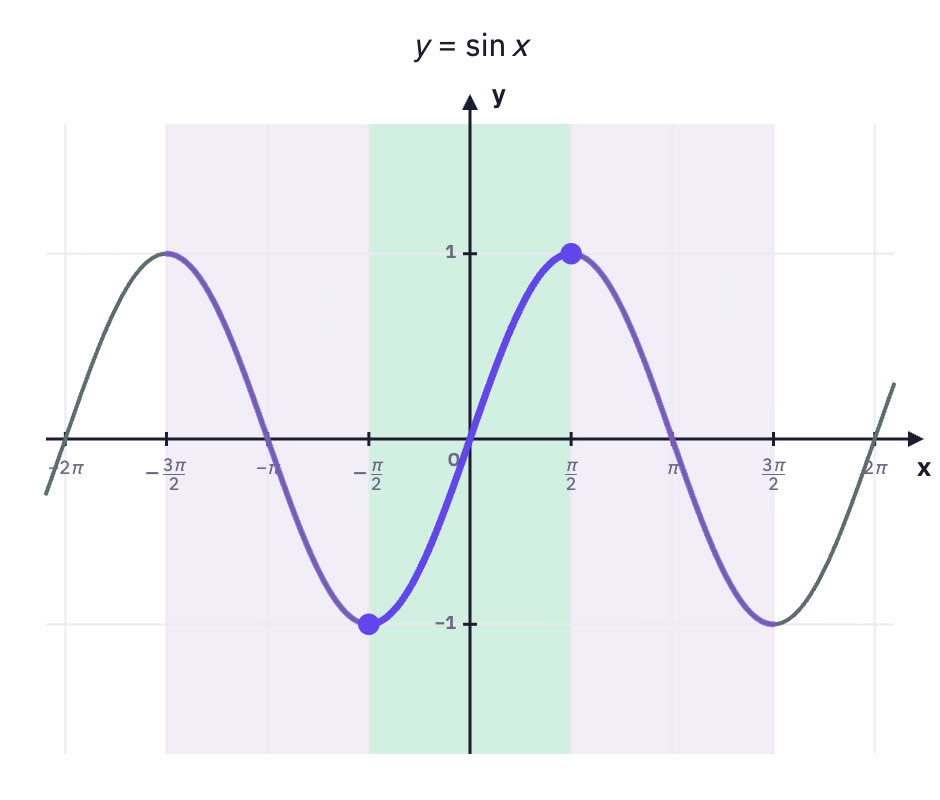
on
On , rises from to and takes every value once. Other pieces such as also work and give other branches; the principal one is the agreed choice.
Domains and principal ranges
leaves out and leaves out , the angles where sec and cosec are undefined.
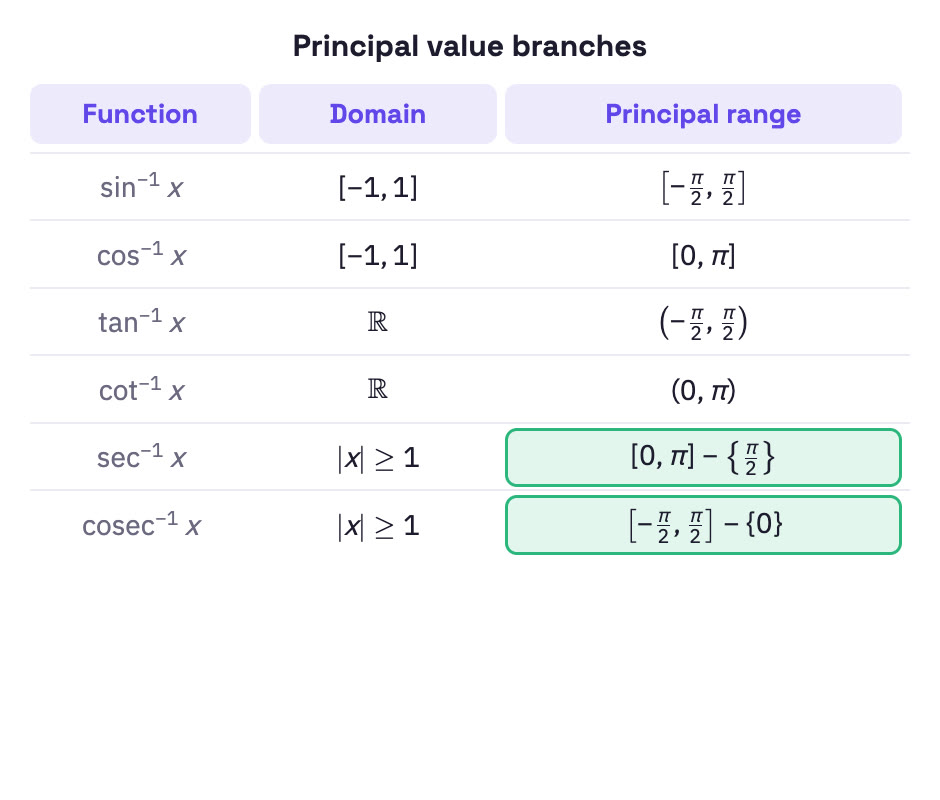
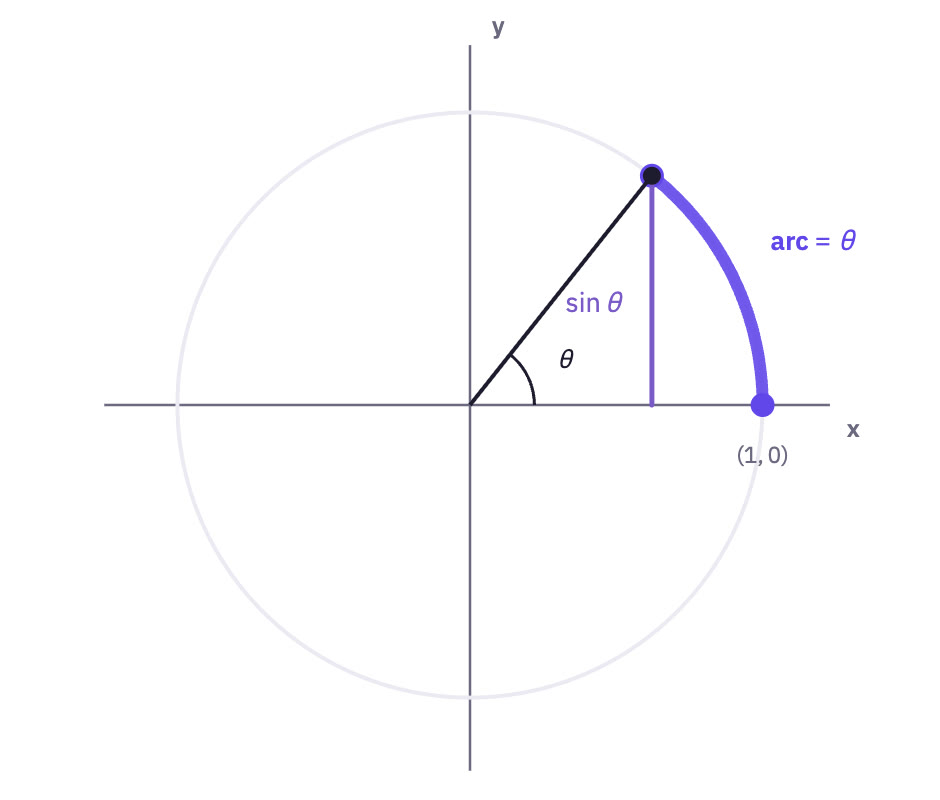
Arc length = angle
On a unit circle the arc from has length equal to the angle in radians, so is the arc whose sine is : arcsin .
Key formulas
One for every idea
1. with , , , , and with , , . Which one has an inverse? Write it.
- Each of 1, 2, 3, 4 has exactly one pre-image under : one-one and onto.
- Reverse the arrows: , , , .
- and nothing maps to : is many-one and into.
Only is invertible; has no inverse.
2. Can be used as a branch for ? Can it be used for ?
- On , increases from to : one-one and onto .
- On , goes : , and it never takes positive values.
Yes for (a valid, non-principal branch); no for .
3. A point on the unit circle, in the principal branch of , has height . How long is the arc from to it?
- The height is , so .
- On a unit circle, arc .
units.
Your turn
On which interval is sin x one-one and onto [−1, 1], so that it could define a branch of sin⁻¹?
Show the answer and the traps
On [π/2, 3π/2], sin falls from 1 to −1 and takes each value once. Option b.
[0, π]: sin(π/6) = sin(5π/6), and there are no negative values.
[−π, 0]: it goes 0, −1, 0. It repeats, and is never positive.
[π/4, 5π/4]: sin(π/4) = sin(3π/4), so it is not one-one.
Common mistakes
Try these
1. Is , invertible? If not, give a largest interval containing 2 on which it is.
Not one-one () and not onto. On onto it is a bijection, with inverse .
2. Which of these is a valid branch for : or ?
: increases through all of there. On it jumps at and repeats values.