Mathematics › Trigonometry › Inverse Trigonometric Functions · Part 13/17
1. Principal Branch 2. Graphs & Principal Values 3. Domain, Range & Inequalities 4. Extreme Values & [x] 5. sin⁻¹(sin x), cos⁻¹(cos x) 6. tan⁻¹(tan x) & Graphs 7. Reference Triangle 8. Substitution 9. f⁻¹(−x) and f⁻¹(1/x) 10. sin⁻¹x + cos⁻¹x = π/2 11. Ranges & Extremes 12. tan⁻¹ Addition Formula 13. 2tan⁻¹x & Equations 14. Telescoping Series 15. sin⁻¹ and cos⁻¹ Sums 16. Multiple-Angle Formulas 17. Multiple Angles in Action
Inverse Trigonometric Functions · Part 13 of 17
2tan⁻¹x, 3tan⁻¹x and tan⁻¹ Equations
Put y = x in the sum formula and you get 2 tan − 1 x , with cut points at ± 1 ; the triple-angle formula gives 3 tan − 1 x , with cut points at ± 3 1 . In equations, taking tan of both sides keeps the true roots but can add false ones, so every root gets checked.
Builds on: Part 12 · tan⁻¹x + tan⁻¹y: The Addition Formula and Its Cases .
Video coming soon
2tan⁻¹x
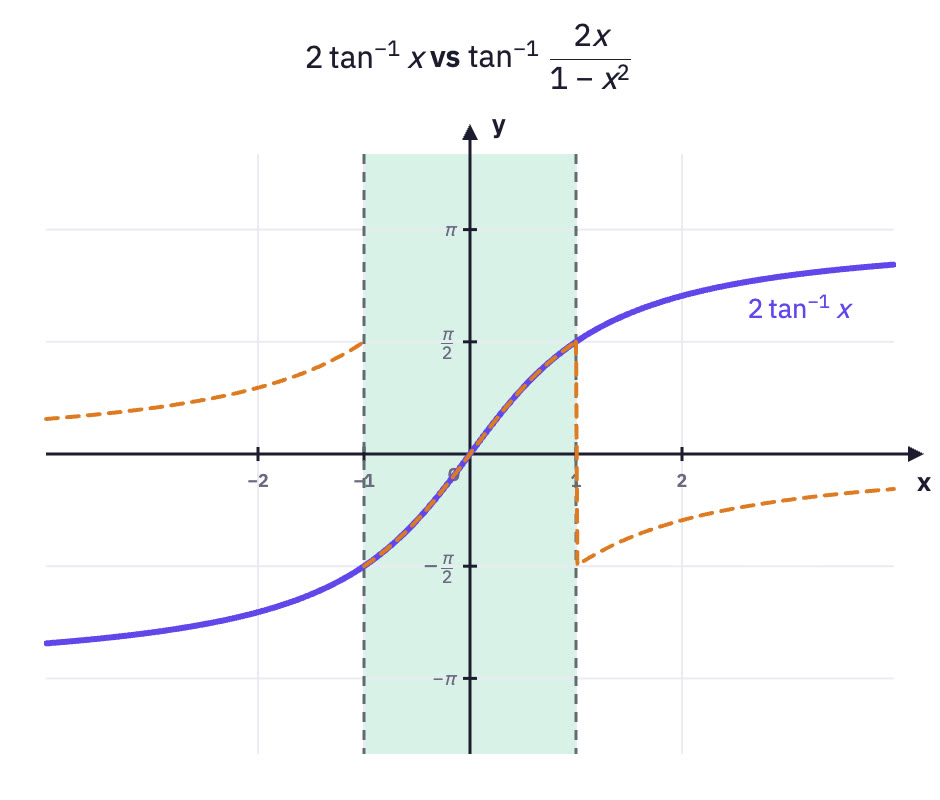
Equal on ( − 1 , 1 ) , π apart outside 2 tan − 1 x = tan − 1 1 − x 2 2 x for ∣ x ∣ < 1 , π + … for x > 1 , − π + … for x < − 1 .
2tan⁻¹x (solid) and tan⁻¹(2x/(1 − x²)) (dashed).
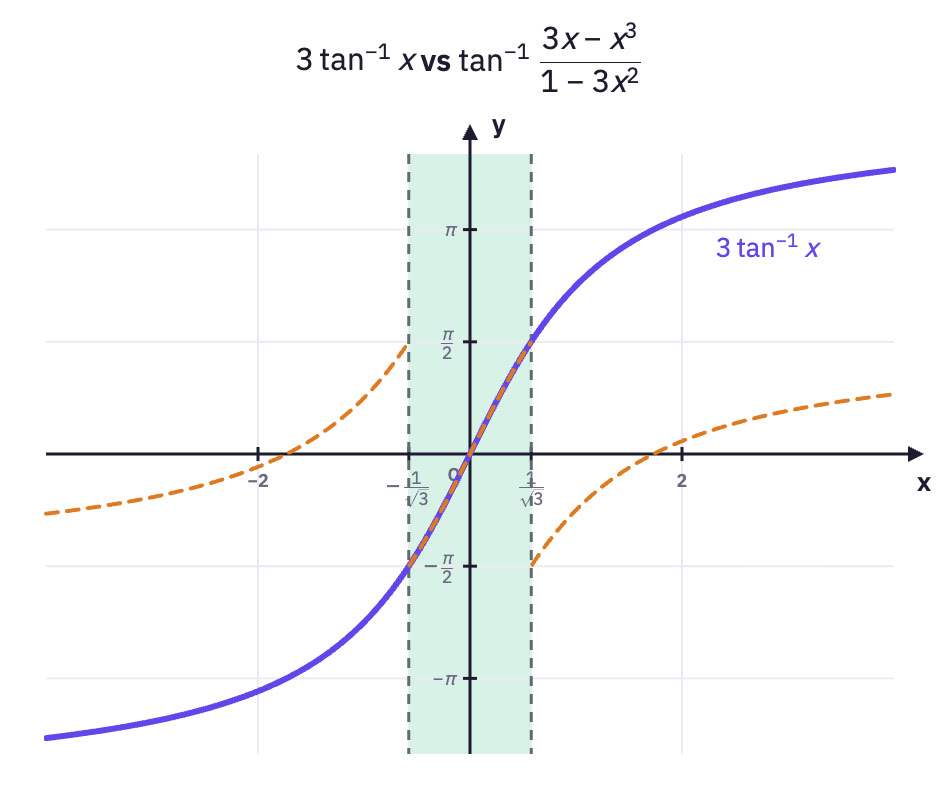
3tan⁻¹x (solid) and tan⁻¹((3x − x³)/(1 − 3x²)) (dashed).
3tan⁻¹x
Cut points ± 3 1 With x = tan θ , 3 θ ∈ ( − 2 π , 2 π ) exactly when ∣ x ∣ < 3 1 ; beyond, shift by ± π .
Equations
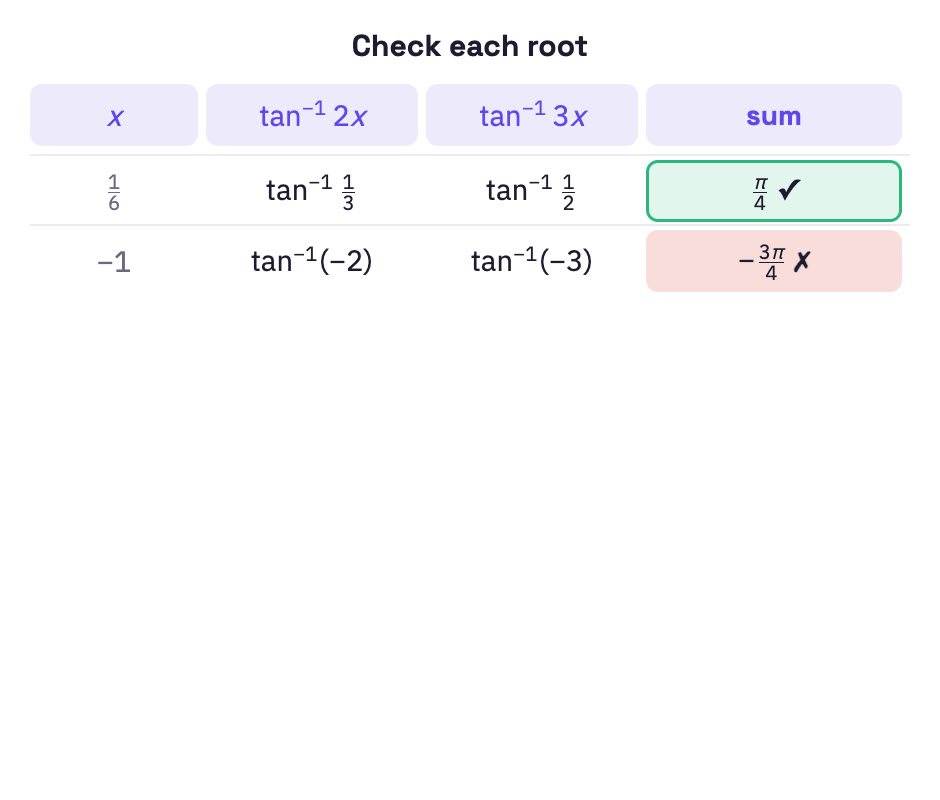
Check each root tan − 1 2 x + tan − 1 3 x = 4 π gives x = 6 1 or x = − 1 after taking tan ; at x = − 1 the sum is − 4 3 π .
One root survives.
Summary
Key formulas
2 tan − 1 x = tan − 1 1 − x 2 2 x ( ∣ x ∣ < 1 ) ; ± π + … ( x ≷ ± 1 ) 2tan⁻¹x and 3tan⁻¹x in tan⁻¹ form
3 tan − 1 x = tan − 1 1 − 3 x 2 3 x − x 3 ( ∣ x ∣ < 3 1 ) ; ± π + … 2tan⁻¹x and 3tan⁻¹x in tan⁻¹ form
Worked examples
One for every idea
2tan⁻¹x and 3tan⁻¹x in tan⁻¹ form
1. Write 3 tan − 1 2 1 and 3 tan − 1 1 as single tan − 1 expressions.
2 1 < 3 1 : tan − 1 1 − 3/4 3/2 − 1/8 = tan − 1 2 11 .1 > 3 1 : π + tan − 1 1 − 3 3 − 1 = π − 4 π .tan − 1 2 11 and 4 3 π .
Equations with tan⁻¹ sums: rejecting extra roots
2. Solve tan − 1 2 x + tan − 1 3 x = 4 π .
Taking tan : 1 − 6 x 2 5 x = 1 ⇒ ( 6 x − 1 ) ( x + 1 ) = 0 . x = − 1 : both terms negative, sum − 4 3 π ; reject.x = 6 1 : tan − 1 3 1 + tan − 1 2 1 = 4 π .x = 6 1 .
Equations with tan⁻¹ sums: rejecting extra roots
3. Find all positive integers x , y with tan − 1 x + tan − 1 y 1 = tan − 1 3 .
tan − 1 y 1 = tan − 1 3 − tan − 1 x = tan − 1 1 + 3 x 3 − x .y = 3 − x 1 + 3 x > 0 ⇒ x < 3 .x = 1 ⇒ y = 2 ; x = 2 ⇒ y = 7 .( 1 , 2 ) and ( 2 , 7 ) .
JEE-style question
Your turn
2tan⁻¹3 equals:
(a) tan − 1 ( − 4 3 )
(b) π − tan − 1 4 3
(c) tan − 1 4 3
(d) − π − tan − 1 4 3
Show the answer and the traps
3 > 1, so add π: π + tan⁻¹(6/(1 − 9)) = π + tan⁻¹(−3/4) = π − tan⁻¹(3/4). Option b.
tan⁻¹(−3/4) is the middle form: negative, but 2tan⁻¹3 is above π/2.
tan⁻¹(3/4) is below π/4, far too small.
−π − tan⁻¹(3/4) is the x < −1 shape and is negative.
Watch out
Common mistakes
Using the middle form of 2 tan − 1 x for ∣ x ∣ > 1 Outside ( − 1 , 1 ) add or subtract π .
Mixing the cut points of 2 tan − 1 x and 3 tan − 1 x ± 1 for the double,
± 3 1 for the triple.
Not checking roots Taking tan cannot tell θ from θ ± π .
Practice
Try these
1. Solve tan − 1 x + tan − 1 2 x = 4 π . 1 − 2 x 2 3 x = 1 ⇒ 2 x 2 + 3 x − 1 = 0 ⇒ x = 4 − 3 ± 17 ; only x = 4 17 − 3 gives a positive sum.
2. For x > 1 , simplify 2 tan − 1 x − tan − 1 1 − x 2 2 x . π .