 layrd.liveLayer by Layer
- 1. Principal Branch
- 2. Graphs & Principal Values
- 3. Domain, Range & Inequalities
- 4. Extreme Values & [x]
- 5. sin⁻¹(sin x), cos⁻¹(cos x)
- 6. tan⁻¹(tan x) & Graphs
- 7. Reference Triangle
- 8. Substitution
- 9. f⁻¹(−x) and f⁻¹(1/x)
- 10. sin⁻¹x + cos⁻¹x = π/2
- 11. Ranges & Extremes
- 12. tan⁻¹ Addition Formula
- 13. 2tan⁻¹x & Equations
- 14. Telescoping Series
- 15. sin⁻¹ and cos⁻¹ Sums
- 16. Multiple-Angle Formulas
- 17. Multiple Angles in Action
Inverse Trig of −x and 1/x
Negative inputs split the six inverse functions into two groups: the odd ones, and the ones that give minus the angle. Reciprocal inputs swap a function for its partner, except that is off by when is negative.
Builds on: Part 2 · Graphs of Inverse Trig Functions and Principal Values.
 Video coming soon
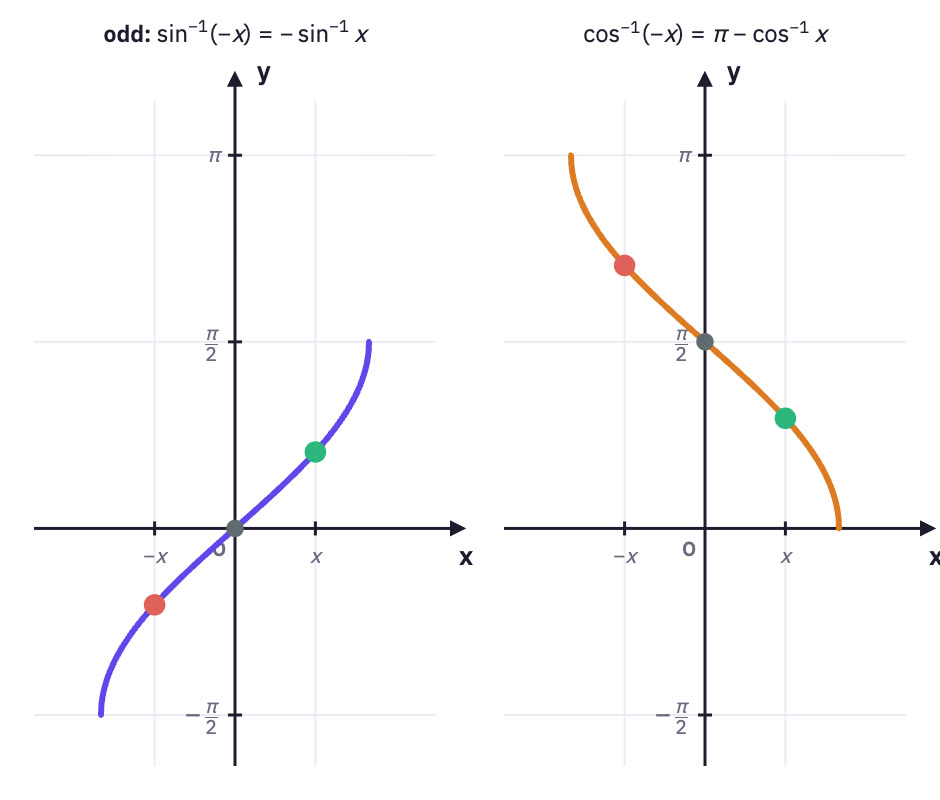
Origin vs
, , are odd: . , , satisfy , a symmetry about the point .
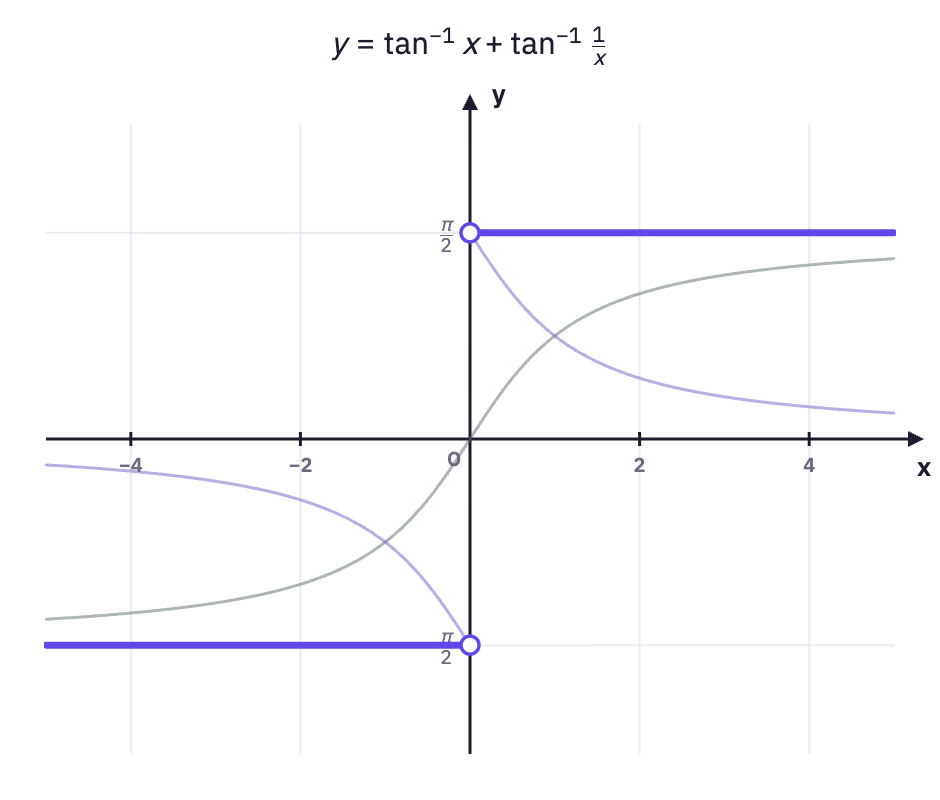
for and for , so the sum is for and for .
Key formulas
One for every idea
1. Evaluate .
- .
- .
- .
.
2. Evaluate .
- .
- .
.
3. Evaluate .
- : , so .
.
Your turn
The value of tan⁻¹(−3) + tan⁻¹(−1/3) is:
Show the answer and the traps
This is tan⁻¹x + tan⁻¹(1/x) with x = −3 < 0: the sum is −π/2. Option b.
π/2 is the answer for x > 0, or comes from writing tan⁻¹(−1/3) = cot⁻¹(−3).
0 would need tan⁻¹(1/x) = −tan⁻¹x, which is false.
−π is impossible: each term is above −π/2, so the sum is above −π.
Common mistakes
Try these
1. Evaluate .
.
2. Evaluate .
, so the sum is .
3. Evaluate .
.