 layrd.liveLayer by Layer
MathematicsInverse Trigonometric FunctionsJEE
- 1. Principal Branch
- 2. Graphs & Principal Values
- 3. Domain, Range & Inequalities
- 4. Extreme Values & [x]
- 5. sin⁻¹(sin x), cos⁻¹(cos x)
- 6. tan⁻¹(tan x) & Graphs
- 7. Reference Triangle
- 8. Substitution
- 9. f⁻¹(−x) and f⁻¹(1/x)
- 10. sin⁻¹x + cos⁻¹x = π/2
- 11. Ranges & Extremes
- 12. tan⁻¹ Addition Formula
- 13. 2tan⁻¹x & Equations
- 14. Telescoping Series
- 15. sin⁻¹ and cos⁻¹ Sums
- 16. Multiple-Angle Formulas
- 17. Multiple Angles in Action
Inverse Trigonometric Functions · Part 10 of 17
sin⁻¹x + cos⁻¹x = π/2 and the Complementary Identities
and are complementary angles: their sum is always . The same holds for and , and for and . Any equation or inequality with a pair then has one unknown instead of two.
Builds on: Part 9 · Inverse Trig of −x and 1/x.
 Video coming soon
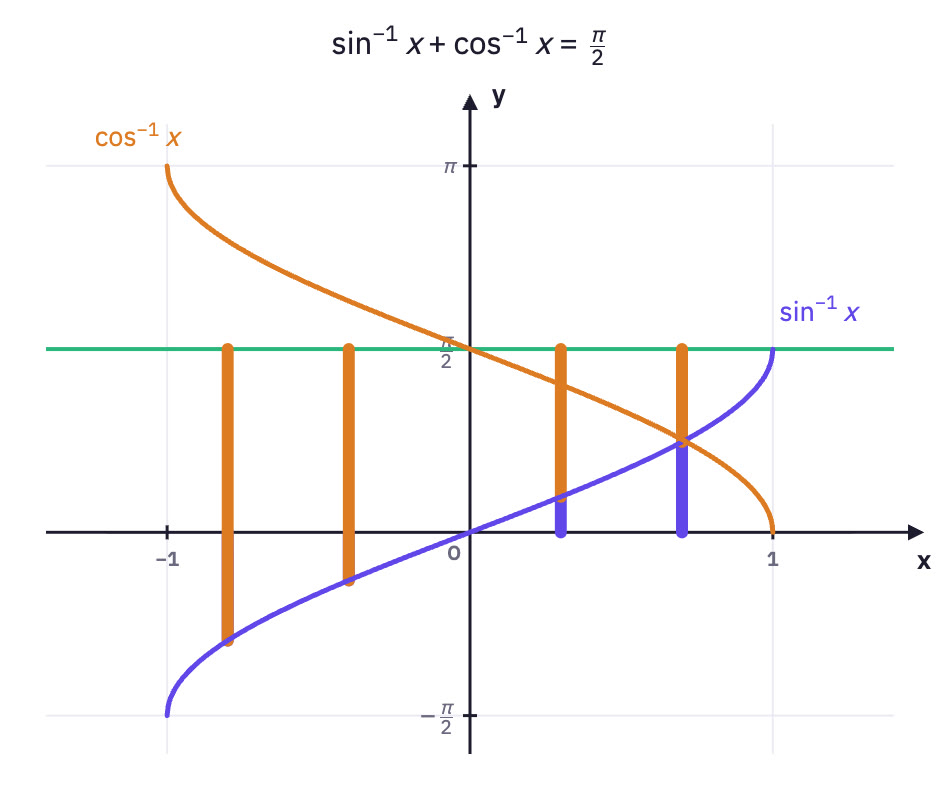
sin⁻¹x + cos⁻¹x
Always
At every the height of and the height of stack to . Proof: and .
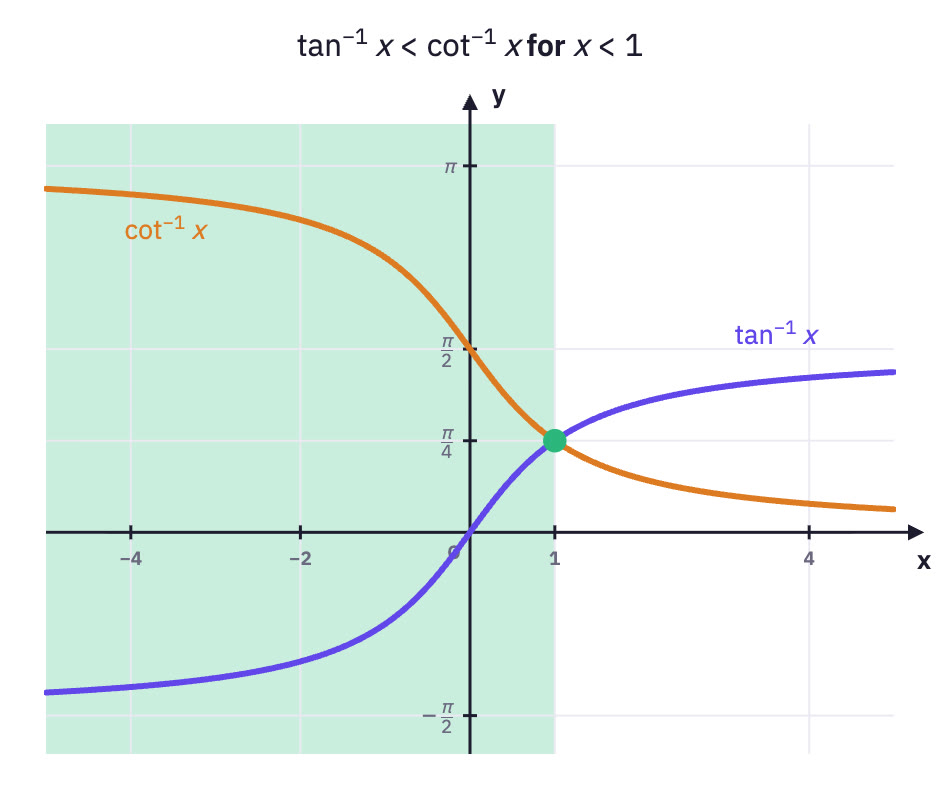
tan⁻¹ vs cot⁻¹
They cross at
.
Summary
Key formulas
The three identities
The three identities
The three identities
Worked examples
One for every idea
The three identities
1. If , find .
- .
.
The three identities
2. Solve .
- The angle lies in , where cosine vanishes only at .
- .
.
Inequalities and equations with complementary pairs
3. Solve (i) (ii) (iii) .
- (i) , with .
- (ii) .
- (iii) .
(i) (ii) (iii) .
JEE-style question
Your turn
If sin⁻¹x − cos⁻¹x = π/6, then x equals:
(a)
(b)
(c)
(d)
Show the answer and the traps
Add sin⁻¹x + cos⁻¹x = π/2: 2sin⁻¹x = 2π/3, so sin⁻¹x = π/3 and x = √3/2. Option b.
1/2 solves sin⁻¹x = π/6 and ignores the cos⁻¹x term.
1/√2 makes the two terms equal, so their difference would be 0.
−√3/2 makes sin⁻¹x = −π/3, so the difference is negative, not π/6.
Watch out
Common mistakes
Using an identity outside its domain needs ; needs .
Dropping the domain from an inequality's answer gives , not .
Practice
Try these
1. Solve .
.
2. If , find .
(indeed ).