 layrd.liveLayer by Layer
- 1. Principal Branch
- 2. Graphs & Principal Values
- 3. Domain, Range & Inequalities
- 4. Extreme Values & [x]
- 5. sin⁻¹(sin x), cos⁻¹(cos x)
- 6. tan⁻¹(tan x) & Graphs
- 7. Reference Triangle
- 8. Substitution
- 9. f⁻¹(−x) and f⁻¹(1/x)
- 10. sin⁻¹x + cos⁻¹x = π/2
- 11. Ranges & Extremes
- 12. tan⁻¹ Addition Formula
- 13. 2tan⁻¹x & Equations
- 14. Telescoping Series
- 15. sin⁻¹ and cos⁻¹ Sums
- 16. Multiple-Angle Formulas
- 17. Multiple Angles in Action
Extreme-Value and Greatest Integer Equations in Inverse Trig
Some equations look impossible to solve: one equation in three unknowns, or a greatest integer around an inverse function. The principal ranges do the work. A sum that reaches its largest possible value pins every term, and the greatest integer of an inverse function can only take a handful of values.
Builds on: Part 3 · Domain, Range and Inequalities of Inverse Trig Expressions.
 Video coming soon
Every term at its maximum
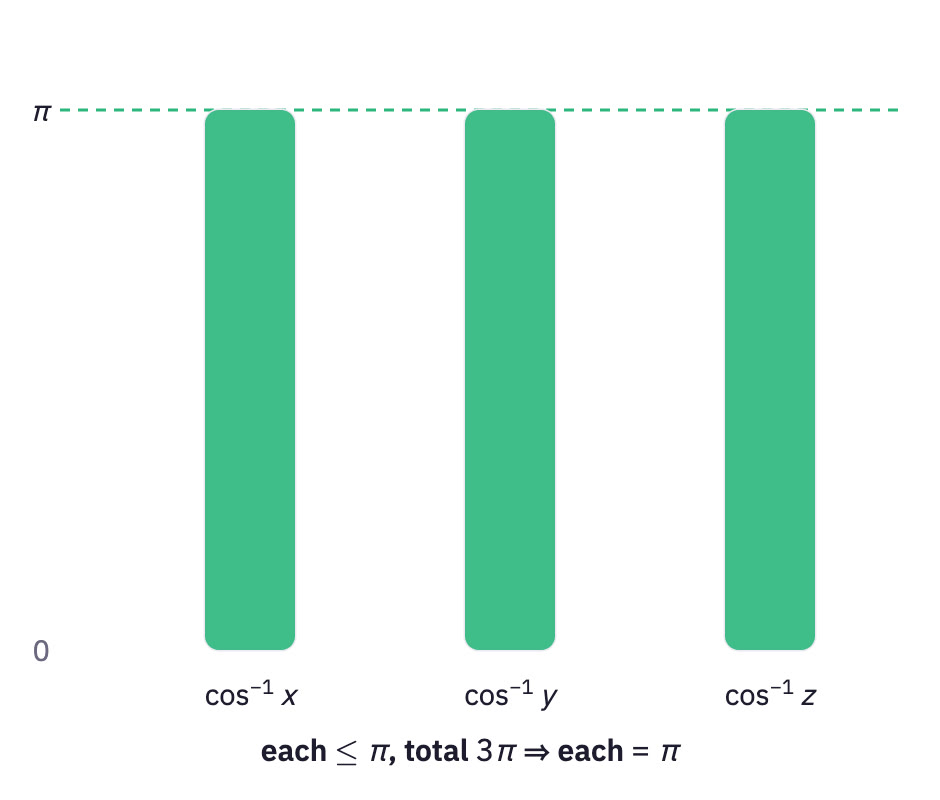
Each term is at most , so a total of forces all three to equal , that is .
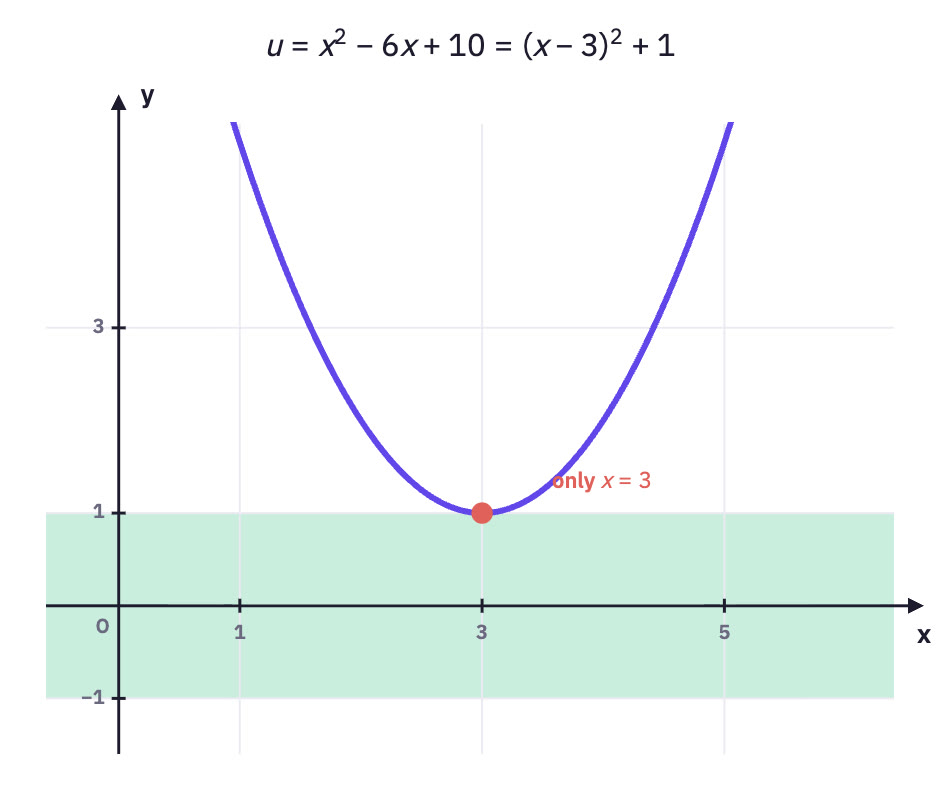
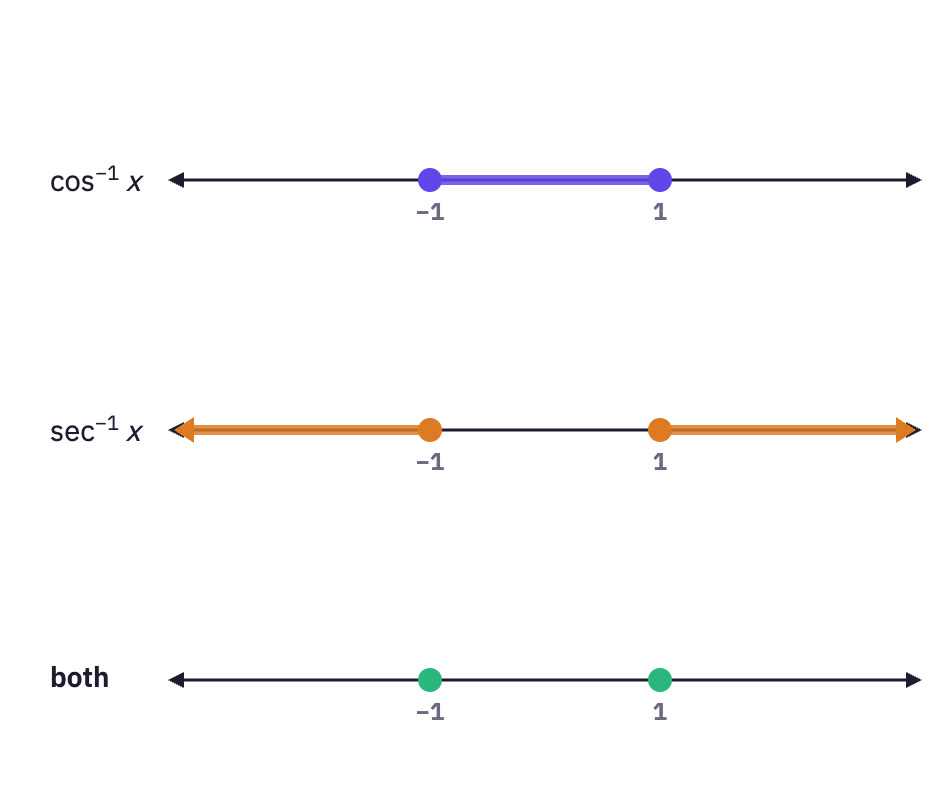
and need their argument in . An argument that is never below 1 is allowed only where it equals 1.
and
exists only at : test those two points.
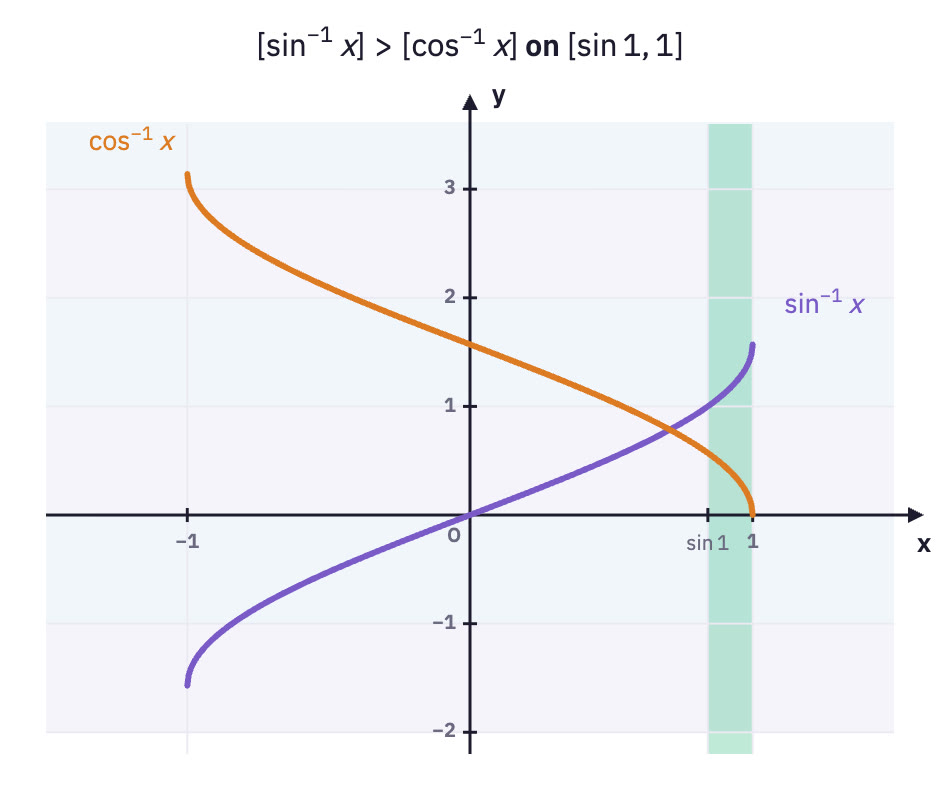
Integer bands
and . Each case means , cut to the principal range.
One for every idea
1. If , find .
- Each term is at most , so each equals : .
- .
.
2. Where is defined, and what is its value there?
- ; it must be , so and .
- , so and .
Only at , ; value .
3. Find every value taken by .
- Domains and meet only at .
- : . : .
.
4. Solve , where is the greatest integer function.
- .
- is increasing: .
.
5. Solve .
- , so and .
- .
- .
- .
.
Your turn
The solution set of [cos⁻¹x] = 3, where [·] is the greatest integer function, is:
Show the answer and the traps
3 ≤ cos⁻¹x ≤ π, since cos⁻¹x never reaches 4. cos⁻¹ is decreasing: x ∈ [−1, cos 3]. Option a.
[cos 3, 1] forgets to flip for the decreasing cos⁻¹.
(cos 4, cos 3] is empty: cos 4 ≈ −0.65 is bigger than cos 3 ≈ −0.99.
And there are solutions: π ≈ 3.14 is above 3.
Common mistakes
Try these
1. If , find .
Both terms equal : , so the value is 2.
2. Solve .
.