 layrd.liveLayer by Layer
- 1. Electric Flux
- 2. Gauss's Law
- 3. Conductors
- 4. Concentric Conductors
- 5. Lines, Spheres, Cylinders
- 6. Sheets and Plates
- 7. Parallel Plates
- 8. Electrostatic Pressure
- 9. Solid Angle
- 10. Cavities
Gauss's Law: Enclosed Charge and Flux by Symmetry
Gauss's law says the total flux through any closed surface is the enclosed charge over ε₀. Charges outside change the field on the surface but not the flux, zero flux does not mean zero field, and symmetry splits the flux between faces.
Builds on: Part 1 · Electric Flux: Area Vector, Curved Surfaces and Integration.
 Video coming soon
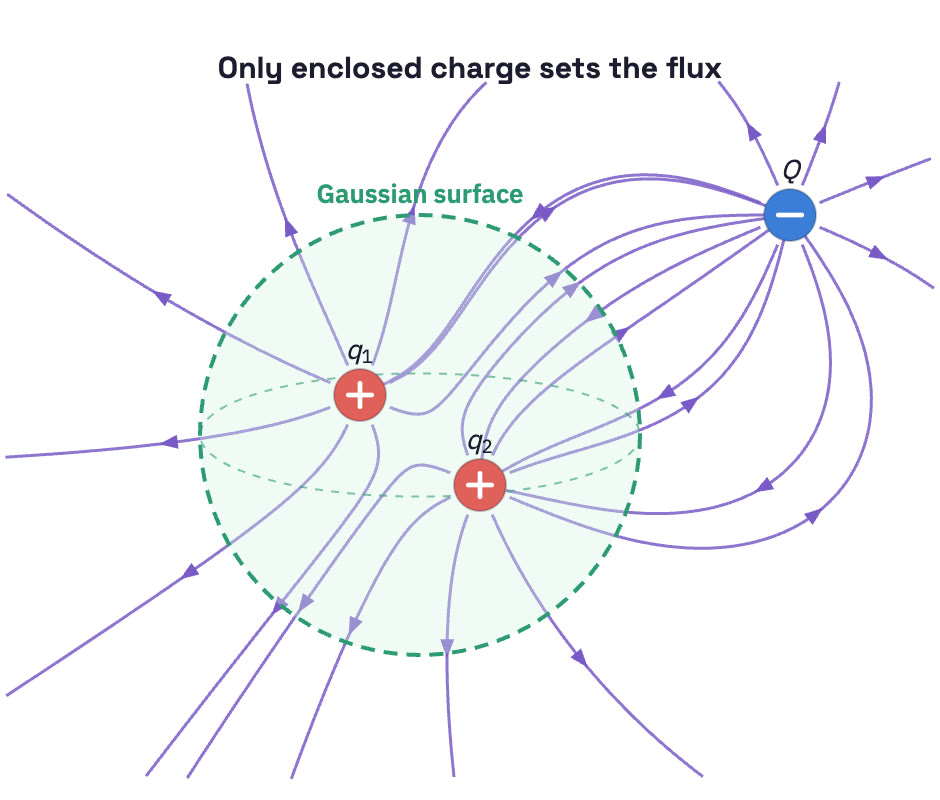
Only enclosed charge counts
; the outside charge sends in as much flux as it takes out.
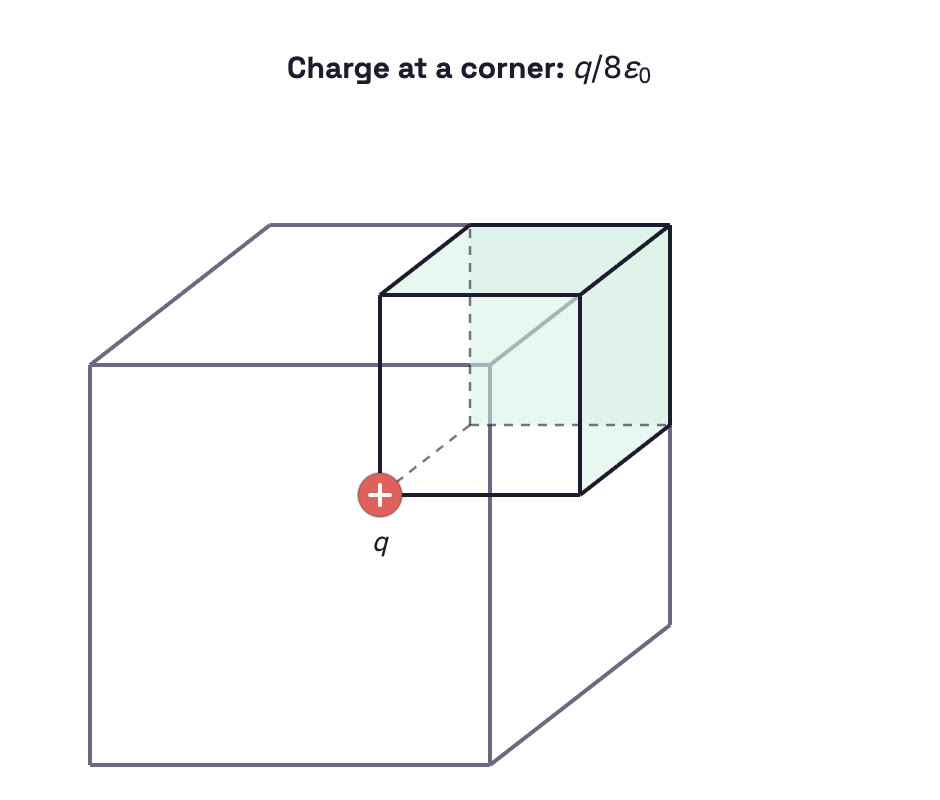
Charge at a corner
Eight such cubes would surround the charge, so one cube gets and each far face .
Key formulas
From the video
1. In a region E = (100 + 40y) ĵ N/C, y in metres. Find the charge inside a cube of side 0.2 m with one corner at the origin and edges along the axes.
- Only the faces and m have along their normals.
- N m² C⁻¹.
- .
C; the constant 100 N/C cancels.
2. A 6 μC charge sits at one corner of a cube. Find the flux through the cube, through a face not touching the charge, and through a face containing it.
- Eight cubes would surround the corner: N m² C⁻¹.
- Only the three far faces carry it: each.
8.5 × 10⁴, 2.8 × 10⁴ and 0 N m² C⁻¹ (the field lies in the faces at the corner).
Your turn
A point charge q sits at the centre of one face of a cube. The total electric flux through the cube is:
Show the answer and the traps
Answer (a), q/2ε₀. Another cube on the other side would complete a box around q, so each cube gets half.
q/6ε₀ is one face with the charge at the centre of the cube.
q/ε₀ counts the whole charge as inside.
q/8ε₀ is the charge at a corner.
Common mistakes
Try these
1. A closed surface encloses +4 μC and −6 μC; +5 μC lies outside. Find the net flux.
−2 μC/ε₀ ≈ −2.26 × 10⁵ N m² C⁻¹.
2. A 3 μC charge is at the centre of a cube. Find the flux through one face.
q/6ε₀ ≈ 5.65 × 10⁴ N m² C⁻¹.
3. The field in a region is radial, E = 100r (V/m², r in m). Find the charge inside a sphere of radius 0.3 m.
q = 4πε₀aR³ ≈ 3.0 × 10⁻¹⁰ C.
4. An infinite line of 2 μC/m passes 3 cm from the centre of a sphere of radius 5 cm. Find the flux through the sphere.
Chord 8 cm: Φ = λ(0.08)/ε₀ ≈ 1.81 × 10⁴ N m² C⁻¹.