 layrd.liveLayer by Layer
- 1. Electric Flux
- 2. Gauss's Law
- 3. Conductors
- 4. Concentric Conductors
- 5. Lines, Spheres, Cylinders
- 6. Sheets and Plates
- 7. Parallel Plates
- 8. Electrostatic Pressure
- 9. Solid Angle
- 10. Cavities
Conductors, Charged Shells and Charge in a Cavity
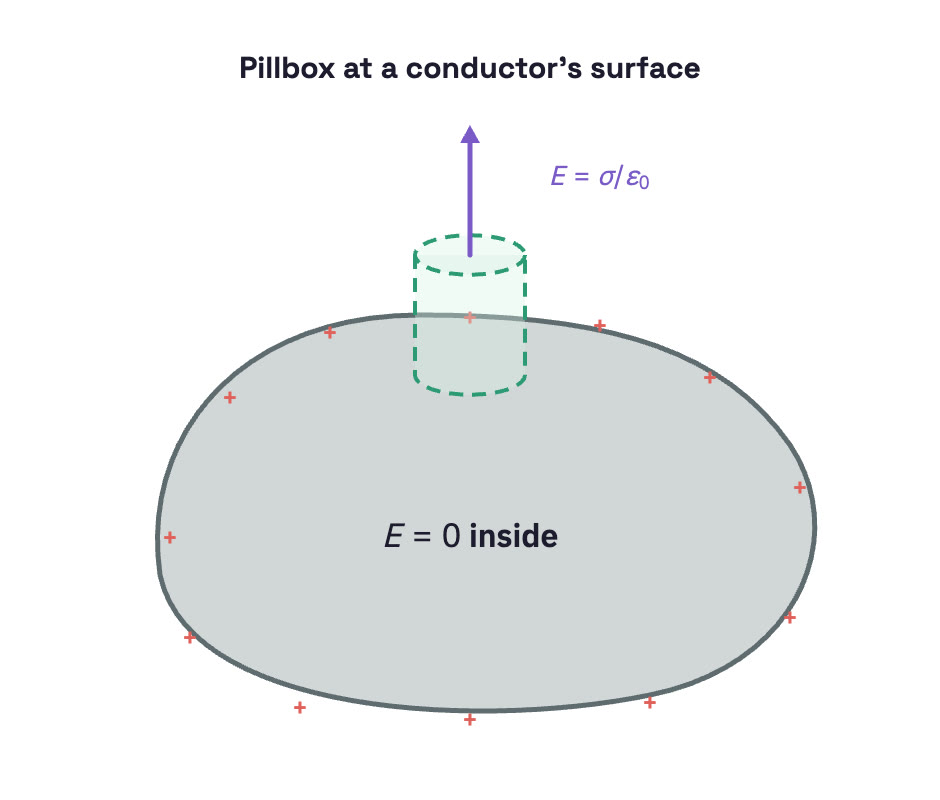
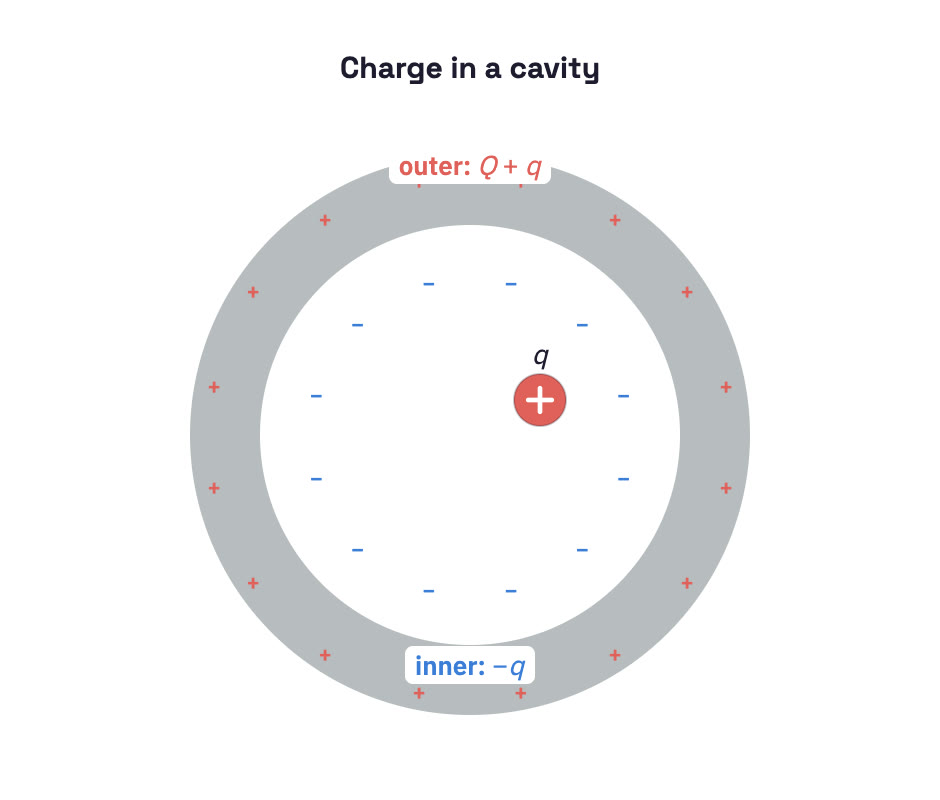
Inside a conductor in equilibrium E = 0, so any excess charge sits on its surface and the field just outside is σ/ε₀, normal to it. A charge q in a cavity puts −q on the inner surface and Q + q on the outer, and the outside sees only the outer surface.
Builds on: Part 2 · Gauss's Law: Enclosed Charge and Flux by Symmetry.
 Video coming soon
Pillbox at the surface
Flux leaves only through the outer face: , so .
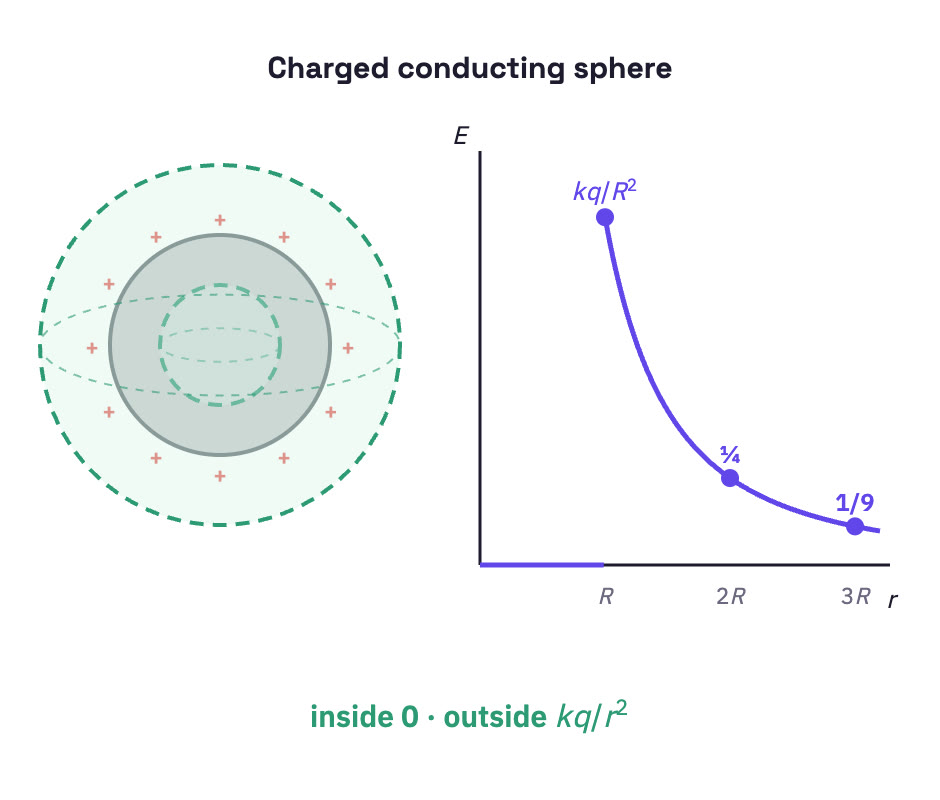
Charged conducting sphere
Zero inside, at the surface, then a fall.
Charge in a cavity
The inner surface carries and the outer .
Key formulas
From the video
1. A thick spherical conducting shell carries −3 μC. A +8 μC charge is placed off-centre in its cavity. Find the charge on each surface, and the field 50 cm from the centre.
- A Gaussian surface in the metal: the inner surface carries −8 μC, non-uniformly.
- Outer surface: μC, uniform because the outside is a sphere.
- .
−8 μC inside, +5 μC outside; E = 1.8 × 10⁵ N/C, radially from the centre.
Your turn
At a point on a charged conductor the surface charge density is 17.7 μC/m². The electric field just outside the conductor at that point is:
Show the answer and the traps
Answer (a), 2 × 10⁶ N/C. E = σ/ε₀ = 17.7 × 10⁻⁶ / 8.85 × 10⁻¹².
1 × 10⁶ uses σ/2ε₀, the result for a sheet, not a conductor.
Zero is the field inside the metal, not just outside.
4 × 10⁶ doubles the right answer.
Common mistakes
Try these
1. A conductor has σ = 4.425 μC/m² at a point. Find the field just outside it.
σ/ε₀ = 5 × 10⁵ N/C.
2. A conducting sphere of radius 10 cm carries 6 nC. Find E at 5 cm and at 30 cm from its centre.
0 and 600 N/C.
3. A conducting shell carries +2 μC; −5 μC is placed at its centre. Find the charges on its surfaces.
Inner +5 μC, outer −3 μC.
4. A charged conductor has an empty cavity. What is the field inside the cavity?
Zero.