 layrd.liveLayer by Layer
- 1. Electric Flux
- 2. Gauss's Law
- 3. Conductors
- 4. Concentric Conductors
- 5. Lines, Spheres, Cylinders
- 6. Sheets and Plates
- 7. Parallel Plates
- 8. Electrostatic Pressure
- 9. Solid Angle
- 10. Cavities
Coaxial and Concentric Conductors: Connecting and Earthing
Every shell's inner surface carries minus the charge it encloses and its outer surface the rest. Joining nested conductors with a wire sends all the charge outside; earthing the outer shell empties only its outer surface.
Builds on: Part 3 · Conductors, Charged Shells and Charge in a Cavity.
 Video coming soon
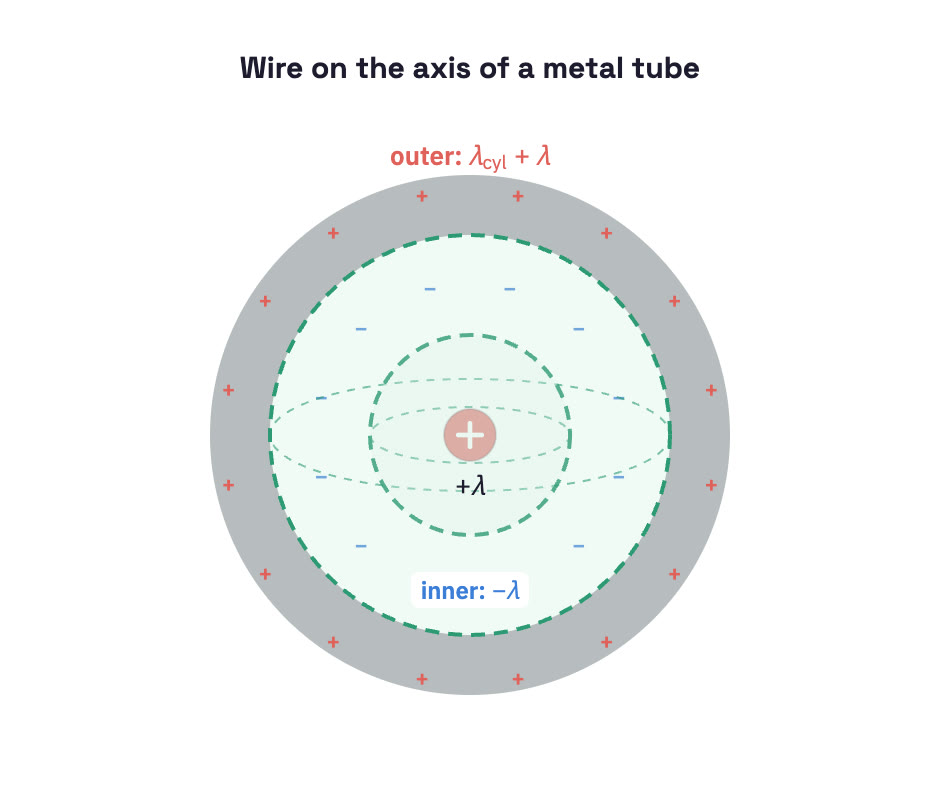
Wire on the axis of a metal tube
The inner wall carries and the outer wall .
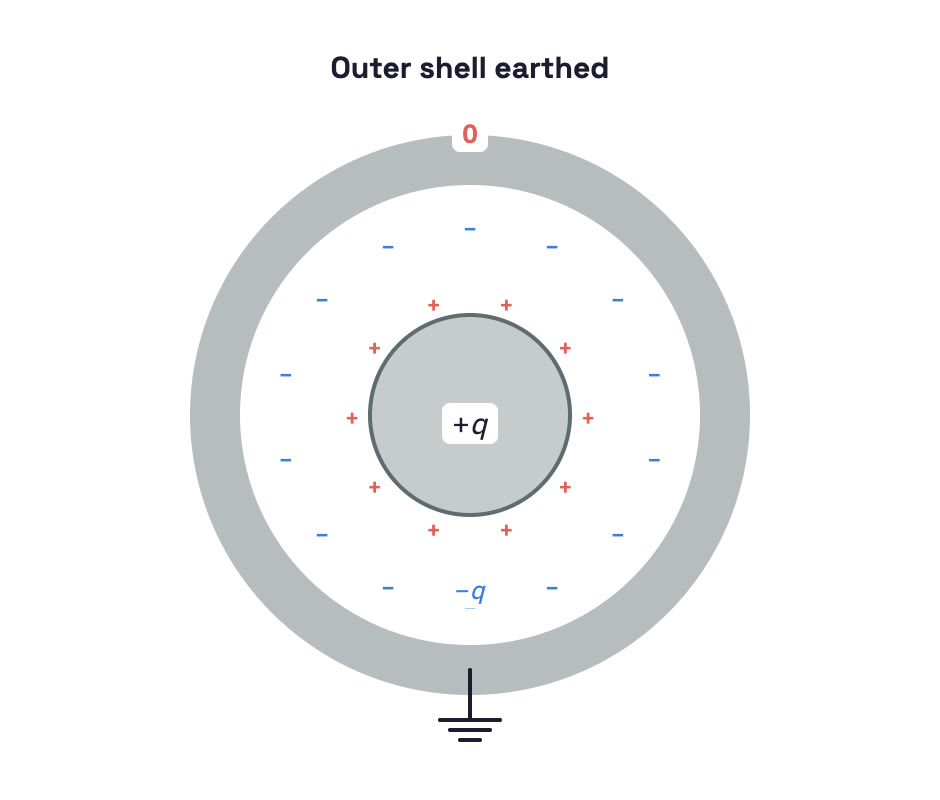
Outer shell earthed
The outer surface goes to zero; the inner surface keeps .
Key formulas
From the video
1. A metal sphere with +3 μC is at the centre of a metal shell carrying +4 μC. Find the shell's surface charges; then if the two are joined by a wire; then, instead, if the shell is earthed.
- Shell: inner μC, outer μC.
- Joined: one conductor, all 7 μC on the shell's outer surface; sphere and inner surface 0.
- Earthed: outer 0, inner still μC.
7 μC flows to earth when the shell is earthed (its charge goes from +4 to −3 μC).
Your turn
A long wire with +2 nC/m lies on the axis of a hollow metal cylinder carrying +3 nC/m. The charge per unit length on the cylinder's outer surface is:
Show the answer and the traps
Answer (a), +5 nC/m. The inner wall takes −2, so the outer wall holds 3 − (−2) = +5.
+3 forgets the charge induced by the wire.
+1 subtracts the wire's charge instead of adding it.
−2 is the charge on the inner wall.
Common mistakes
Try these
1. A wire with −3 nC/m is on the axis of a metal tube carrying +5 nC/m. Find the charge on each wall and the field 1 m from the axis.
Inner +3, outer +2 nC/m; E = 36 N/C.
2. A sphere with +2 μC is inside a shell carrying −2 μC. Find the field outside the shell.
Zero (outer surface 0).
3. A sphere with +5 μC is inside a shell with +1 μC. The shell is earthed. How much charge flows to earth?
6 μC.
4. The sphere and shell above are joined by a wire instead. What is the sphere's final charge?
Zero.