 layrd.liveLayer by Layer
- 1. Electric Flux
- 2. Gauss's Law
- 3. Conductors
- 4. Concentric Conductors
- 5. Lines, Spheres, Cylinders
- 6. Sheets and Plates
- 7. Parallel Plates
- 8. Electrostatic Pressure
- 9. Solid Angle
- 10. Cavities
Gauss's Law for a Line, a Solid Sphere and a Cylinder
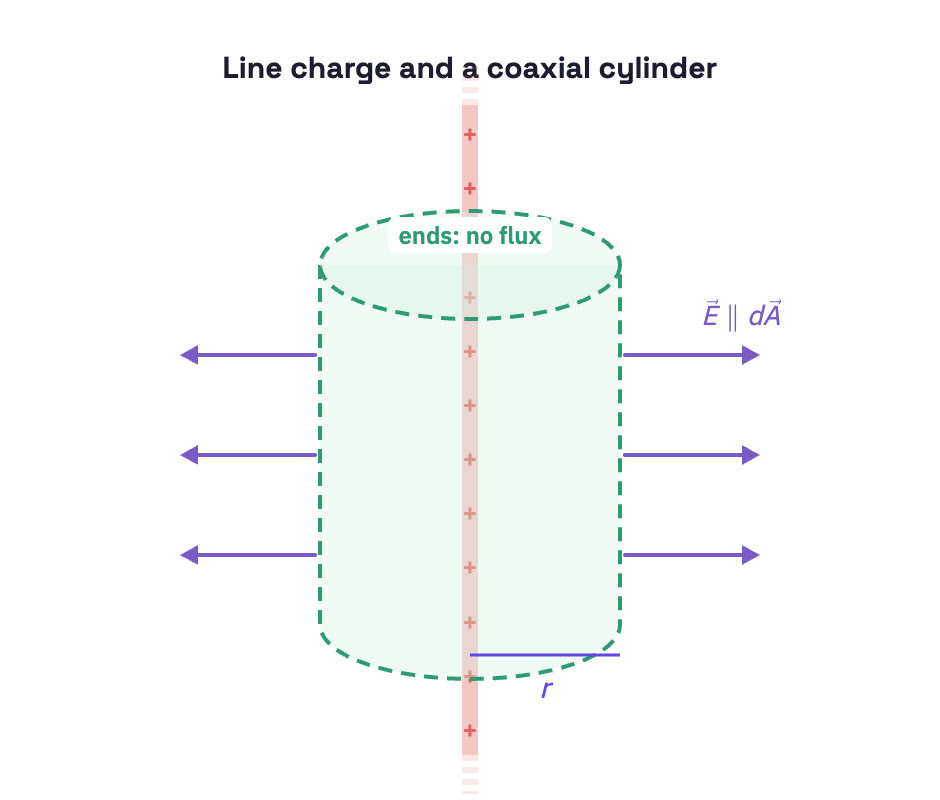
With a Gaussian surface that fits the symmetry, Gauss's law gives the field in two lines: 2kλ/r for a line charge, kQr/R³ inside and kQ/r² outside a uniformly charged sphere, and ρr/2ε₀ inside a long cylinder.
Builds on: Part 2 · Gauss's Law: Enclosed Charge and Flux by Symmetry.
 Video coming soon
Coaxial Gaussian cylinder
No flux through the ends; .
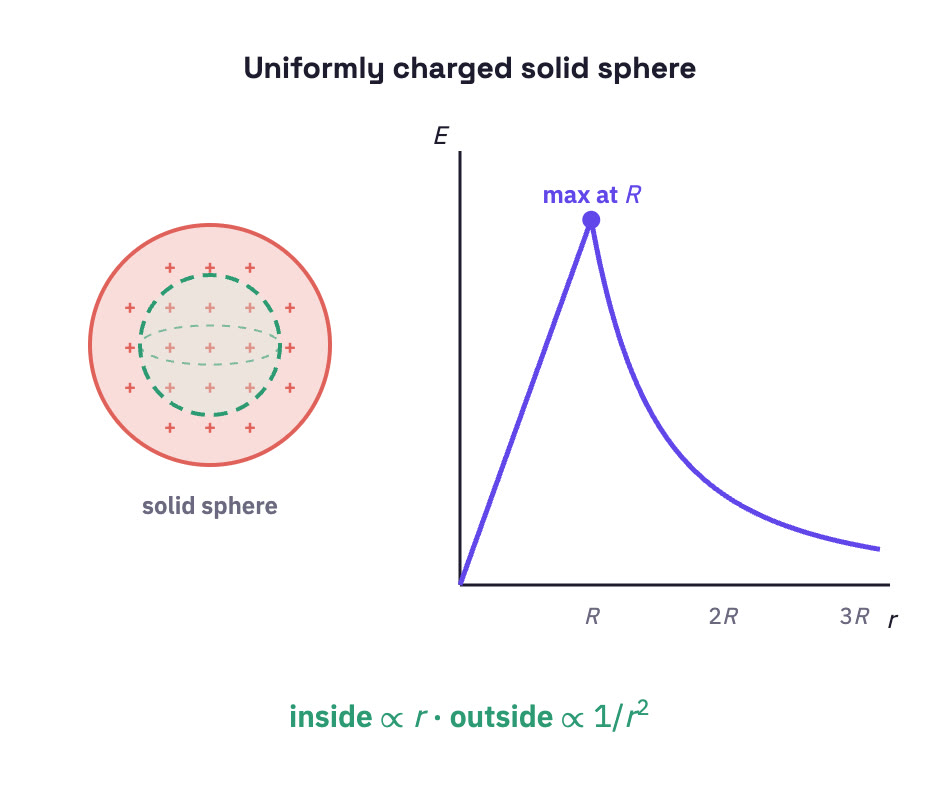
Field of a charged solid sphere
Linear inside, outside, largest at .
Key formulas
From the video
1. A long straight wire carries 3 μC/m. Find the field 20 cm and 60 cm from it.
- .
2.7 × 10⁵ N/C at 20 cm and 9 × 10⁴ N/C at 60 cm (a third, as E ∝ 1/r).
2. An insulating sphere of radius 10 cm holds 4 μC uniformly. Find the field 5 cm and 20 cm from its centre.
- Inside: .
- Outside: .
1.8 × 10⁶ N/C and 9 × 10⁵ N/C; both below the surface value 3.6 × 10⁶ N/C.
Your turn
A long solid cylinder of radius R carries a uniform volume charge density. The ratio of the field at R/2 from its axis to the field at 2R from its axis is:
Show the answer and the traps
Answer (a), 1 : 1. Inside, ρ(R/2)/2ε₀ = ρR/4ε₀. Outside, ρR²/(2ε₀ · 2R) = ρR/4ε₀. Equal.
2 : 1 uses a 1/r² fall outside, as for a sphere.
1 : 2 turns the ratio upside down.
0 : 1 treats the cylinder as a conductor, with no field inside.
Common mistakes
Try these
1. Find the field 0.5 m from a long wire carrying 4 μC/m.
1.44 × 10⁵ N/C.
2. A uniformly charged sphere of radius 20 cm holds 8 μC. Find E at 10 cm and 40 cm from its centre.
9 × 10⁵ N/C and 4.5 × 10⁵ N/C.
3. A long cylinder of radius 5 cm has ρ = 8.85 μC/m³. Find E at 2 cm and 10 cm from its axis.
10⁴ N/C and 1.25 × 10⁴ N/C.
4. Where is the field of a uniformly charged sphere largest?
At its surface, r = R.