 layrd.liveLayer by Layer
- 1. Electric Flux
- 2. Gauss's Law
- 3. Conductors
- 4. Concentric Conductors
- 5. Lines, Spheres, Cylinders
- 6. Sheets and Plates
- 7. Parallel Plates
- 8. Electrostatic Pressure
- 9. Solid Angle
- 10. Cavities
Parallel Conducting Plates, Earthing and Thick Slabs
Facing surfaces of parallel plates carry equal and opposite charges and the two outer surfaces share the total equally. Earthing any plate makes both outer faces zero, and a thick slab's field grows linearly inside and is constant outside.
Builds on: Part 6 · Charged Sheets and Conducting Plates.
 Video coming soon
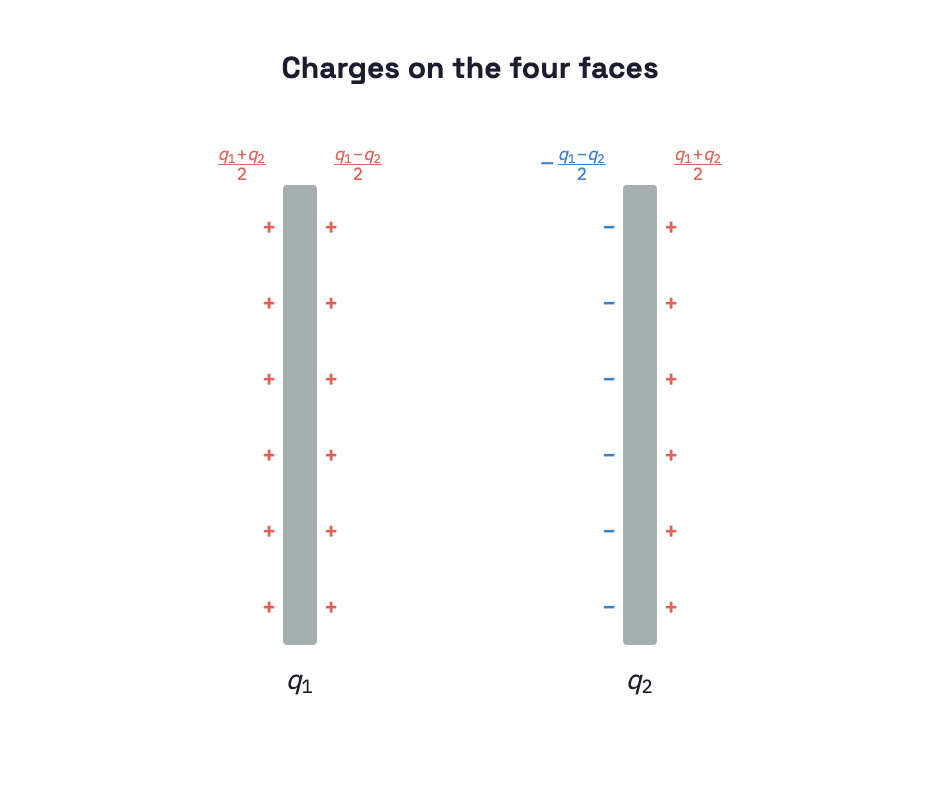
Charges on four faces
Outer faces ; facing faces .
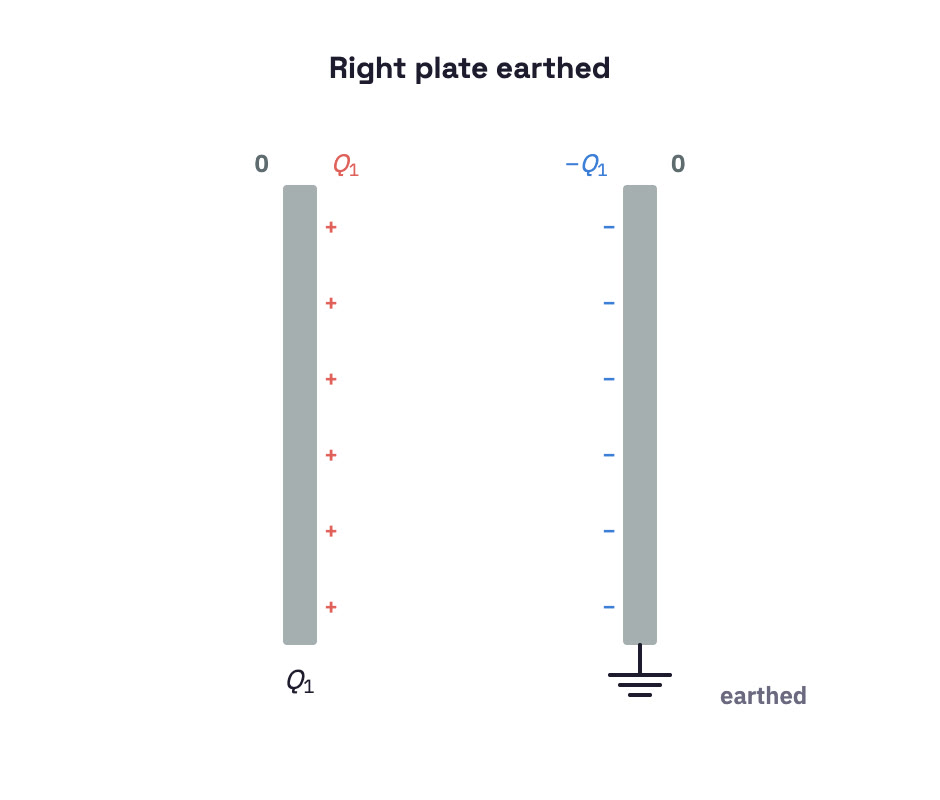
One plate earthed
Both outer faces drop to zero; the facing faces carry .
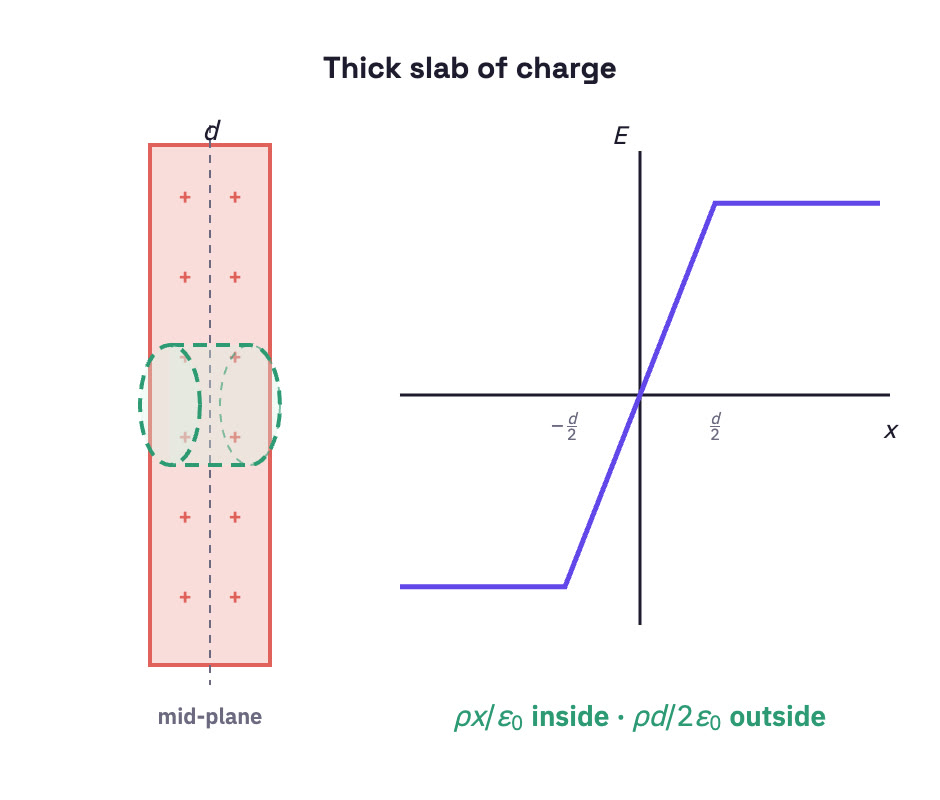
Thick slab of charge
inside, outside.
Key formulas
From the video
1. Two large parallel metal plates of area 0.2 m² carry +5 μC and +1 μC. Find the charge on each face and the field between them.
- Outer faces: μC each; facing faces μC.
- .
+3, +2, −2, +3 μC; E ≈ 1.13 × 10⁶ N/C between them.
2. The same plates, but the +1 μC plate is earthed. Find the face charges, the field between, and the charge sent to earth.
- Outer faces 0; the left plate's +5 μC sits on its inner face, the earthed plate's inner face gets −5 μC.
- N/C.
The earthed plate goes from +1 to −5 μC: 6 μC flows to earth.
Your turn
A large slab 4 cm thick carries a uniform volume charge. The ratio of the electric field 1 cm from its mid-plane to the field 3 cm from its mid-plane is:
Show the answer and the traps
Answer (a), 1 : 2. At 1 cm, inside: ρ(0.01)/ε₀. At 3 cm, outside: ρ(0.04)/2ε₀ = ρ(0.02)/ε₀.
1 : 3 keeps the field growing outside the slab.
1 : 1 treats the field as constant inside too.
2 : 1 turns the ratio upside down.
Common mistakes
Try these
1. Plates carry +8 μC and −2 μC. Find the charge on each face.
Outer +3 each; facing +5 and −5 μC.
2. Plates carry +3 μC and 0. Find the charge on each face.
Outer +1.5 each; facing +1.5 and −1.5 μC.
3. Plates carry +4 μC and +6 μC; the left one is earthed. How much charge flows to earth?
10 μC (left plate ends at −6 μC).
4. A slab 6 cm thick has ρ = 8.85 μC/m³. Find E 2 cm from its mid-plane and outside it.
2 × 10⁴ N/C and 3 × 10⁴ N/C.