 layrd.liveLayer by Layer
- 1. Electric Flux
- 2. Gauss's Law
- 3. Conductors
- 4. Concentric Conductors
- 5. Lines, Spheres, Cylinders
- 6. Sheets and Plates
- 7. Parallel Plates
- 8. Electrostatic Pressure
- 9. Solid Angle
- 10. Cavities
Solid Angle and the Flux of a Point Charge
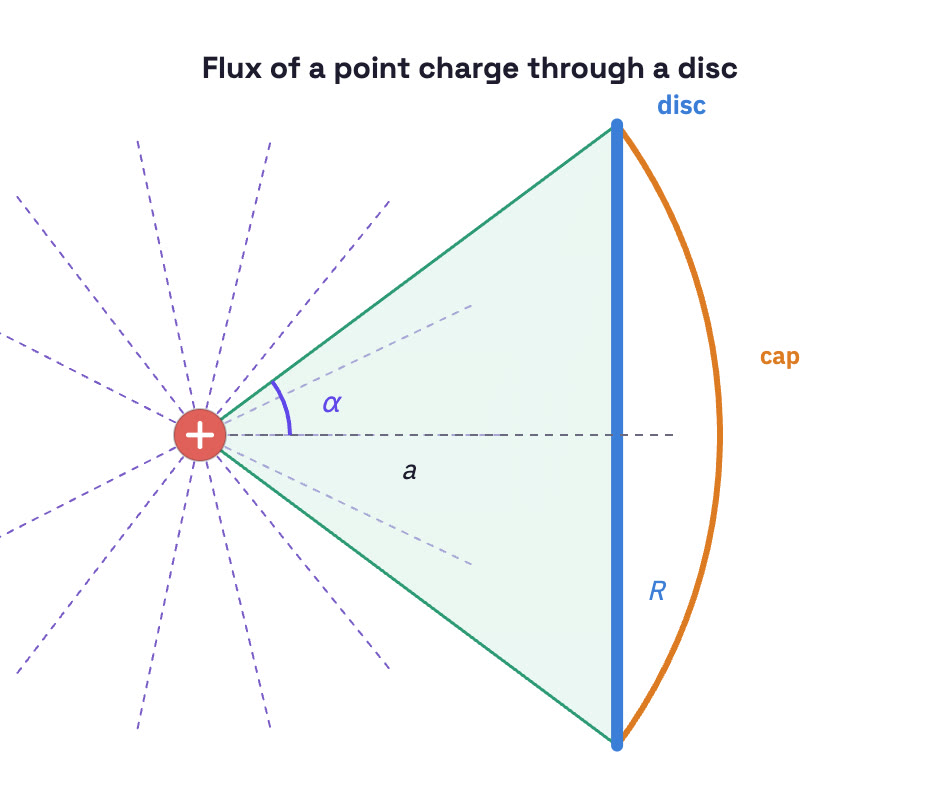
A solid angle is a three-dimensional angle, Ω = S/r², with 4π for a closed surface and 2π(1 − cos α) for a cone. A point charge sends (q/4πε₀)Ω through any surface, so a disc on its axis catches the fraction (1 − cos α)/2.
Builds on: Part 2 · Gauss's Law: Enclosed Charge and Flux by Symmetry.
 Video coming soon
Flux through a disc
The rim sets the half-angle ; .
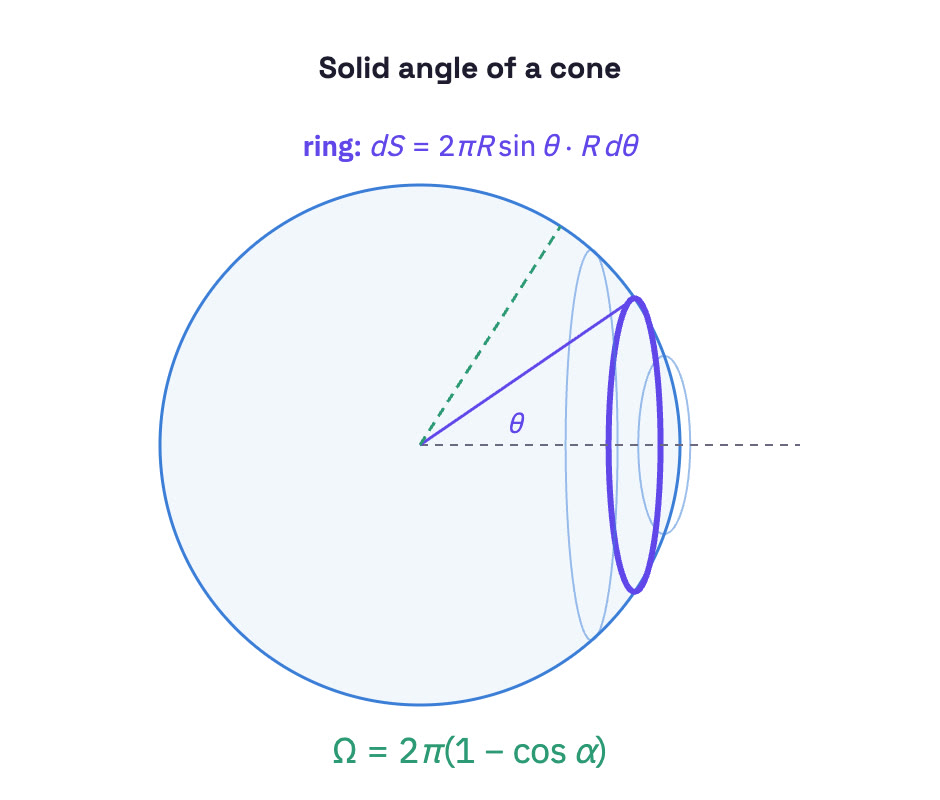
Rings on a sphere
Adding rings gives .
Key formulas
From the video
1. A 17.7 nC point charge sits on the axis of a disc of radius 6 cm, 8 cm from its centre. Find the flux through the disc.
- The rim is 10 cm away: .
- Fraction ; N m² C⁻¹.
Φ = 200 N m² C⁻¹, a tenth of the charge's total flux.
Your turn
A point charge q sits at the vertex of a cone of half-angle 60°. The electric flux through the cone's flat base is:
Show the answer and the traps
Answer (a), q/4ε₀. Φ = (q/2ε₀)(1 − cos 60°) = (q/2ε₀)(1/2).
q/2ε₀ is the flux for a half-angle of 90°, a full hemisphere.
3q/4ε₀ uses 1 + cos α instead of 1 − cos α.
Zero is the flux through the curved surface, not the base.
Common mistakes
Try these
1. Find the solid angle of a cone of half-angle 60°.
π sr.
2. What solid angle does a hemisphere subtend at its centre?
2π sr.
3. A charge q is on the axis of a disc of radius R, a distance R away. Find the flux through the disc.
(q/2ε₀)(1 − 1/√2) ≈ 0.146 q/ε₀.
4. How far from a charge must a disc of radius R be, on its axis, to catch one eighth of its flux?
cos α = 3/4: a = 3R/√7 ≈ 1.13R.