 layrd.liveLayer by Layer
- 1. Principal Branch
- 2. Graphs & Principal Values
- 3. Domain, Range & Inequalities
- 4. Extreme Values & [x]
- 5. sin⁻¹(sin x), cos⁻¹(cos x)
- 6. tan⁻¹(tan x) & Graphs
- 7. Reference Triangle
- 8. Substitution
- 9. f⁻¹(−x) and f⁻¹(1/x)
- 10. sin⁻¹x + cos⁻¹x = π/2
- 11. Ranges & Extremes
- 12. tan⁻¹ Addition Formula
- 13. 2tan⁻¹x & Equations
- 14. Telescoping Series
- 15. sin⁻¹ and cos⁻¹ Sums
- 16. Multiple-Angle Formulas
- 17. Multiple Angles in Action
Graphs of Inverse Trig Functions and Principal Values
Every inverse graph is its trig branch reflected in the line . Read off which inverse functions increase, where the asymptotes go, and then evaluate principal values, including the negative inputs that catch most students out.
Builds on: Part 1 · Why Inverse Trig Needs a Principal Value Branch.
 Video coming soon
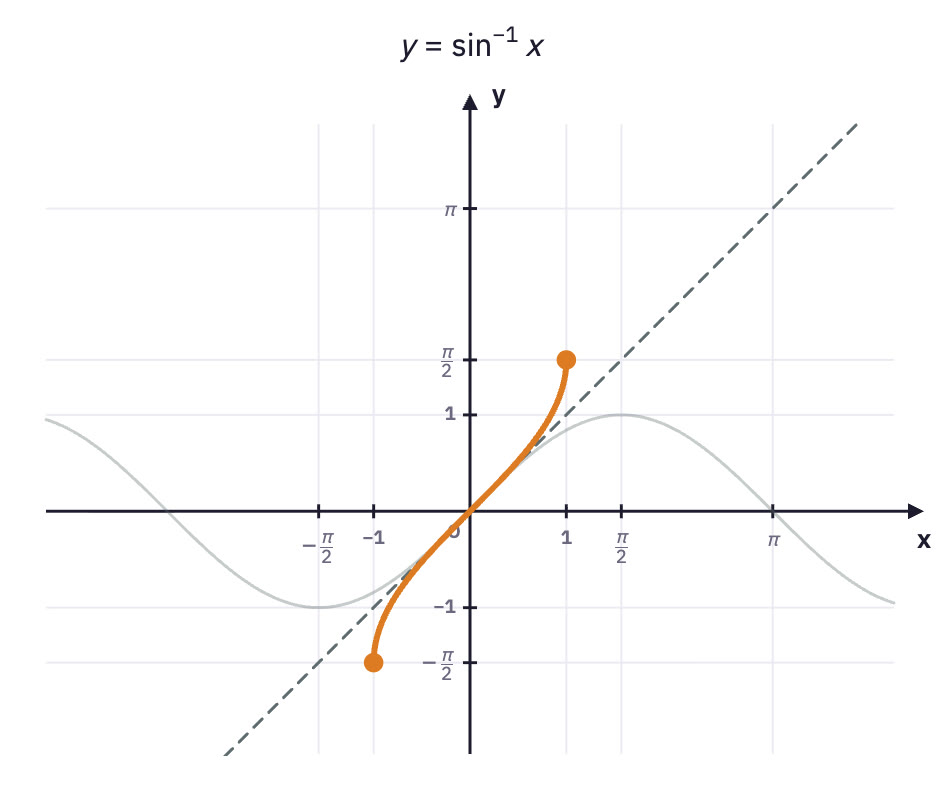
Reflect in
on means on . The principal branch of from to reflects to from to .
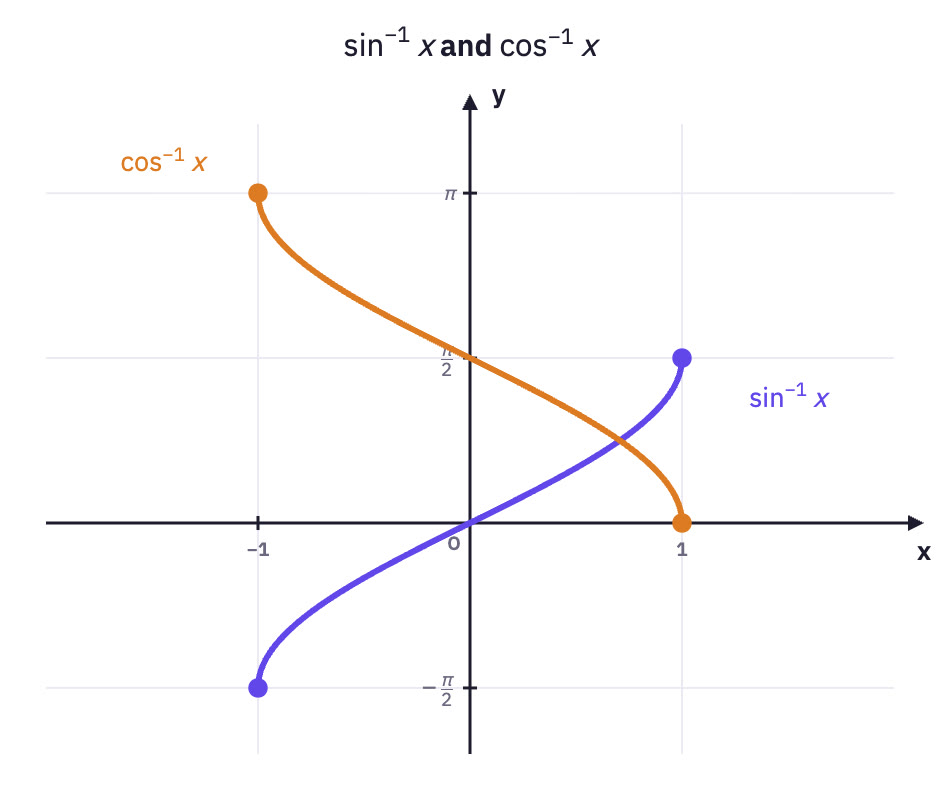
Domain
increases from to ; decreases from to .
Domain
increases between the asymptotes ; decreases between and .
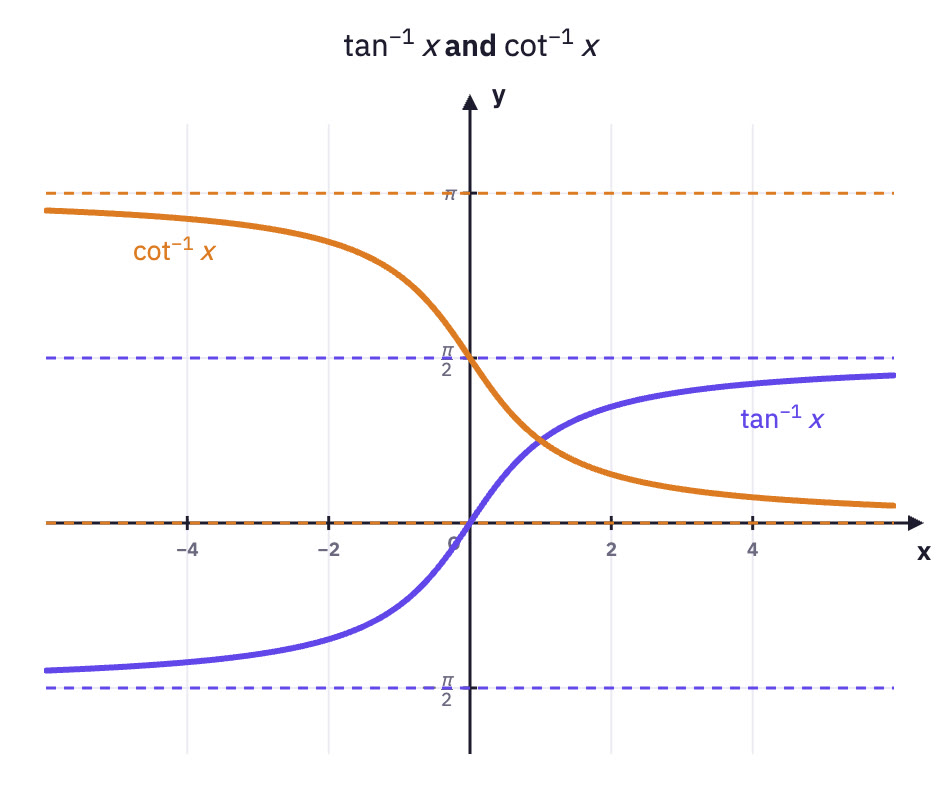
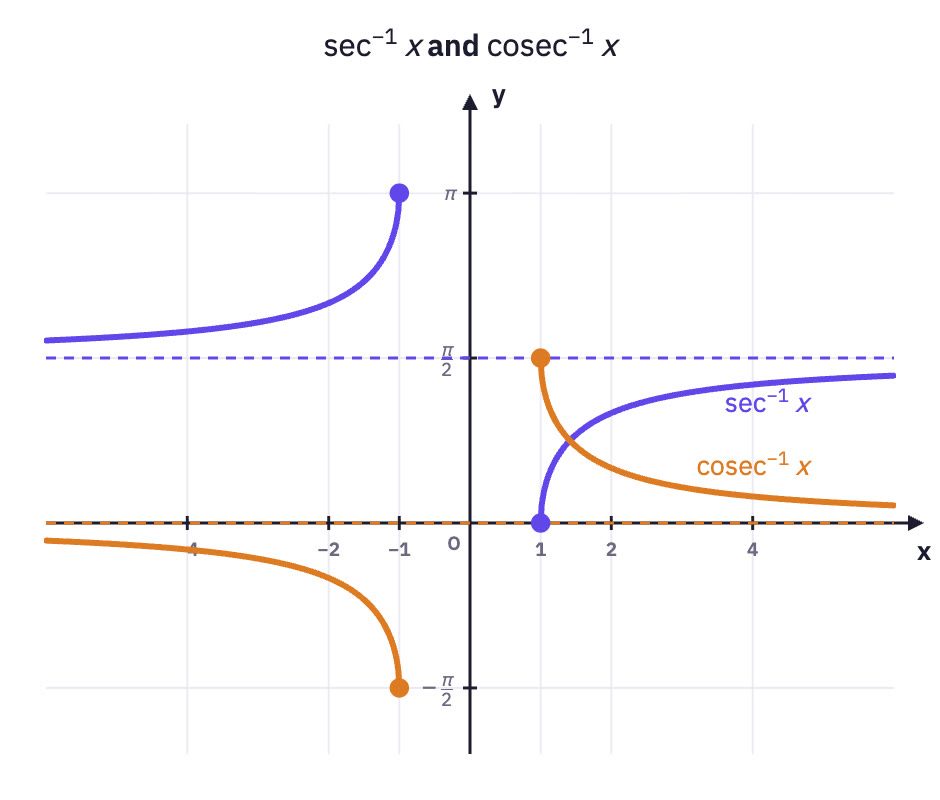
Domain
approaches from both sides and approaches , neither value being reached.
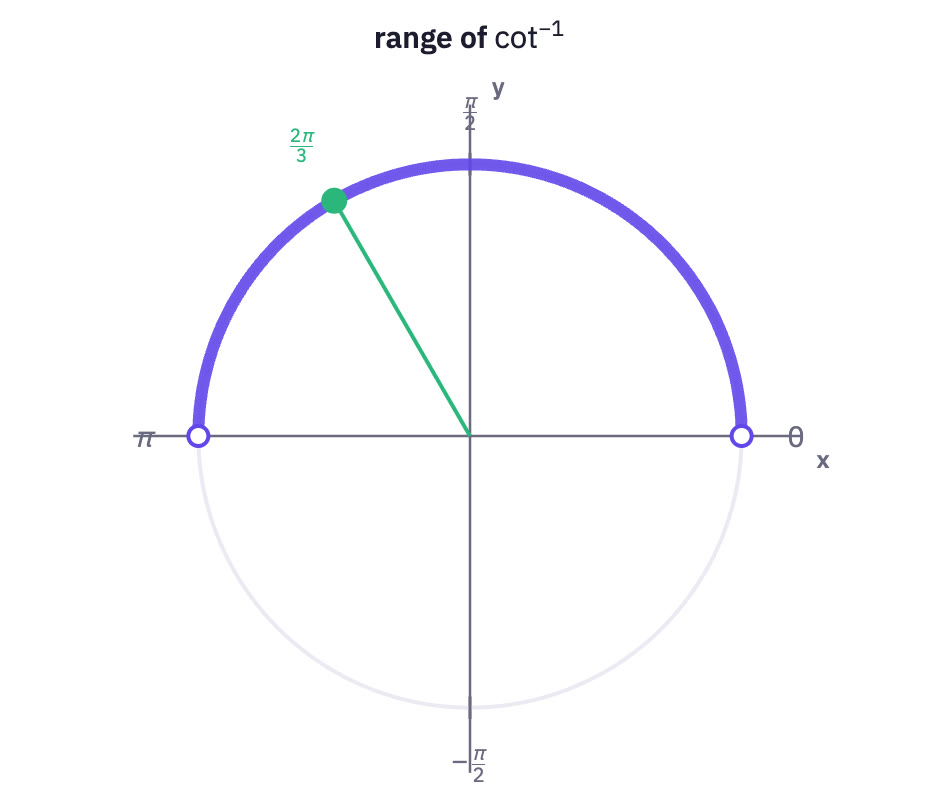
The answer lands in the range
Write the input as a trig ratio of a standard angle, then move the angle into the principal range. For negative inputs, , , give minus the angle; , , give minus the angle.
One for every idea
1. From the graph of , find , the limits as and , and say whether the function is increasing or decreasing.
- At the curve is in the middle of : .
- As , ; as , . Neither is reached.
- The graph falls from left to right.
; limits and ; decreasing on .
2. Find the principal values of (i) (ii) (iii) (iv) .
- (i) , ⇒ .
- (ii) , ⇒ .
- (iii) , ⇒ .
- (iv) , ⇒ .
, , , .
Your turn
The value of tan⁻¹(−1) + cos⁻¹(−1/√2) is:
Show the answer and the traps
tan⁻¹(−1) = −π/4 and cos⁻¹(−1/√2) = 3π/4, so the sum is π/2. Option b.
0 takes cos⁻¹(−1/√2) as π/4, ignoring the sign.
3π/2 puts tan⁻¹(−1) in the second quadrant, at 3π/4: that is outside its range.
−π/2 makes cos⁻¹(−1/√2) negative, and cos⁻¹ never is.
Common mistakes
Try these
1. Find .
.
2. Find .
.