 layrd.liveLayer by Layer
- 1. Principal Branch
- 2. Graphs & Principal Values
- 3. Domain, Range & Inequalities
- 4. Extreme Values & [x]
- 5. sin⁻¹(sin x), cos⁻¹(cos x)
- 6. tan⁻¹(tan x) & Graphs
- 7. Reference Triangle
- 8. Substitution
- 9. f⁻¹(−x) and f⁻¹(1/x)
- 10. sin⁻¹x + cos⁻¹x = π/2
- 11. Ranges & Extremes
- 12. tan⁻¹ Addition Formula
- 13. 2tan⁻¹x & Equations
- 14. Telescoping Series
- 15. sin⁻¹ and cos⁻¹ Sums
- 16. Multiple-Angle Formulas
- 17. Multiple Angles in Action
Domain, Range and Inequalities of Inverse Trig Expressions
Put an expression inside an inverse trig function and three questions follow: where is it defined, what values does it take, and when does it satisfy an inequality? Each one comes down to the allowed argument and the direction in which the function moves.
Builds on: Part 2 · Graphs of Inverse Trig Functions and Principal Values.
 Video coming soon
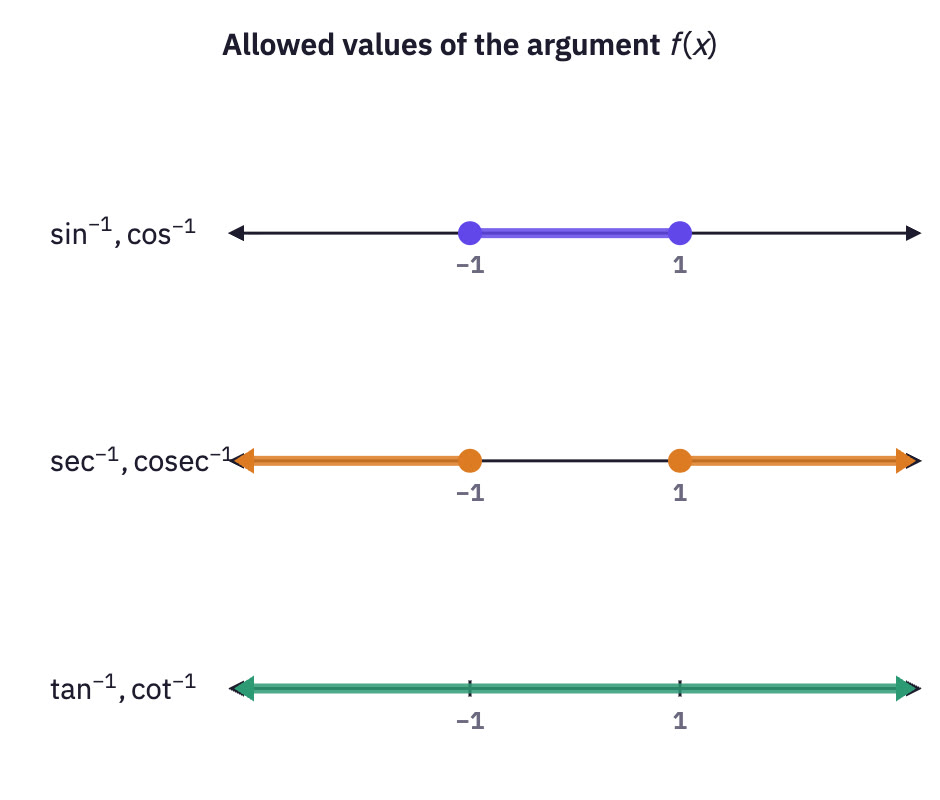
What the argument may be
and need ; and need ; and only need to exist. A sum is defined on the intersection of the domains.
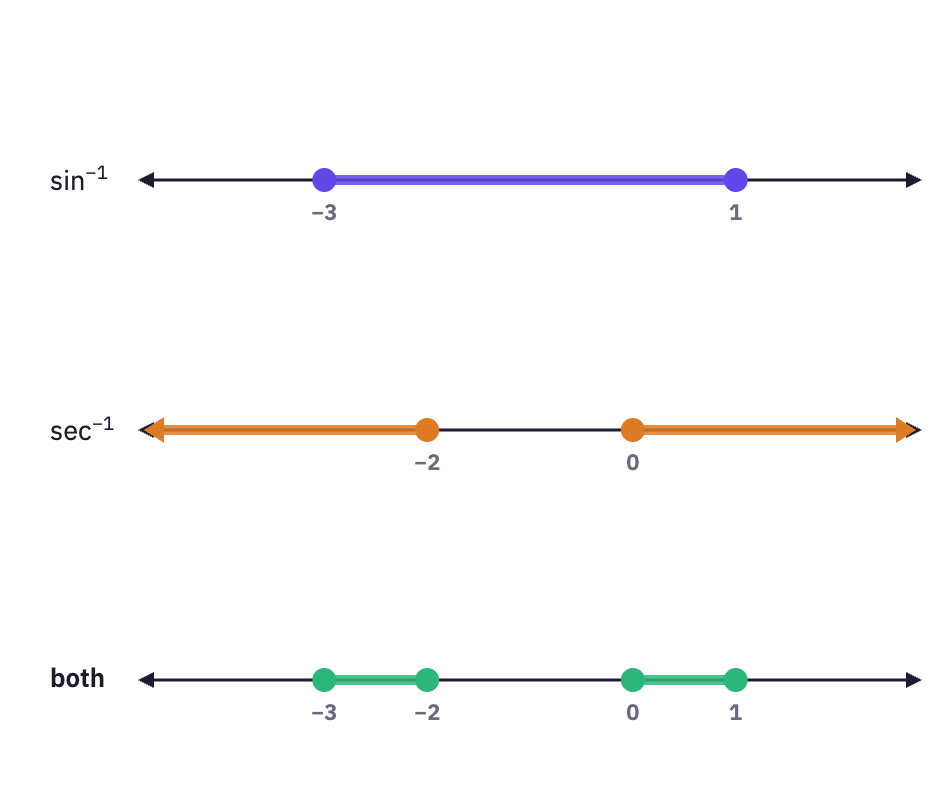
Intersect the domains
needs ; needs or . Both: .
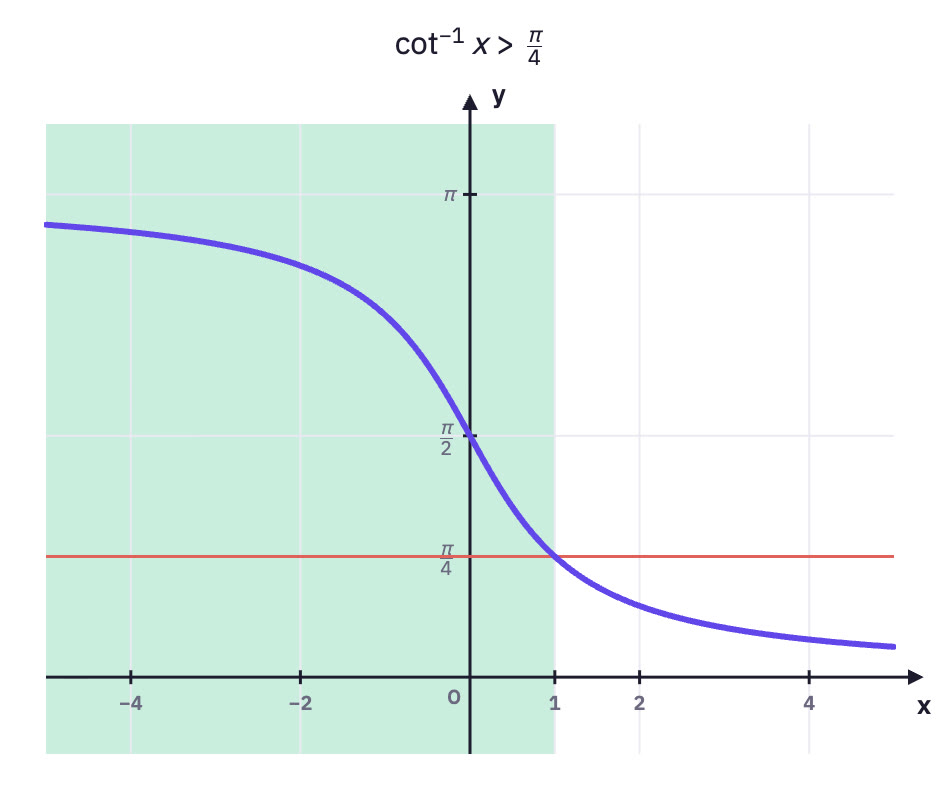
Decreasing: the sign flips
and increase, so applying or keeps the sign; and decrease, so applying or flips it.
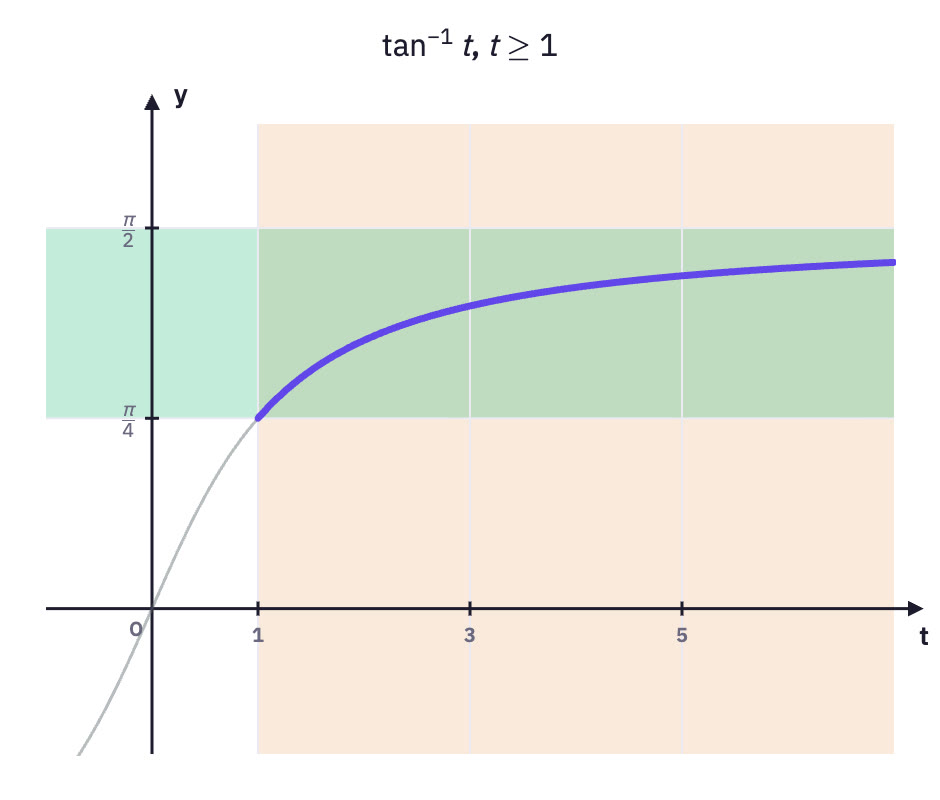
Inner range, cut, carry through
Find the values of the inner expression, cut them to the outer function's domain, then carry them through the monotonic inverse function. gives .
One for every idea
1. Find the domains of (i) (ii) (iii) .
- (i) .
- (ii) (which keeps ).
- (iii) or or .
(i) (ii) (iii) .
2. Find the domain of .
- .
- or or .
- Intersect.
.
3. Solve .
- is decreasing, so applying flips the sign: .
- The domain is .
.
4. Solve .
- : or .
- and , so is impossible.
- ( is increasing).
.
5. Find the ranges of (i) (ii) (iii) .
- (i) , cut to ; is decreasing: up to (not reaching) .
- (ii) ; is increasing.
- (iii) ; is decreasing.
(i) (ii) (iii) .
Your turn
The domain of cos⁻¹(x² − 3) is:
Show the answer and the traps
−1 ≤ x² − 3 ≤ 1 gives 2 ≤ x² ≤ 4: x ∈ [−2, −√2] ∪ [√2, 2]. Option b.
[√2, 2] forgets the negative x.
[−2, 2] keeps only x² ≤ 4 and drops x² ≥ 2.
|x| ≥ 2 uses the sec⁻¹ rule instead.
Common mistakes
Try these
1. Find the domain of .
.
2. Solve .
Increasing: ; with the domain, .
3. Find the range of .
, so the range is .