 layrd.liveLayer by Layer
- 1. Principal Branch
- 2. Graphs & Principal Values
- 3. Domain, Range & Inequalities
- 4. Extreme Values & [x]
- 5. sin⁻¹(sin x), cos⁻¹(cos x)
- 6. tan⁻¹(tan x) & Graphs
- 7. Reference Triangle
- 8. Substitution
- 9. f⁻¹(−x) and f⁻¹(1/x)
- 10. sin⁻¹x + cos⁻¹x = π/2
- 11. Ranges & Extremes
- 12. tan⁻¹ Addition Formula
- 13. 2tan⁻¹x & Equations
- 14. Telescoping Series
- 15. sin⁻¹ and cos⁻¹ Sums
- 16. Multiple-Angle Formulas
- 17. Multiple Angles in Action
sin⁻¹(sin x) and cos⁻¹(cos x): Zig-Zag and Tent Graphs
wherever exists, but only on the principal branch. Elsewhere it follows a zig-zag, and follows a tent. Find the piece a number lies in, and these values take one line.
Builds on: Part 2 · Graphs of Inverse Trig Functions and Principal Values.
 Video coming soon
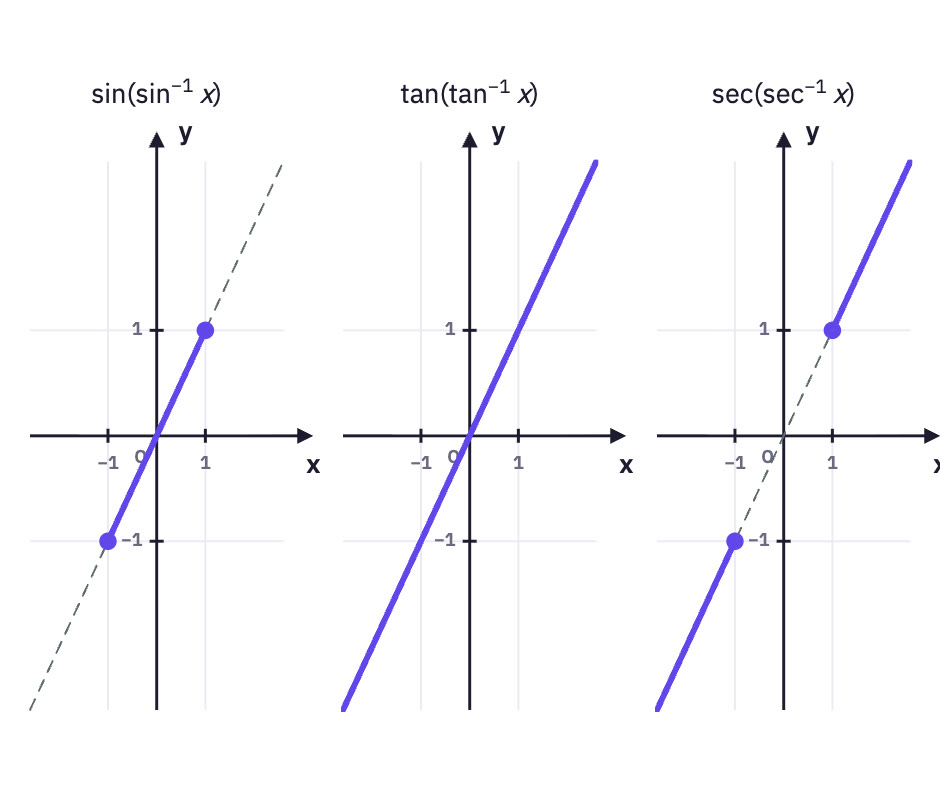
, on the domain of
and on (a segment); and on (the full line); and on (two rays).
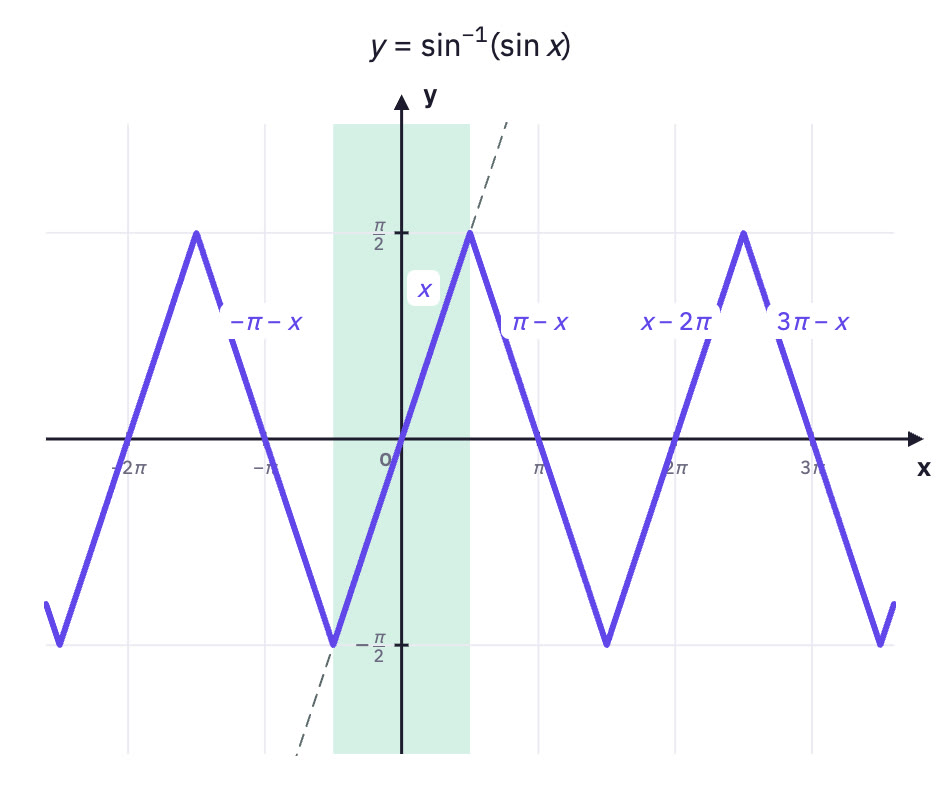
The zig-zag
From : , with chosen so that . Pieces: on , on , on , on . Period .
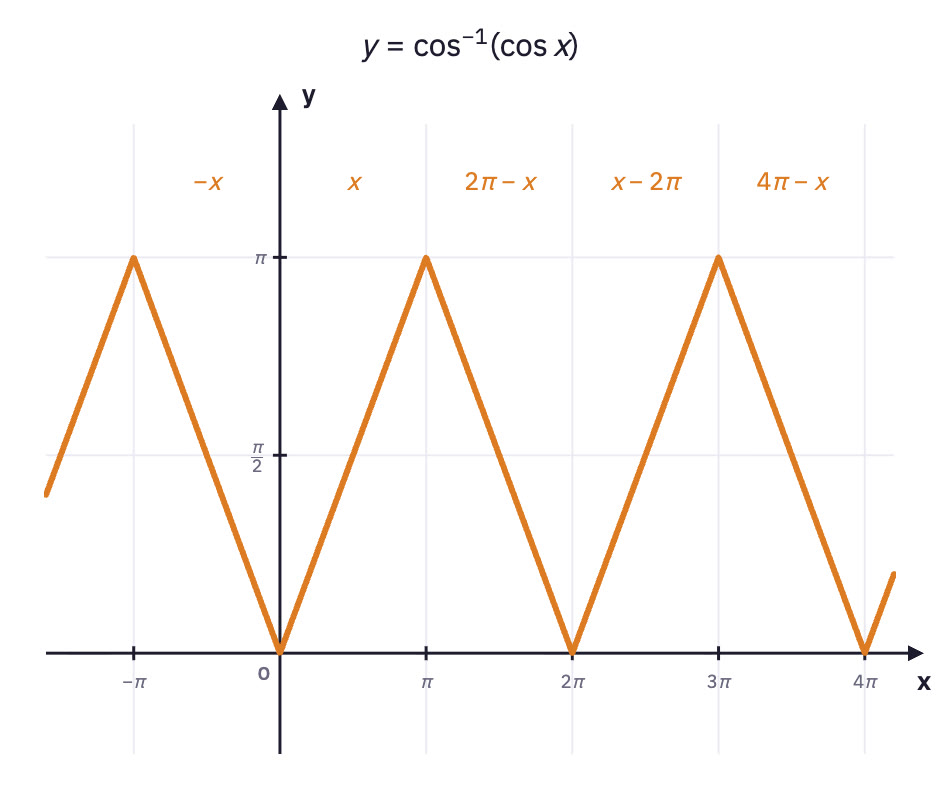
The tent
From : , with . Pieces: on , on , on , on . The function is even.
Key formulas
One for every idea
1. Find the domain of and sketch it.
- for all real .
- only for .
- So on .
Domain ; the graph is two rays of starting at and .
2. Evaluate (i) (ii) (iii) (iv) .
- (i) : .
- (ii) : .
- (iii) , : .
- (iv) .
, , , .
3. Find the area between and the -axis for .
- Each hump is a triangle with base and height : area .
- holds three humps (two above the axis, one below).
.
4. Evaluate (i) (ii) (iii) .
- (i) : .
- (ii) : .
- (iii) Even: ; : .
, , .
Your turn
The value of sin⁻¹(sin 6) + cos⁻¹(cos 6) is:
Show the answer and the traps
6 lies in [3π/2, 2π]: sin⁻¹(sin 6) = 6 − 2π and cos⁻¹(cos 6) = 2π − 6. The sum is 0. Option b.
12 treats both as 6: f⁻¹(f(x)) = x only on the principal branch.
4π − 12 makes sin⁻¹(sin 6) positive, but sin 6 < 0.
12 − 4π makes cos⁻¹(cos 6) negative, and cos⁻¹ never is.
Common mistakes
Try these
1. Evaluate .
.
2. Evaluate .
: .