 layrd.liveLayer by Layer
- 1. Principal Branch
- 2. Graphs & Principal Values
- 3. Domain, Range & Inequalities
- 4. Extreme Values & [x]
- 5. sin⁻¹(sin x), cos⁻¹(cos x)
- 6. tan⁻¹(tan x) & Graphs
- 7. Reference Triangle
- 8. Substitution
- 9. f⁻¹(−x) and f⁻¹(1/x)
- 10. sin⁻¹x + cos⁻¹x = π/2
- 11. Ranges & Extremes
- 12. tan⁻¹ Addition Formula
- 13. 2tan⁻¹x & Equations
- 14. Telescoping Series
- 15. sin⁻¹ and cos⁻¹ Sums
- 16. Multiple-Angle Formulas
- 17. Multiple Angles in Action
tan⁻¹(tan x), cot⁻¹(cot x), sec⁻¹(sec x) and Solving with Graphs
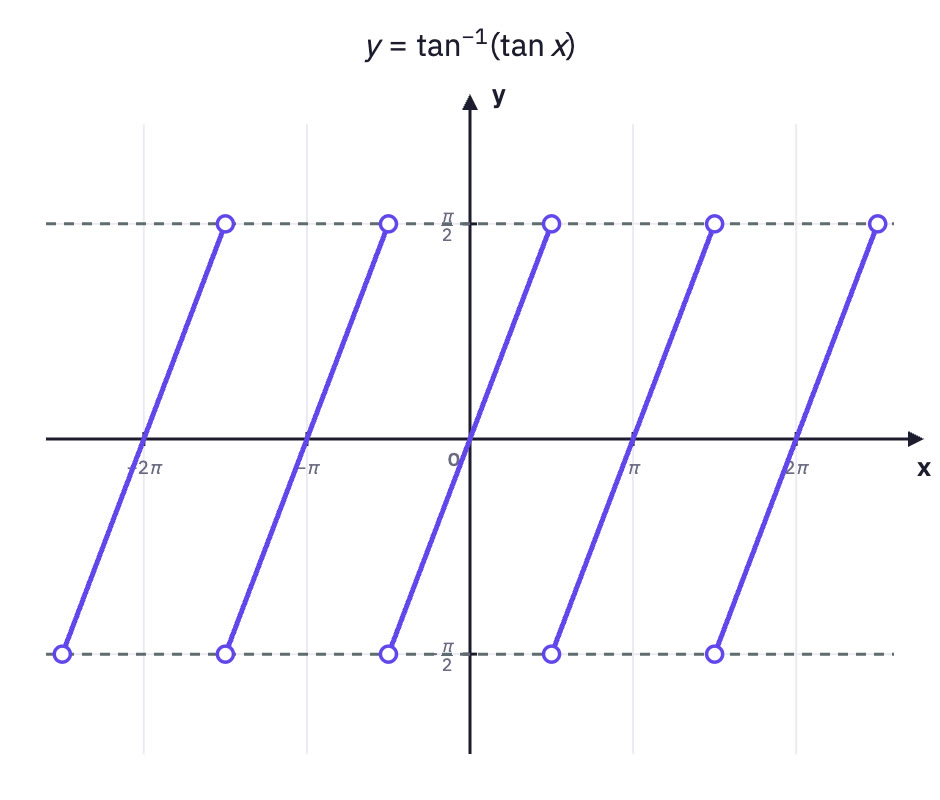
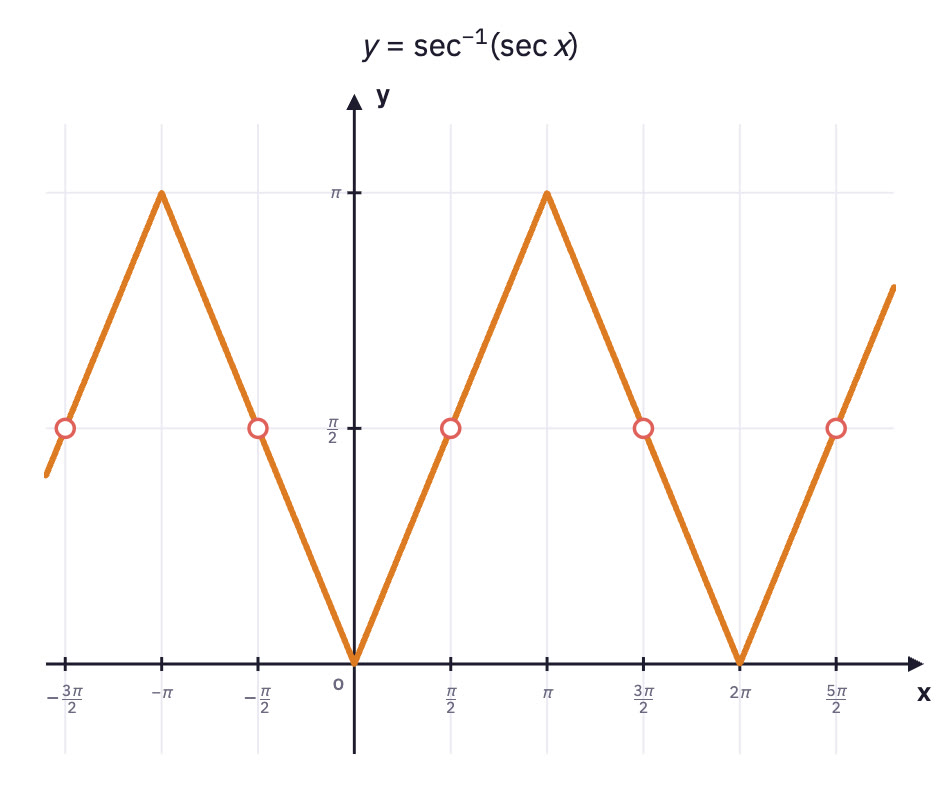
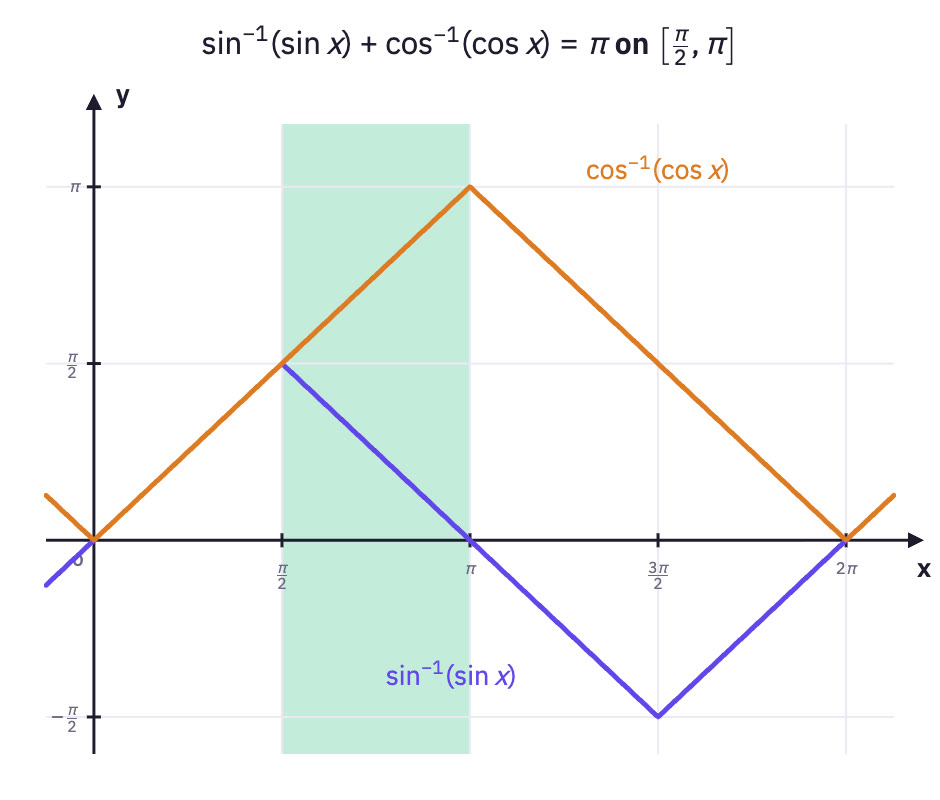
and are parallel line pieces with period ; and are the tent and zig-zag with holes. With all of them drawn, equations and solution counts become a matter of reading where graphs meet.
Builds on: Part 5 · sin⁻¹(sin x) and cos⁻¹(cos x): Zig-Zag and Tent Graphs.
 Video coming soon
, period
on , with hollow ends at odd multiples of .
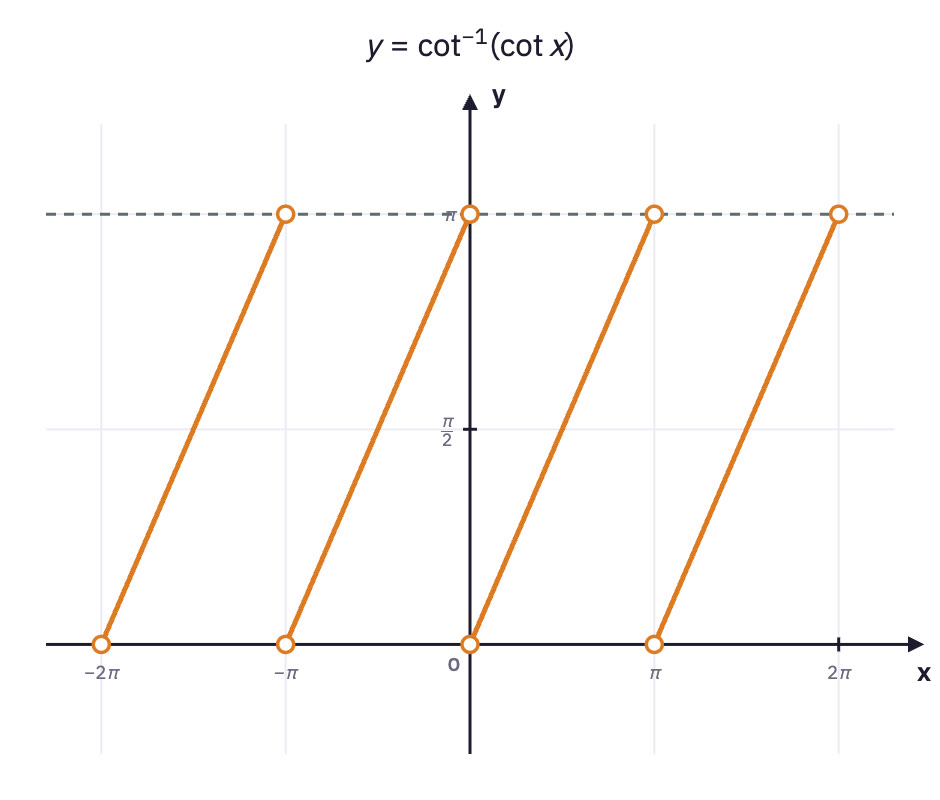
Range
on : never negative, undefined at multiples of .
The tent with holes
except at ; likewise except at .
Draw both sides
On each piece both sides are straight lines, so equations become linear. A right-hand side like must itself lie in the range of the left-hand side.
One for every idea
1. Evaluate (i) (ii) (iii) (iv) .
- Shift by a multiple of into : , .
- Shift into : , .
, , , .
2. Evaluate and . Is defined?
- ().
- ().
- does not exist.
; ; not defined.
3. Solve for .
- : .
- : for all .
- : .
- : .
.
4. Find the number of solutions of .
- .
- : .
- : .
- : .
3 solutions: , , .
Your turn
The number of real solutions of sin⁻¹(sin x) = x/2 is:
Show the answer and the traps
|x/2| ≤ π/2, so |x| ≤ π. Solutions 0 and π − x = x/2, x = 2π/3; the function is odd, so −2π/3 too. Three: option c.
1 keeps only x = 0, as if sin⁻¹(sin x) = x everywhere.
2 misses the mirror solution −2π/3.
5 counts crossings where x/2 is already outside [−π/2, π/2].
Common mistakes
Try these
1. Evaluate .
.
2. Solve for .
Only on the principal piece: .
3. Find the number of solutions of .
: , , , and their negatives: 5 solutions.