 layrd.liveLayer by Layer
- 1. Principal Branch
- 2. Graphs & Principal Values
- 3. Domain, Range & Inequalities
- 4. Extreme Values & [x]
- 5. sin⁻¹(sin x), cos⁻¹(cos x)
- 6. tan⁻¹(tan x) & Graphs
- 7. Reference Triangle
- 8. Substitution
- 9. f⁻¹(−x) and f⁻¹(1/x)
- 10. sin⁻¹x + cos⁻¹x = π/2
- 11. Ranges & Extremes
- 12. tan⁻¹ Addition Formula
- 13. 2tan⁻¹x & Equations
- 14. Telescoping Series
- 15. sin⁻¹ and cos⁻¹ Sums
- 16. Multiple-Angle Formulas
- 17. Multiple Angles in Action
The Reference Triangle: Converting Inverse Trig Functions
Draw a right triangle with the right sides and every inverse trig function turns into every other. The triangle only works for positive , so negative needs a correction. The same idea gives ratios like or of an inverse-trig angle.
Builds on: Part 6 · tan⁻¹(tan x), cot⁻¹(cot x), sec⁻¹(sec x) and Solving with Graphs.
 Video coming soon
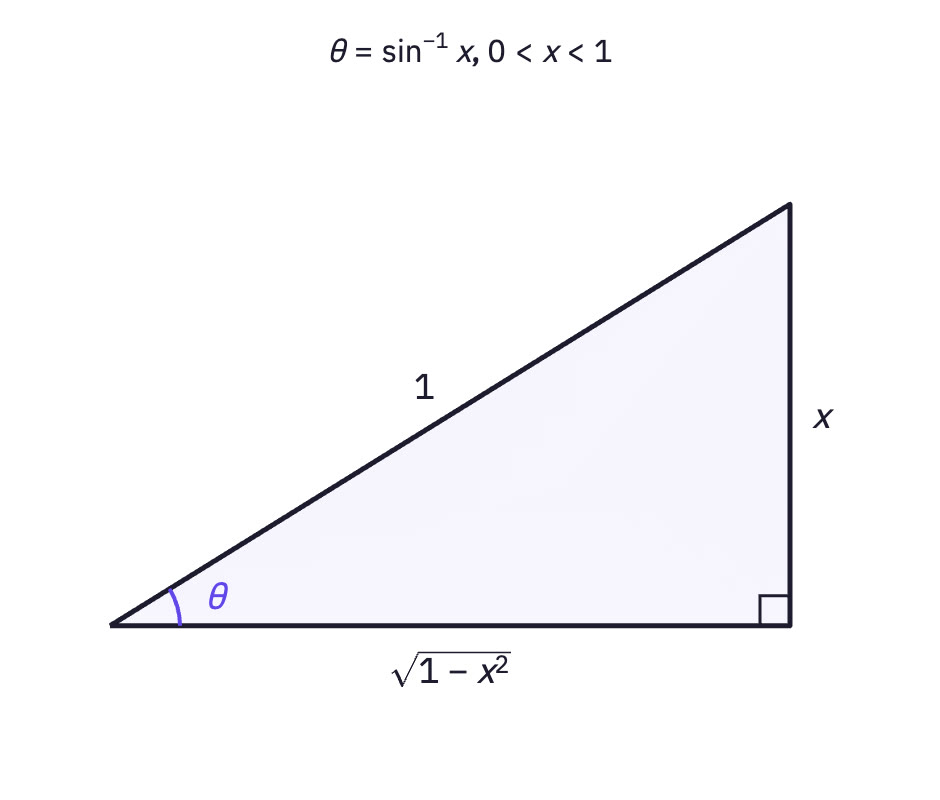
Hypotenuse 1, opposite
For : .
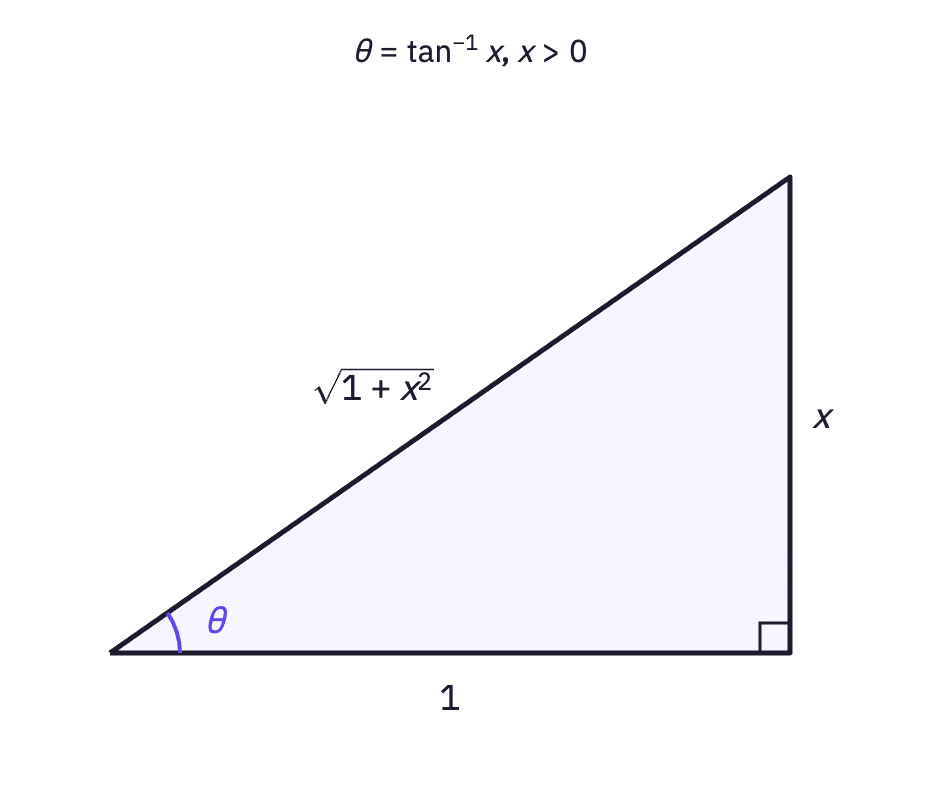
Opposite , adjacent 1
For : .
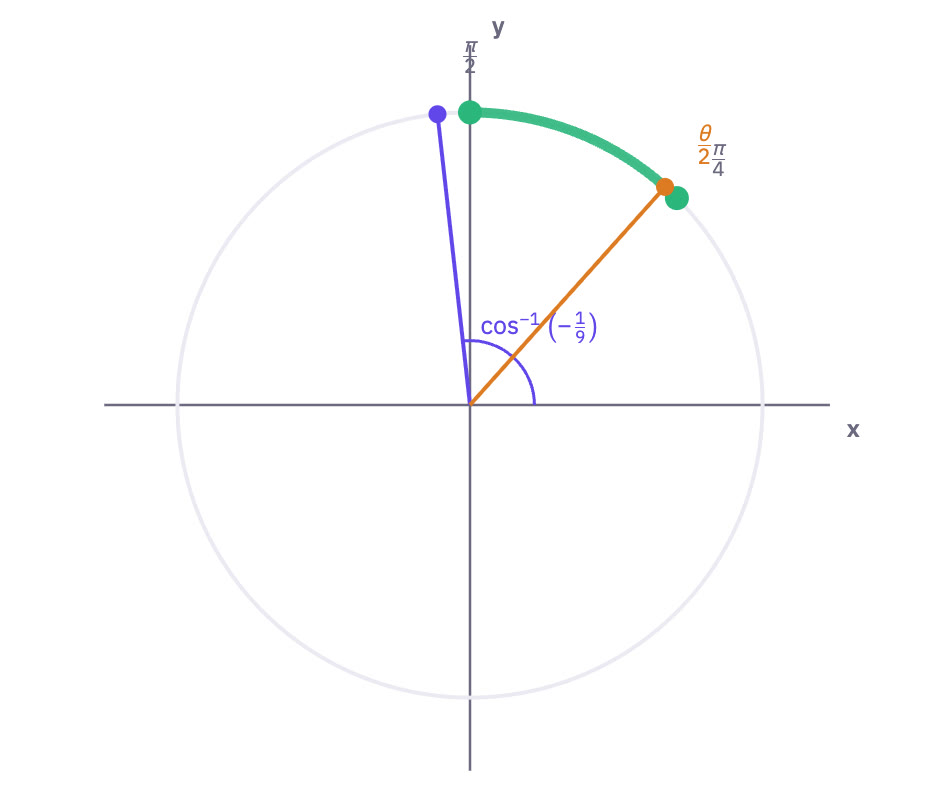
Quadrant decides the sign
, so and .
Key formulas
One for every idea
1. For , simplify .
- .
- : adjacent , opposite 1, so .
- .
.
2. For , express in terms of .
- with , so .
- , since .
.
3. Find (i) (ii) .
- (i) .
- (ii) , so and ; .
(i) (ii) .
4. Solve .
- .
- .
.
Your turn
For x between −1 and 0, sin⁻¹x equals:
Show the answer and the traps
sin⁻¹x is negative there, and −cos⁻¹√(1 − x²) has the right size and sign. Option b.
cos⁻¹√(1 − x²) is positive: the triangle form without the correction.
π − cos⁻¹√(1 − x²) is between π/2 and π: that is the shape of the cos⁻¹ correction, not this one.
cot⁻¹ is never negative, so it can't equal a negative sin⁻¹x.
Common mistakes
Try these
1. Find .
.
2. Find .
.