 layrd.liveLayer by Layer
- 1. Principal Branch
- 2. Graphs & Principal Values
- 3. Domain, Range & Inequalities
- 4. Extreme Values & [x]
- 5. sin⁻¹(sin x), cos⁻¹(cos x)
- 6. tan⁻¹(tan x) & Graphs
- 7. Reference Triangle
- 8. Substitution
- 9. f⁻¹(−x) and f⁻¹(1/x)
- 10. sin⁻¹x + cos⁻¹x = π/2
- 11. Ranges & Extremes
- 12. tan⁻¹ Addition Formula
- 13. 2tan⁻¹x & Equations
- 14. Telescoping Series
- 15. sin⁻¹ and cos⁻¹ Sums
- 16. Multiple-Angle Formulas
- 17. Multiple Angles in Action
Range and Extreme Values Using sin⁻¹x + cos⁻¹x = π/2
Expressions such as or depend on one variable only: put and use . Then complete the square on 's exact interval, and remember which ends of that interval are actually reached.
Builds on: Part 10 · sin⁻¹x + cos⁻¹x = π/2 and the Complementary Identities.
 Video coming soon
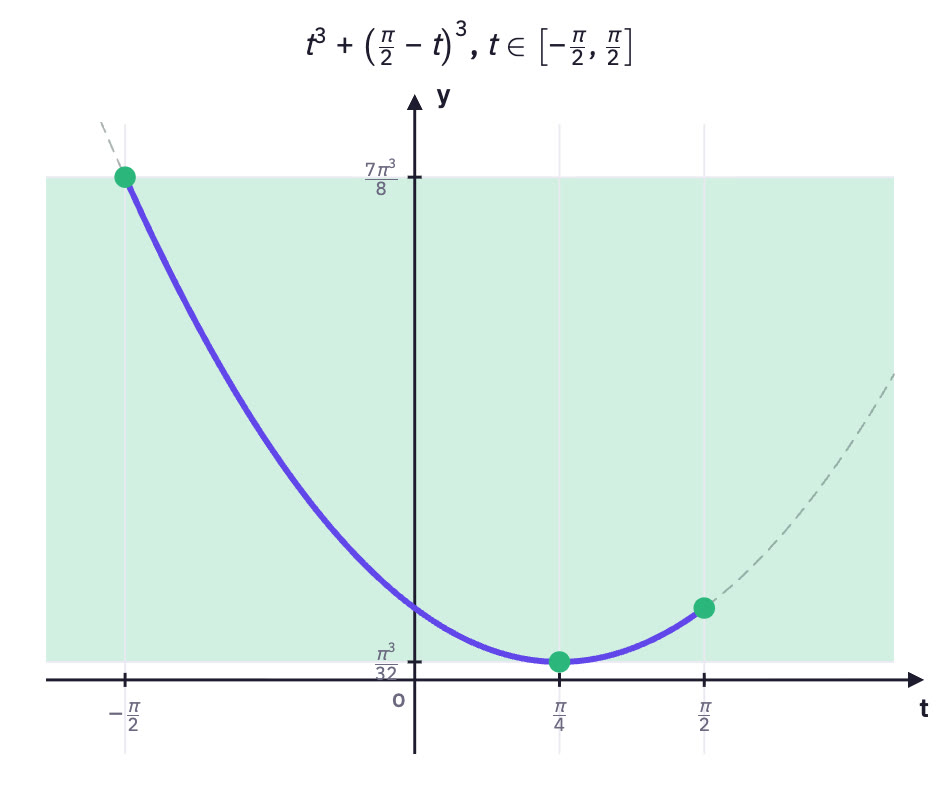
With : , and .
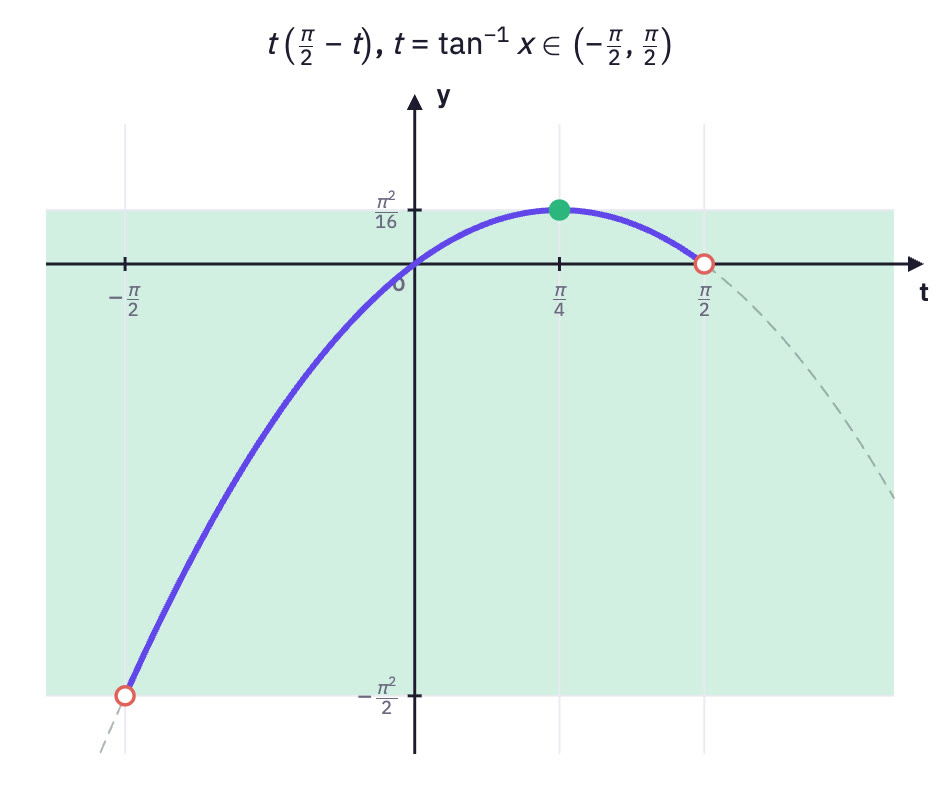
never reaches
. With the range is ; with it is .
on
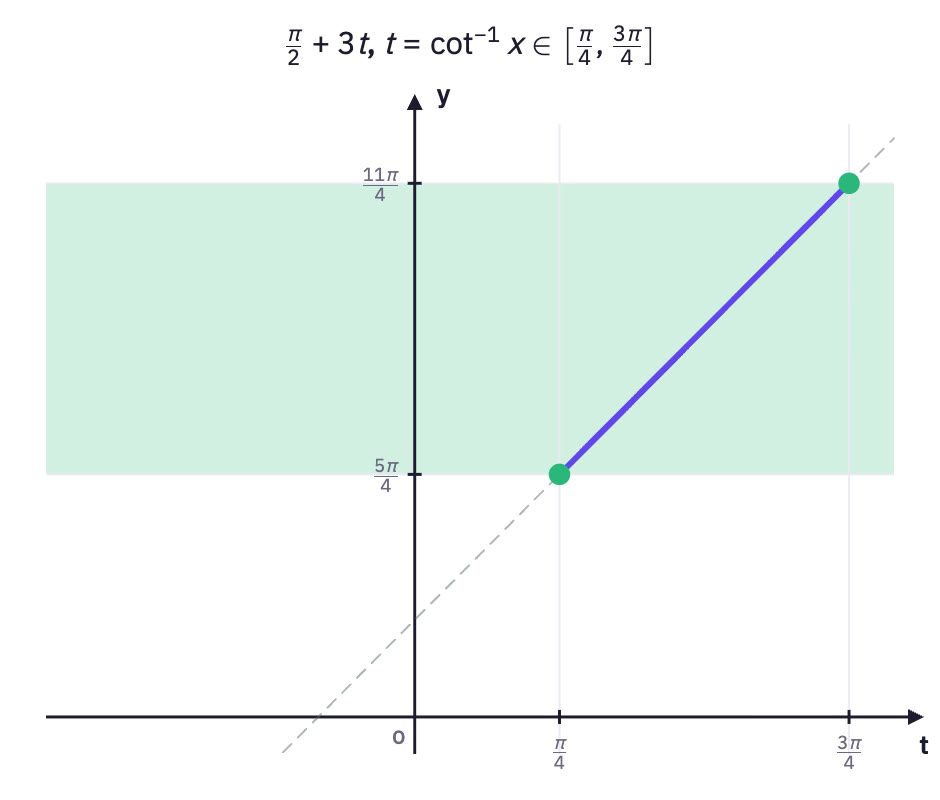
cuts the domain to and leaves one monotonic term.
One for every idea
1. Find the range of .
- , , : .
- , : from to .
- Minimum ; maximum .
.
2. Find the range of , and all for which has a real solution.
- Both equal .
- reaches : range .
- does not: range .
; .
3. Find the range of .
- Domain ; .
- decreases from to on .
.
Your turn
The greatest value of sec⁻¹x · cosec⁻¹x is:
Show the answer and the traps
t = sec⁻¹x, cosec⁻¹x = π/2 − t: t(π/2 − t) peaks at t = π/4, which sec⁻¹ reaches (x = √2). Greatest value π²/16. Option a.
π²/4 squares the sum π/2 instead of its half.
π²/8 is the least value of a sum of squares, not a product.
−π²/2 is the least value, at t = π: not the greatest.
Common mistakes
Try these
1. Find the range of .
: , least at , greatest at : .
2. Find the range of .
on : .