Mathematics › Trigonometry › Inverse Trigonometric Functions · Part 14/17
1. Principal Branch 2. Graphs & Principal Values 3. Domain, Range & Inequalities 4. Extreme Values & [x] 5. sin⁻¹(sin x), cos⁻¹(cos x) 6. tan⁻¹(tan x) & Graphs 7. Reference Triangle 8. Substitution 9. f⁻¹(−x) and f⁻¹(1/x) 10. sin⁻¹x + cos⁻¹x = π/2 11. Ranges & Extremes 12. tan⁻¹ Addition Formula 13. 2tan⁻¹x & Equations 14. Telescoping Series 15. sin⁻¹ and cos⁻¹ Sums 16. Multiple-Angle Formulas 17. Multiple Angles in Action
Inverse Trigonometric Functions · Part 14 of 17
Telescoping tan⁻¹ Series
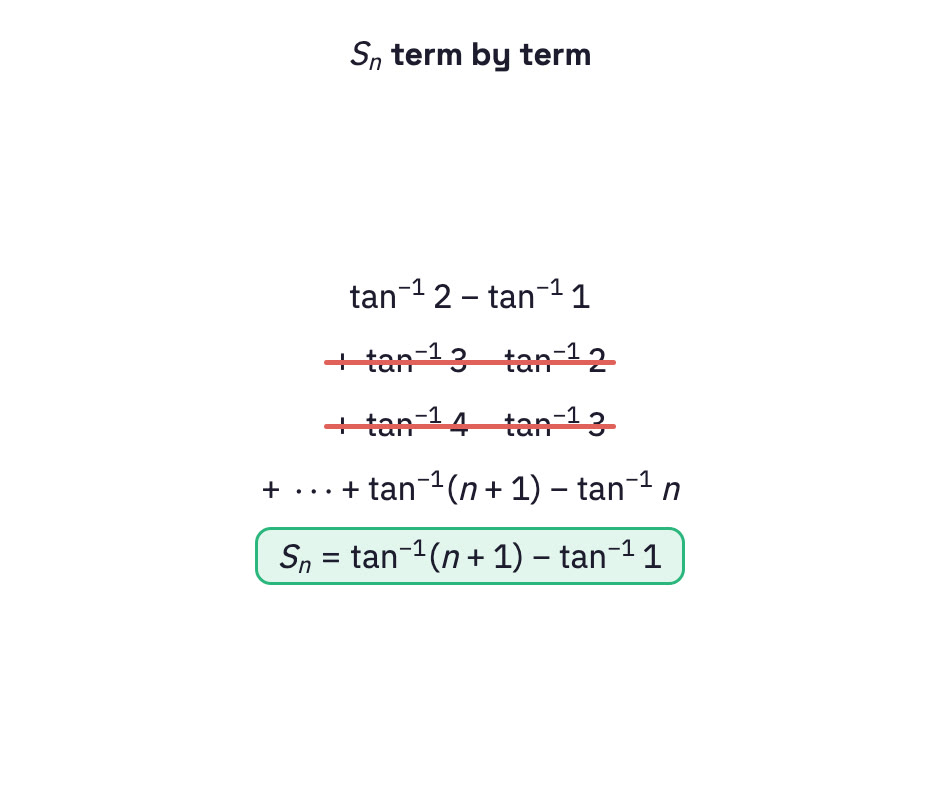
The difference formula read backwards turns a term like tan − 1 1 + r + r 2 1 into tan − 1 ( r + 1 ) − tan − 1 r . Stack the terms and almost everything cancels, leaving a short expression for S n and, as n → ∞ , a limit.
Builds on: Part 13 · 2tan⁻¹x, 3tan⁻¹x and tan⁻¹ Equations .
Video coming soon
Telescoping
Only the ends survive Write the denominator as 1 + ab with a − b equal to the numerator: then the term is tan − 1 a − tan − 1 b (ab > − 1 ). Consecutive terms cancel.
The middle terms cancel in pairs.
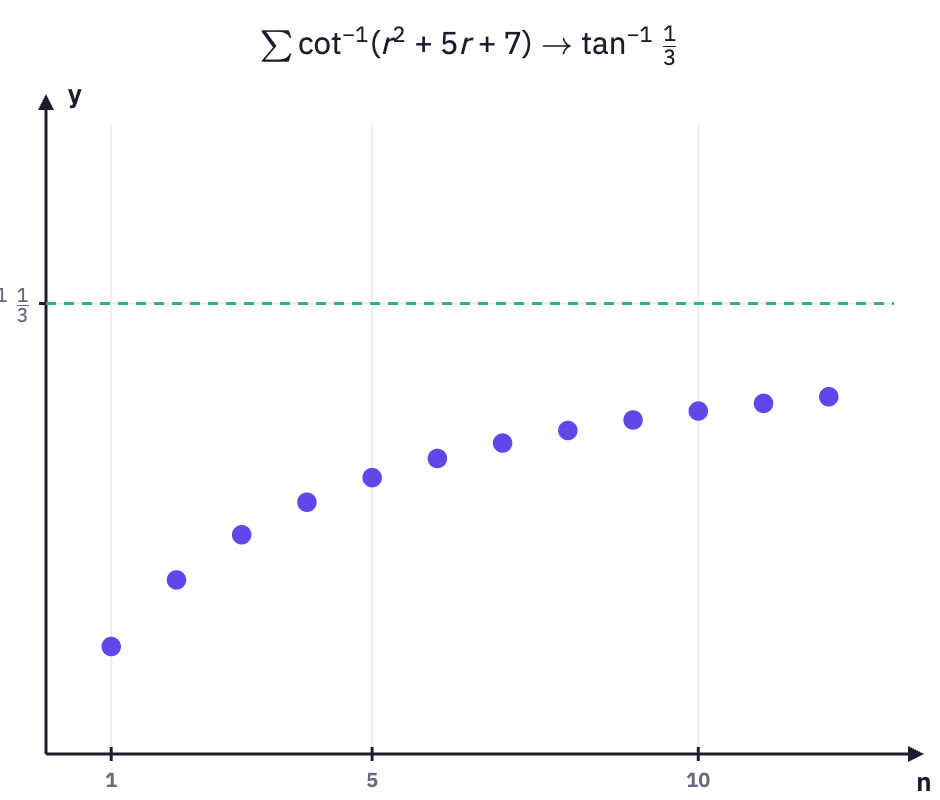
Partial sums approaching the limit.
Sum to infinity
S n → tan − 1 3 1 cot − 1 ( r 2 + 5 r + 7 ) = tan − 1 ( r + 3 ) − tan − 1 ( r + 2 ) , so S n = tan − 1 ( n + 3 ) − tan − 1 3 → 2 π − tan − 1 3 .
Summary
Key formulas
tan − 1 1 + ab a − b = tan − 1 a − tan − 1 b , ab > − 1 Telescoping tan⁻¹ series
Worked examples
One for every idea
Telescoping tan⁻¹ series
1. Find r = 1 ∑ n tan − 1 1 + r + r 2 1 .
1 + r + r 2 = 1 + r ( r + 1 ) , so the term is tan − 1 ( r + 1 ) − tan − 1 r .S n = tan − 1 ( n + 1 ) − tan − 1 1 .S n = tan − 1 ( n + 1 ) − 4 π = tan − 1 n + 2 n .
Telescoping tan⁻¹ series
2. Find r = 1 ∑ ∞ cot − 1 ( r 2 + 5 r + 7 ) .
cot − 1 y = tan − 1 y 1 for y > 0 ; r 2 + 5 r + 7 = 1 + ( r + 2 ) ( r + 3 ) .Term = tan − 1 ( r + 3 ) − tan − 1 ( r + 2 ) , so S n = tan − 1 ( n + 3 ) − tan − 1 3 . n → ∞ : 2 π − tan − 1 3 .cot − 1 3 = tan − 1 3 1 .
JEE-style question
Your turn
The sum Σ (r = 1 to ∞) tan⁻¹(2/(r + 1)²) equals:
(a) 4 π
(b) tan − 1 3
(c) 2 π − tan − 1 2
(d) 2 π
Show the answer and the traps
(r + 1)² = 1 + r(r + 2), and (r + 2) − r = 2: term = tan⁻¹(r + 2) − tan⁻¹r. Two terms survive at each end.
Limit: π/2 + π/2 − tan⁻¹1 − tan⁻¹2 = 3π/4 − tan⁻¹2 = tan⁻¹3. Option b.
π/4 keeps only one surviving term at each end, as if the factors differed by 1.
π/2 − tan⁻¹2 forgets the second π/2 at infinity; π/2 forgets the terms subtracted at the start.
Watch out
Common mistakes
Writing the difference the wrong way round Check that the r = 1 term matches the original term.
One survivor per end when the factors differ by 2 Then two terms survive at each end.
Leaving a cot − 1 term unconverted Use cot − 1 y = tan − 1 y 1 (y > 0 ) first.
Practice
Try these
1. Find r = 1 ∑ ∞ tan − 1 r 2 + 3 r + 3 1 . 1 + ( r + 1 ) ( r + 2 ) : term = tan − 1 ( r + 2 ) − tan − 1 ( r + 1 ) ; sum = 2 π − tan − 1 2 = tan − 1 2 1 .
2. Find r = 1 ∑ n tan − 1 1 + r 2 ( r 2 − 1 ) 2 r . ( r 2 + r ) − ( r 2 − r ) = 2 r and ( r 2 + r ) ( r 2 − r ) = r 2 ( r 2 − 1 ) , so the term is tan − 1 ( r 2 + r ) − tan − 1 ( r 2 − r ) ; since r 2 − r = ( r − 1 ) 2 + ( r − 1 ) , S n = tan − 1 ( n 2 + n ) .