Mathematics › Trigonometry › Inverse Trigonometric Functions · Part 15/17
1. Principal Branch 2. Graphs & Principal Values 3. Domain, Range & Inequalities 4. Extreme Values & [x] 5. sin⁻¹(sin x), cos⁻¹(cos x) 6. tan⁻¹(tan x) & Graphs 7. Reference Triangle 8. Substitution 9. f⁻¹(−x) and f⁻¹(1/x) 10. sin⁻¹x + cos⁻¹x = π/2 11. Ranges & Extremes 12. tan⁻¹ Addition Formula 13. 2tan⁻¹x & Equations 14. Telescoping Series 15. sin⁻¹ and cos⁻¹ Sums 16. Multiple-Angle Formulas 17. Multiple Angles in Action
Inverse Trigonometric Functions · Part 15 of 17
Sum and Difference of sin⁻¹ and cos⁻¹
sin ( A + B ) is easy to write down, but sin − 1 returns A + B only while the sum is at most 2 π . For x , y ≥ 0 that is exactly the condition x 2 + y 2 ≤ 1 . Sums of cos − 1 need no check at all; their differences depend on which argument is larger.
Builds on: Part 14 · Telescoping tan⁻¹ Series .
Video coming soon
Derivation
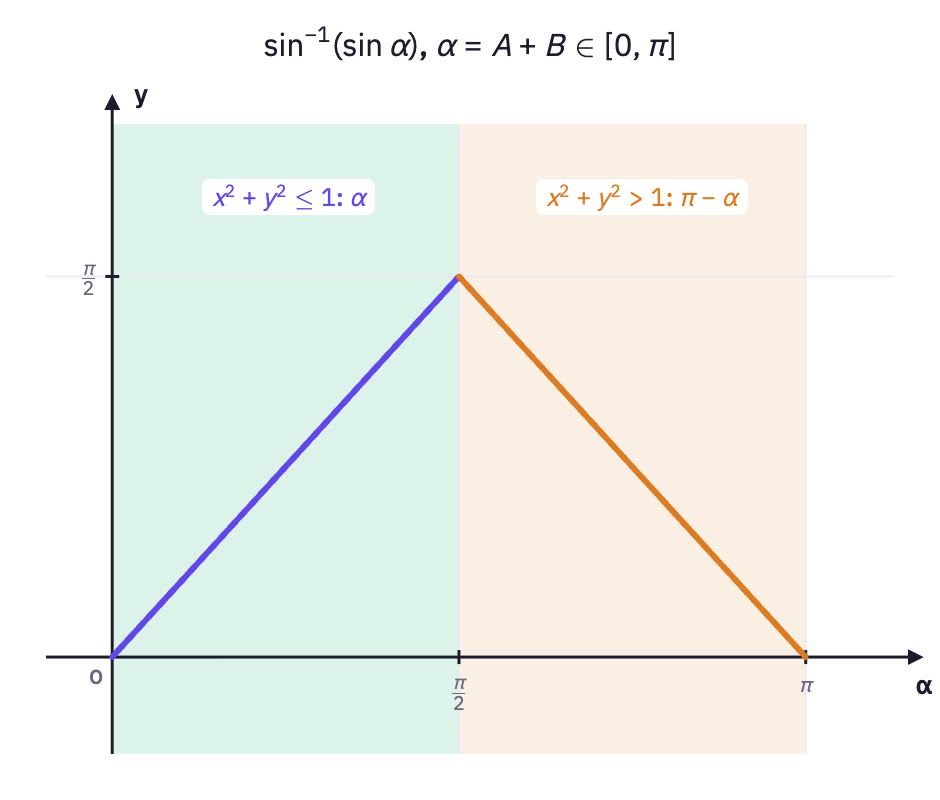
Split at α = 2 π For x , y ≥ 0 : A + B ∈ [ 0 , π ] , and A + B ≤ 2 π ⇔ y ≤ cos A = 1 − x 2 ⇔ x 2 + y 2 ≤ 1 . Beyond, sin − 1 ( sin α ) = π − α .
sin⁻¹(sin α) on [0, π].
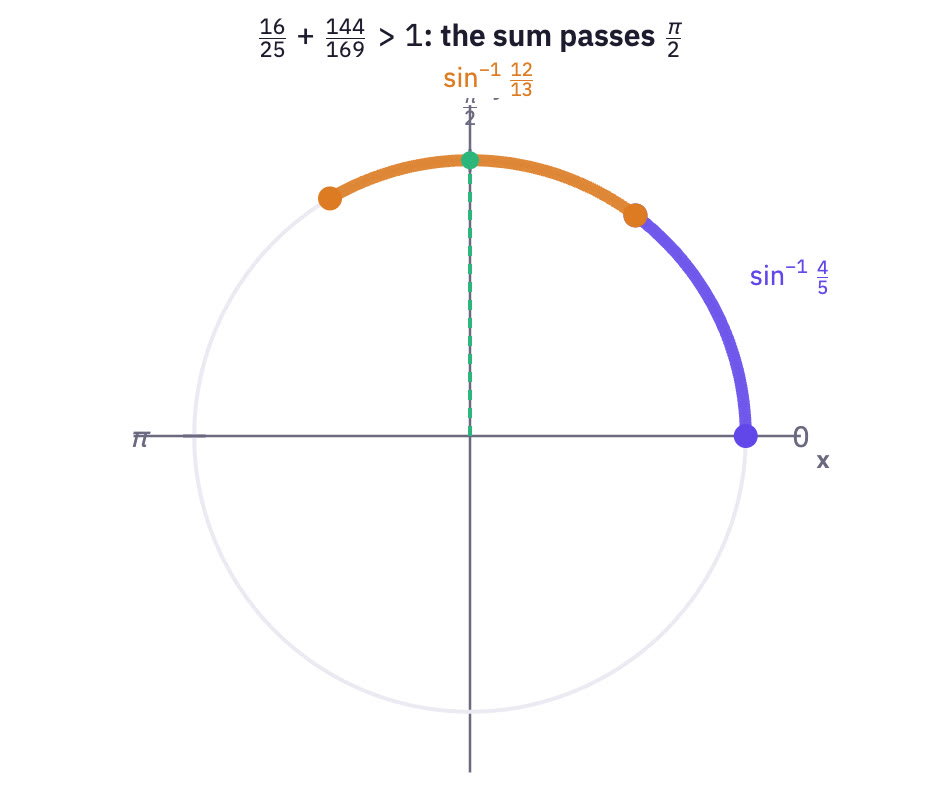
Two arcs passing the π/2 mark.
Acute or obtuse?
sin − 1 5 4 + sin − 1 13 12 25 16 + 169 144 > 1 , so the two acute angles add to more than 2 π : the sum is π − sin − 1 65 56 .
Summary
Key formulas
sin − 1 x + sin − 1 y = sin − 1 ( x 1 − y 2 + y 1 − x 2 ) , x 2 + y 2 ≤ 1 Formulas with their conditions
= π − sin − 1 ( x 1 − y 2 + y 1 − x 2 ) , x 2 + y 2 > 1 Formulas with their conditions
cos − 1 x + cos − 1 y = cos − 1 ( x y − 1 − x 2 1 − y 2 ) Formulas with their conditions
cos − 1 x − cos − 1 y = ± cos − 1 ( x y + 1 − x 2 1 − y 2 ) ( x ≤ y / x > y ) Formulas with their conditions
Worked examples
One for every idea
Formulas with their conditions
1. Find (i) sin − 1 5 4 + sin − 1 13 5 (ii) sin − 1 5 4 + sin − 1 13 12 (iii) cos − 1 5 4 − cos − 1 13 12 .
(i) 25 16 + 169 25 < 1 : sin − 1 ( 5 4 ⋅ 13 12 + 13 5 ⋅ 5 3 ) = sin − 1 65 63 . (ii) 25 16 + 169 144 > 1 : π − sin − 1 ( 5 4 ⋅ 13 5 + 13 12 ⋅ 5 3 ) = π − sin − 1 65 56 . (iii) 5 4 ≤ 13 12 : cos − 1 ( 5 4 ⋅ 13 12 + 5 3 ⋅ 13 5 ) . (i) sin − 1 65 63 (ii) π − sin − 1 65 56 (iii) cos − 1 65 63 .
Equations and comparisons
2. Solve sin − 1 x + sin − 1 2 x = 3 π .
The left side increases and is 0 at x = 0 , so x > 0 . α = sin − 1 x : 2 x = sin ( 3 π − α ) = 2 3 1 − x 2 − 2 x .2 5 x = 2 3 1 − x 2 ⇒ 25 x 2 = 3 − 3 x 2 .x = 28 3 = 14 21 .
Telescoping with sin⁻¹ and cos⁻¹
3. Find k = 1 ∑ n [ cos − 1 k + 1 1 − cos − 1 k 1 ] and its limit as n → ∞ .
The terms telescope: S n = cos − 1 n + 1 1 − cos − 1 1 = cos − 1 n + 1 1 . cos − 1 n + 1 1 , tending to 2 π .
JEE-style question
Your turn
sin⁻¹(3/5) + sin⁻¹(15/17) equals:
(a) sin − 1 85 84
(b) π − sin − 1 85 84
(c) π + sin − 1 85 84
(d) sin − 1 85 84 − π
Show the answer and the traps
9/25 + 225/289 > 1, so the sum is obtuse: π − sin⁻¹((3/5)(8/17) + (15/17)(4/5)) = π − sin⁻¹(84/85). Option b.
sin⁻¹(84/85) skips the check and gives an acute angle.
π + sin⁻¹(84/85) is above π, but two acute angles add to less than π.
sin⁻¹(84/85) − π is negative: impossible for a sum of positive angles.
Watch out
Common mistakes
Skipping the x 2 + y 2 ≤ 1 check for a sin − 1 sum When x 2 + y 2 > 1 the sum is π minus the formula.
Keeping the wrong-sign root after squaring Squaring adds roots; check each in the original.
Practice
Try these
1. Find cos − 1 5 3 + cos − 1 13 12 . cos − 1 ( 65 36 − 65 20 ) = cos − 1 65 16 .
2. Solve sin − 1 x − cos − 1 x = sin − 1 ( 3 x − 2 ) . 2 sin − 1 x − 2 π = sin − 1 ( 3 x − 2 ) ; taking sin : − cos ( 2 sin − 1 x ) = 2 x 2 − 1 = 3 x − 2 ⇒ x = 1 or 2 1 ; both check (2 π = 2 π , − 6 π = − 6 π ).
3. Which is larger: sin − 1 3 1 + sin − 1 3 2 or 2 π ? 9 1 + 9 4 < 1 , so the sum is acute: 2 π is larger.