 layrd.liveLayer by Layer
- 1. Principal Branch
- 2. Graphs & Principal Values
- 3. Domain, Range & Inequalities
- 4. Extreme Values & [x]
- 5. sin⁻¹(sin x), cos⁻¹(cos x)
- 6. tan⁻¹(tan x) & Graphs
- 7. Reference Triangle
- 8. Substitution
- 9. f⁻¹(−x) and f⁻¹(1/x)
- 10. sin⁻¹x + cos⁻¹x = π/2
- 11. Ranges & Extremes
- 12. tan⁻¹ Addition Formula
- 13. 2tan⁻¹x & Equations
- 14. Telescoping Series
- 15. sin⁻¹ and cos⁻¹ Sums
- 16. Multiple-Angle Formulas
- 17. Multiple Angles in Action
Multiple-Angle Formulas: Evaluating and Solving
With every case of the multiple-angle formulas in hand, problems become routine: look at , pick the case, then compute. In equations, expressions like and are in disguise, valid on a known range that becomes part of the answer.
Builds on: Part 16 · 2sin⁻¹x, 3sin⁻¹x, 2cos⁻¹x, 2tan⁻¹x: Where Each Case Comes From.
 Video coming soon
on each piece
form: (), (), (). form: (), (). Both equal on .
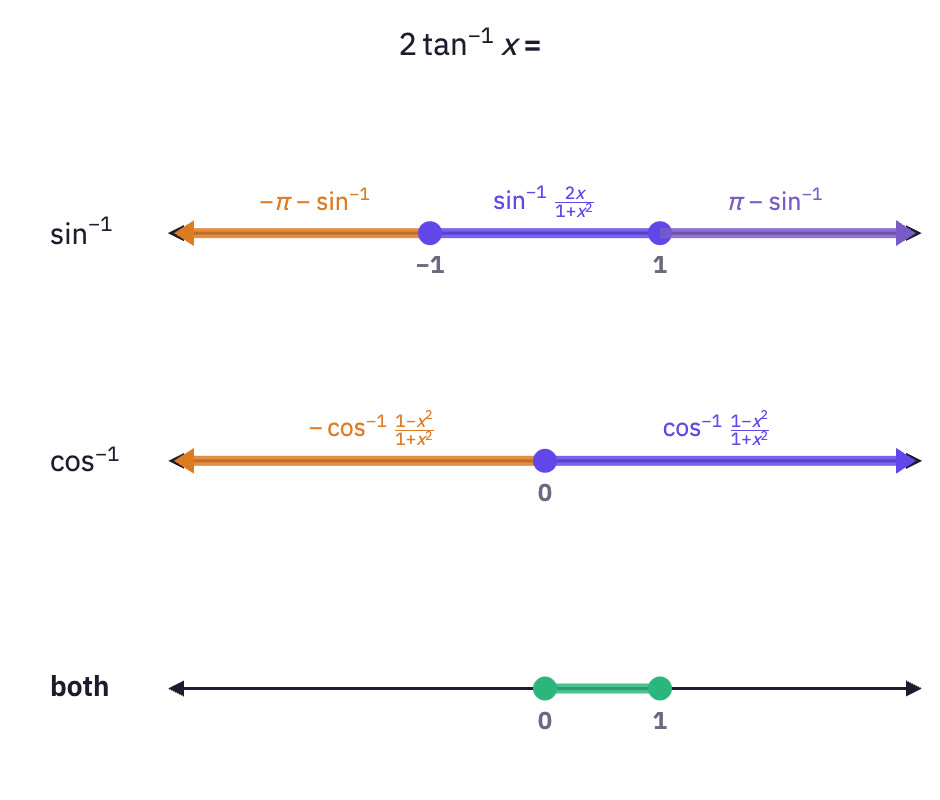
fixes both cases
For : and , so the difference is .
One for every idea
1. (i) Write using . (ii) Evaluate at using the formula. (iii) Find .
- (i) with : .
- (ii) : .
- (iii) ; .
(i) (ii) (iii) .
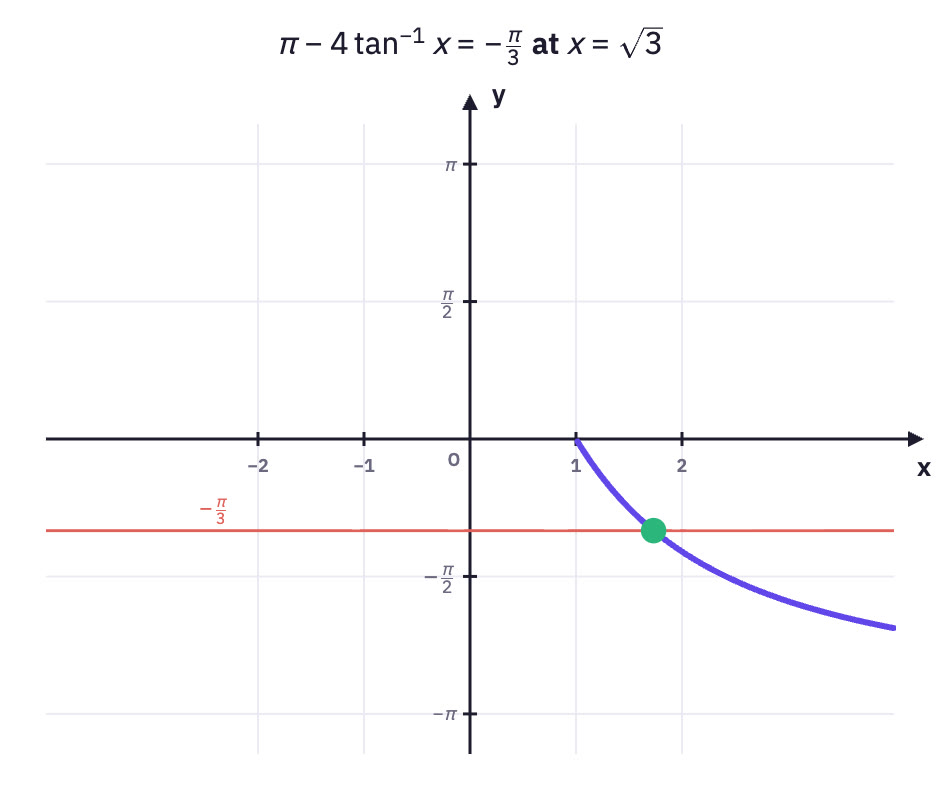
2. For , solve .
- : ; : .
- .
(which is ).
3. If and , solve .
- : the right side is .
- since .
.
Your turn
For negative x, cos⁻¹((1 − x²)/(1 + x²)) equals:
Show the answer and the traps
cos⁻¹(cos 2θ) = |2θ|, and 2θ = 2tan⁻¹x is negative here, so the answer is −2tan⁻¹x. Option a.
2tan⁻¹x is negative for x < 0, but cos⁻¹ never is.
π − 2tan⁻¹x is above π: outside the range of cos⁻¹.
π + 2tan⁻¹x works only at x = −1 by coincidence: at x = −1/√3 it gives 2π/3, not π/3.
Common mistakes
Try these
1. For , solve .
Both terms equal : , .
2. Evaluate .
with , (): the value is .
3. Simplify for .
.