 layrd.liveLayer by Layer
Inverse Trigonometric Functions
Seventeen connected videos that build inverse trigonometric functions layer by layer: why each trig function must be cut to a principal branch, the six graphs, domains and ranges of composite expressions, the zig-zag and tent graphs of f⁻¹(f(x)), conversions and substitutions, the identities for −x, 1/x and complementary pairs, the tan⁻¹, sin⁻¹ and cos⁻¹ sum formulas with their cases, telescoping series, and the multiple-angle formulas. Every subtopic has a worked example in the video and on its page; the formula sheet, revision sheet and practice set cover the whole chapter.
Learning path · Formula sheet · Practice set
Print and revise: Revision sheet (PDF) · Formula sheet (PDF, one page)
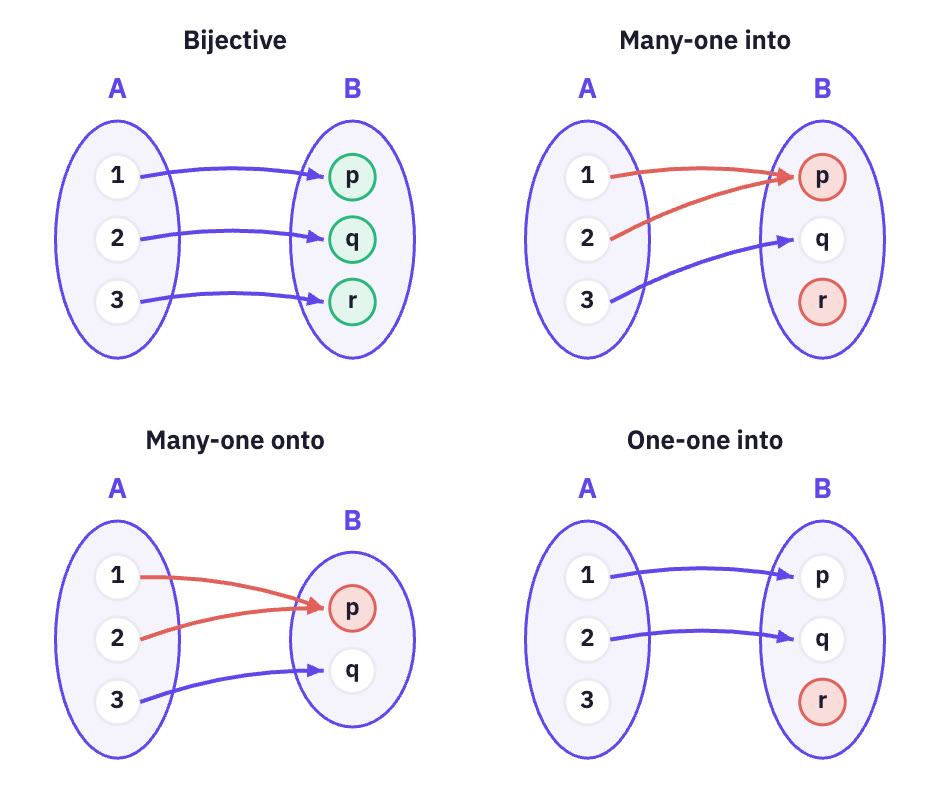
Why Inverse Trig Needs a Principal Value Branch
See why only a bijection has an inverse, restrict each trig function to its principal value branch, and learn all six domains and principal ranges.
Inverse exists only for a bijection · Principal value branch · Domains and principal ranges of all six · Arc functions
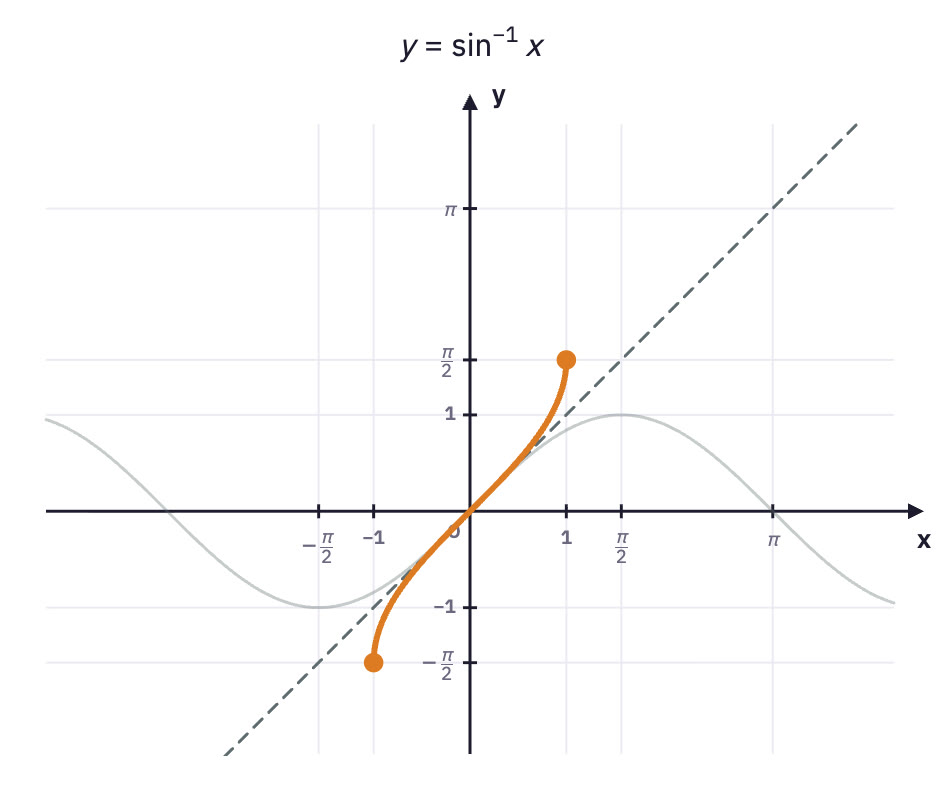
Graphs of Inverse Trig Functions and Principal Values
Draw the six inverse trig graphs as reflections in y = x, and evaluate principal values, including negative inputs.
Graph of f⁻¹ as a mirror in y = x · Increasing and decreasing inverse functions · Asymptotes of tan⁻¹ and cot⁻¹ · Principal values of negative inputs
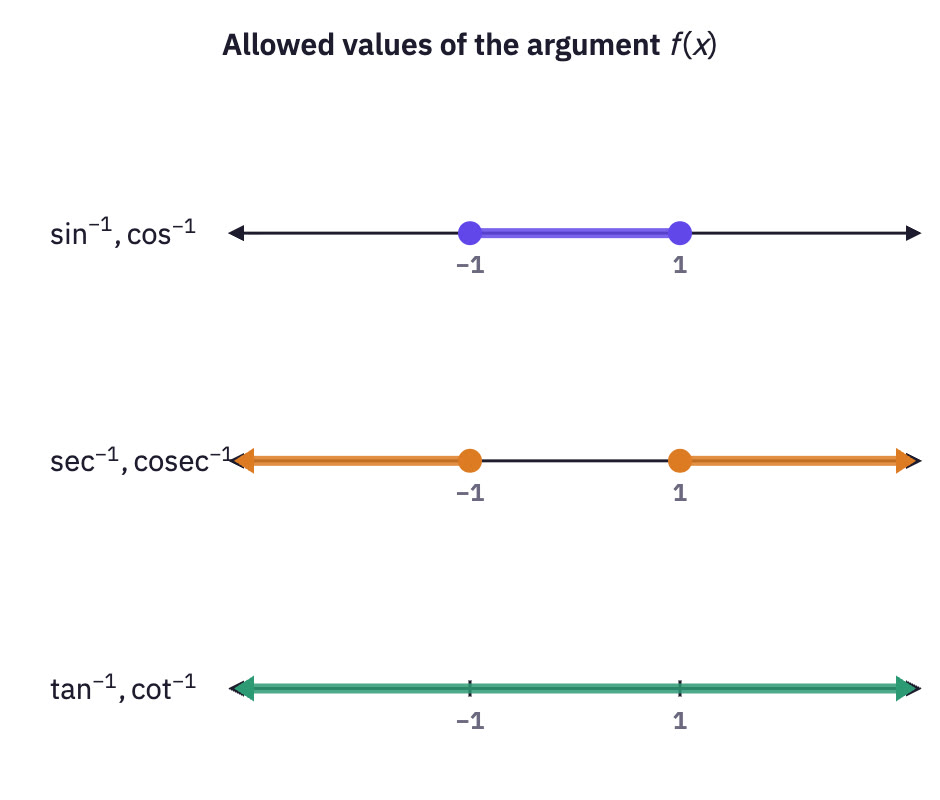
Domain, Range and Inequalities of Inverse Trig Expressions
Find domains of composite inverse trig expressions, solve inequalities with monotonicity, and find ranges by carrying the inner range through the outer function.
Domain of sin⁻¹f(x), sec⁻¹f(x), tan⁻¹f(x) · Inequalities: sign kept or flipped · Range of composite expressions
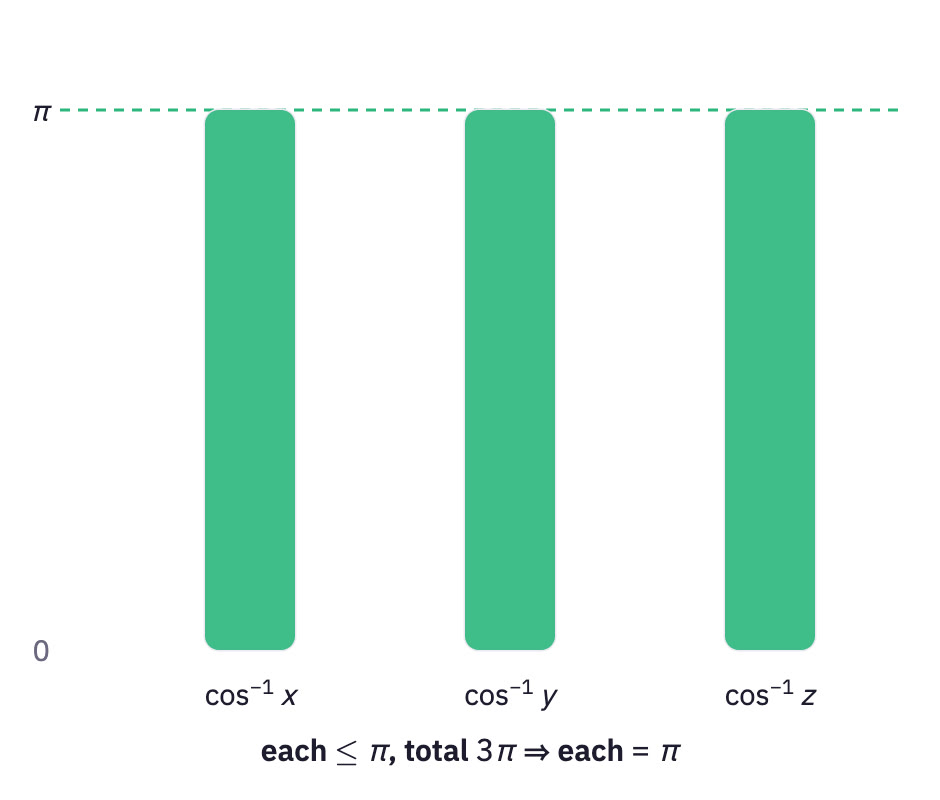
Extreme-Value and Greatest Integer Equations in Inverse Trig
Solve equations that force every inverse trig term to its extreme value, and equations with the greatest integer function by cases.
Sums at their maximum · Expressions defined at one point · Greatest integer of sin⁻¹x, cos⁻¹x, tan⁻¹x
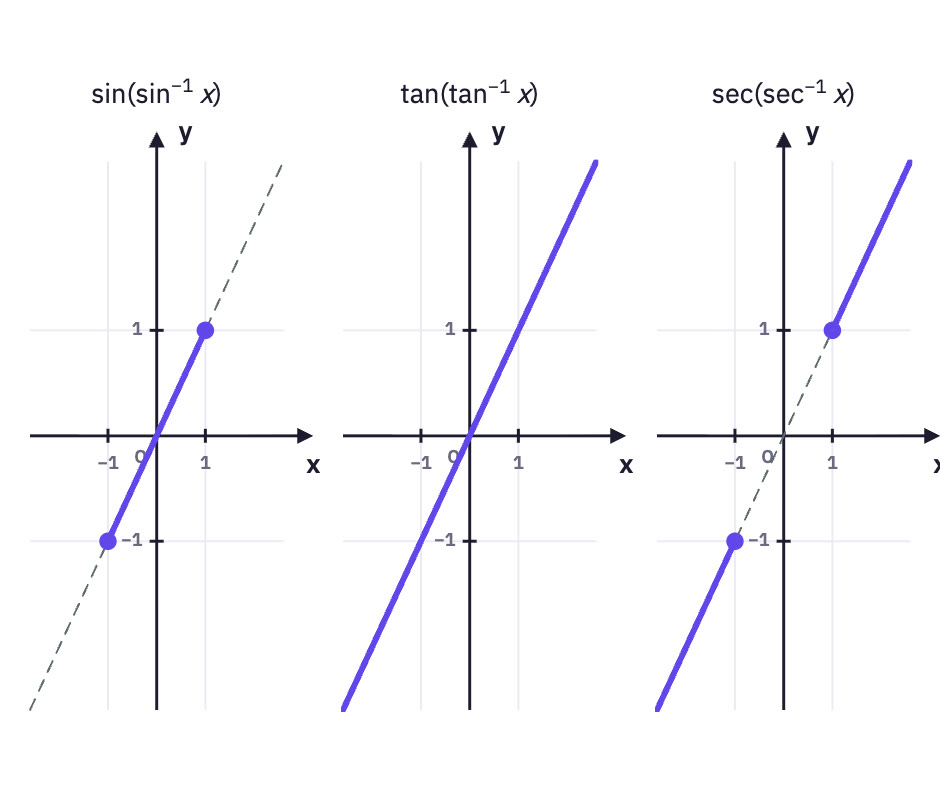
sin⁻¹(sin x) and cos⁻¹(cos x): Zig-Zag and Tent Graphs
Simplify f(f⁻¹(x)), then draw sin⁻¹(sin x) and cos⁻¹(cos x) piece by piece and use them to evaluate values like sin⁻¹(sin 10).
f(f⁻¹(x)) and its domain · Zig-zag graph of sin⁻¹(sin x) · Tent graph of cos⁻¹(cos x) · Evaluating with π ≈ 3.14
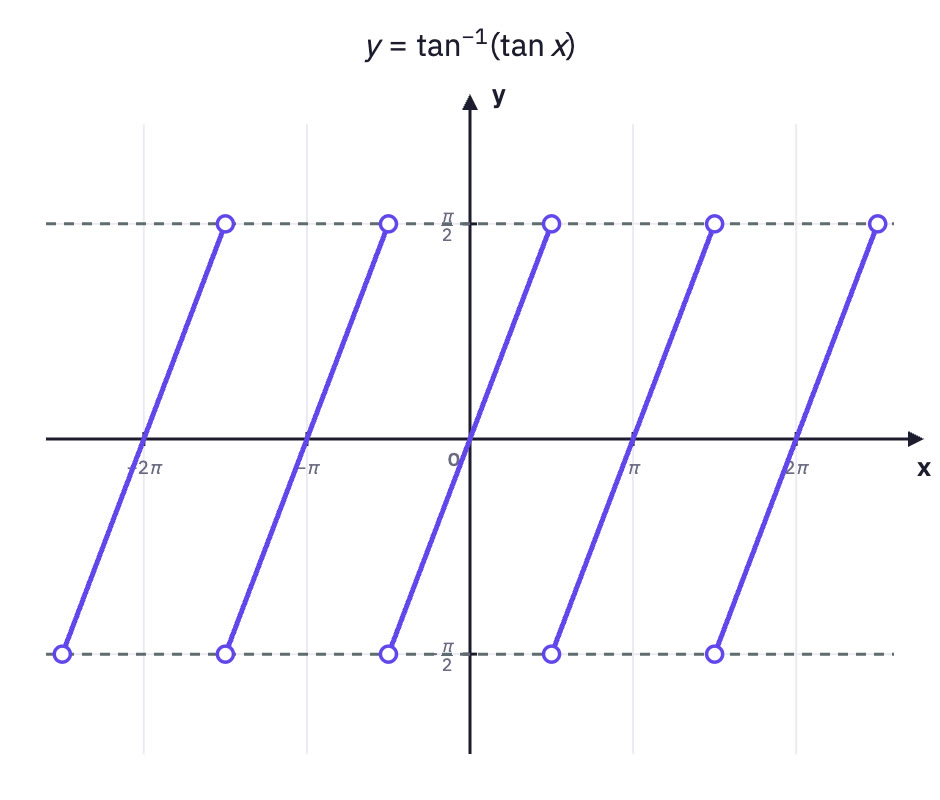
tan⁻¹(tan x), cot⁻¹(cot x), sec⁻¹(sec x) and Solving with Graphs
Draw tan⁻¹(tan x), cot⁻¹(cot x), sec⁻¹(sec x) and cosec⁻¹(cosec x), then solve equations and count solutions from the graphs.
tan⁻¹(tan x) = x − nπ · cot⁻¹(cot x) and its holes · sec⁻¹(sec x), cosec⁻¹(cosec x) · Counting solutions graphically
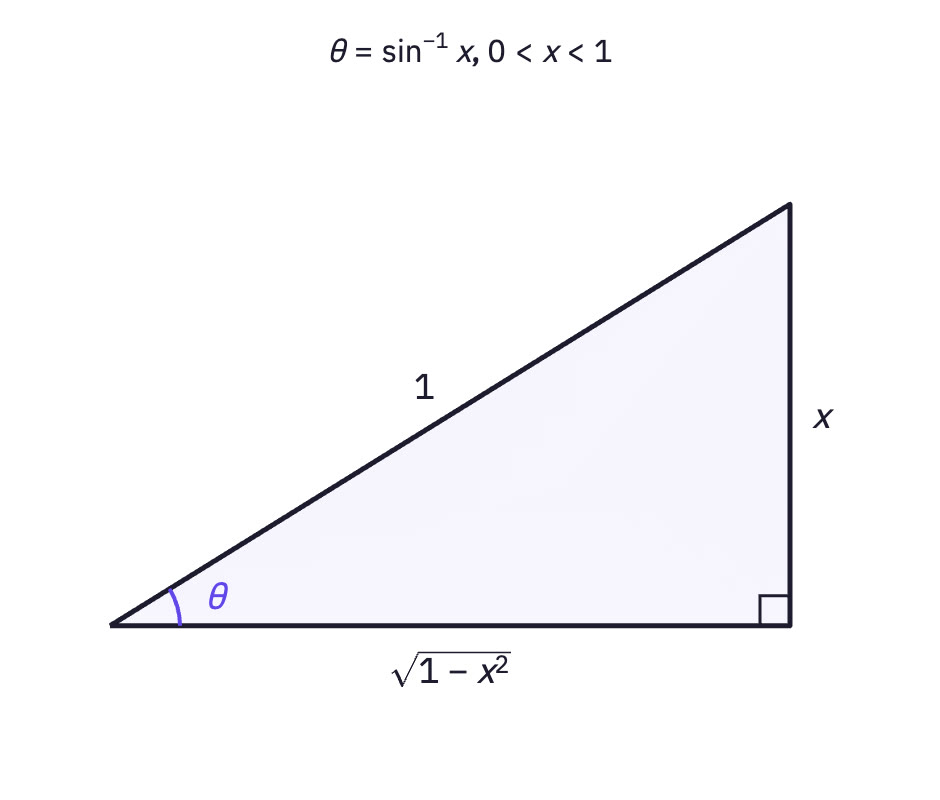
The Reference Triangle: Converting Inverse Trig Functions
Convert one inverse function into another with a right triangle, handle negative x, and find trig ratios of inverse-trig angles.
Reference triangle for sin⁻¹x and tan⁻¹x · Conversions for negative x · cos 2θ, sin(θ/2) of θ = f⁻¹(x)
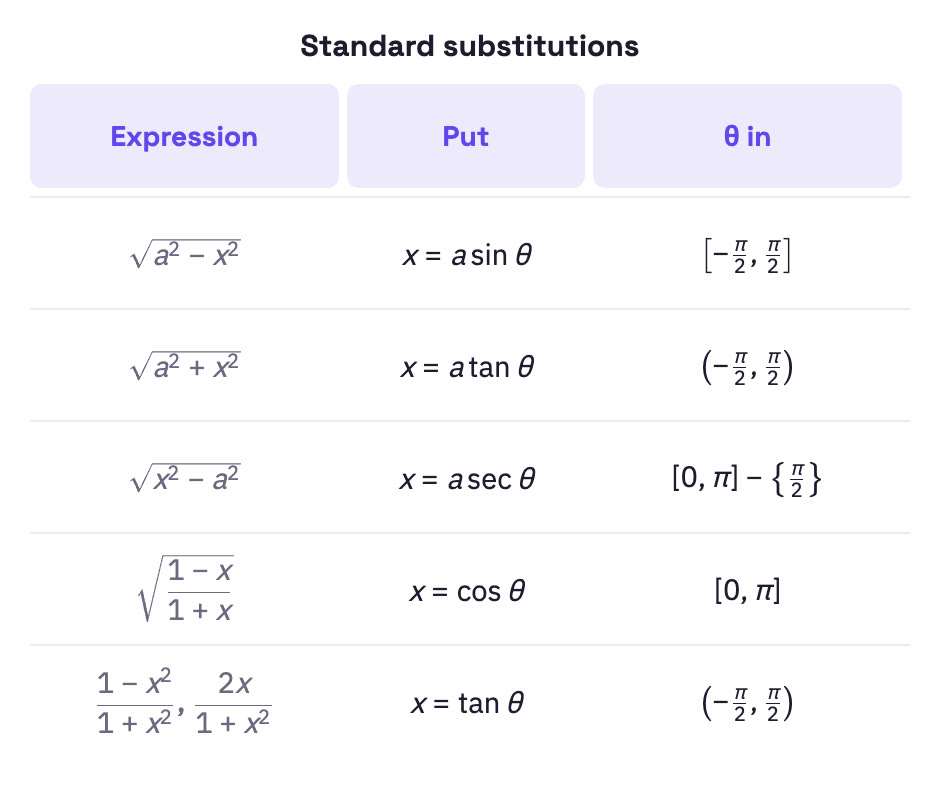
Simplifying Inverse Trig Expressions by Substitution
Simplify nested expressions with x = sin θ, cos θ or tan θ, turning the x-interval into a θ-interval and shifting the angle when it leaves the principal range.
Standard substitutions · x-interval to θ-interval · Shifting out-of-range angles
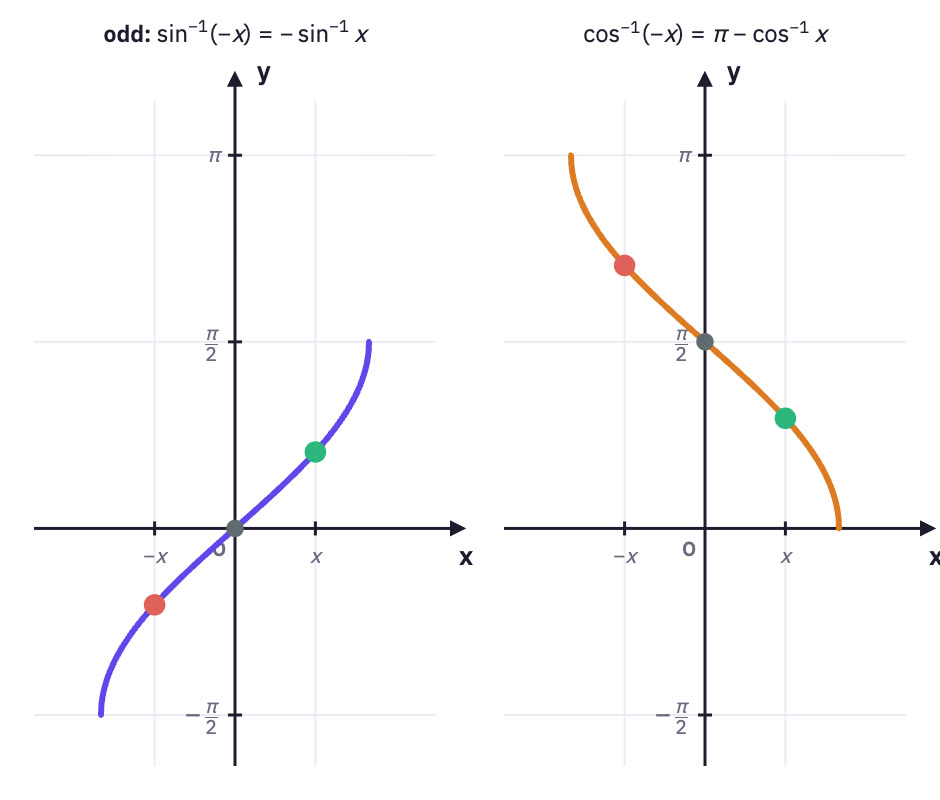
Inverse Trig of −x and 1/x
Prove and use f⁻¹(−x) for all six functions, and the reciprocal identities, including the case split for tan⁻¹(1/x).
Odd inverse functions · f⁻¹(−x) = π − f⁻¹(x) · sin⁻¹(1/x) = cosec⁻¹x · tan⁻¹(1/x) for x < 0
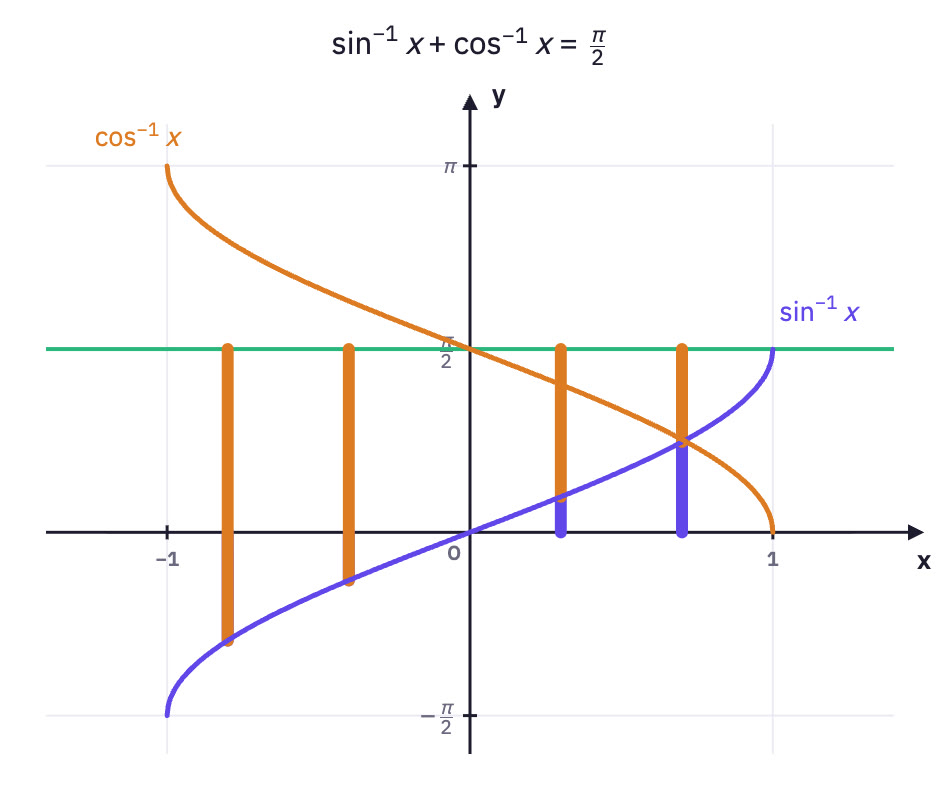
sin⁻¹x + cos⁻¹x = π/2 and the Complementary Identities
Prove the three complementary identities and use them to evaluate, solve equations and solve inequalities with one unknown.
sin⁻¹x + cos⁻¹x = π/2 · tan⁻¹x + cot⁻¹x = π/2 · sec⁻¹x + cosec⁻¹x = π/2 · Inequalities with complementary pairs
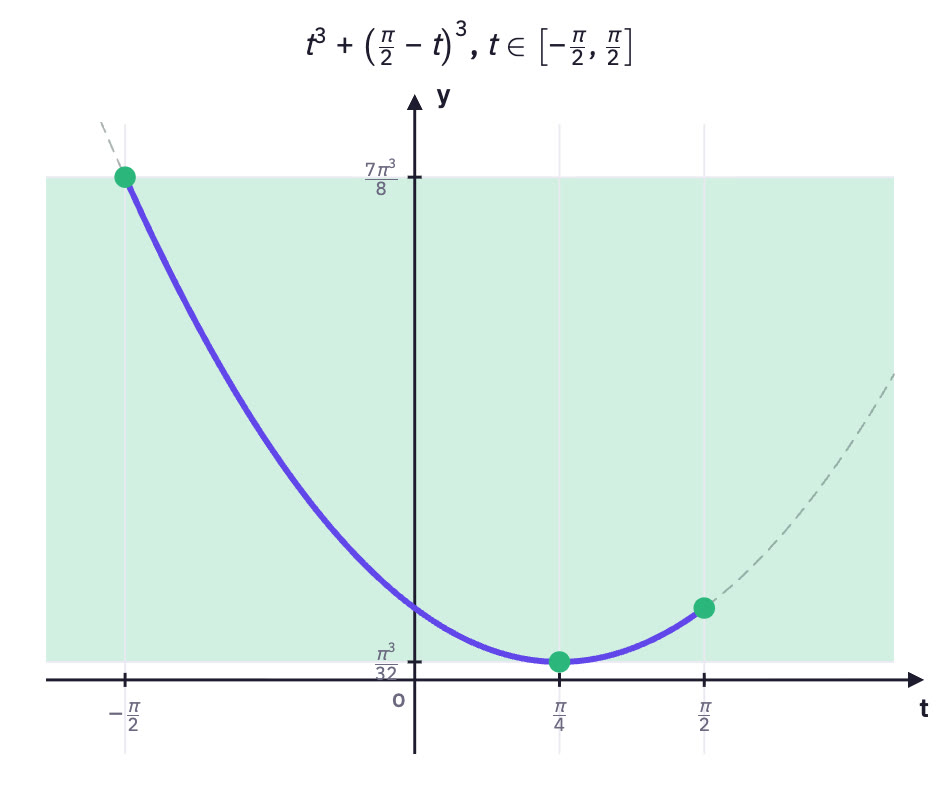
Range and Extreme Values Using sin⁻¹x + cos⁻¹x = π/2
Write expressions in one variable t = sin⁻¹x or tan⁻¹x, complete the square on t's interval and read off the range, open ends included.
One-variable substitution t = sin⁻¹x · Completing the square on an interval · Open range ends for tan⁻¹
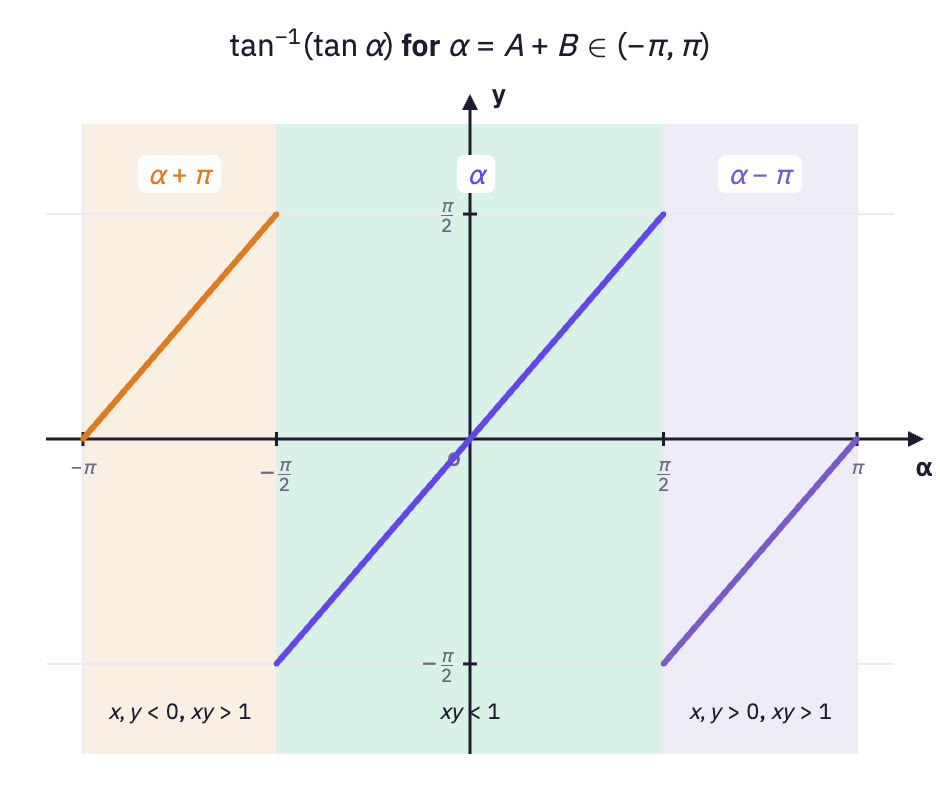
tan⁻¹x + tan⁻¹y: The Addition Formula and Its Cases
Derive tan⁻¹x ± tan⁻¹y with all its cases, then use it to evaluate and prove tan⁻¹ identities, including Machin-type ones.
tan⁻¹x + tan⁻¹y for xy < 1 and xy > 1 · Difference formula · Proving tan⁻¹ identities · Machin's formula
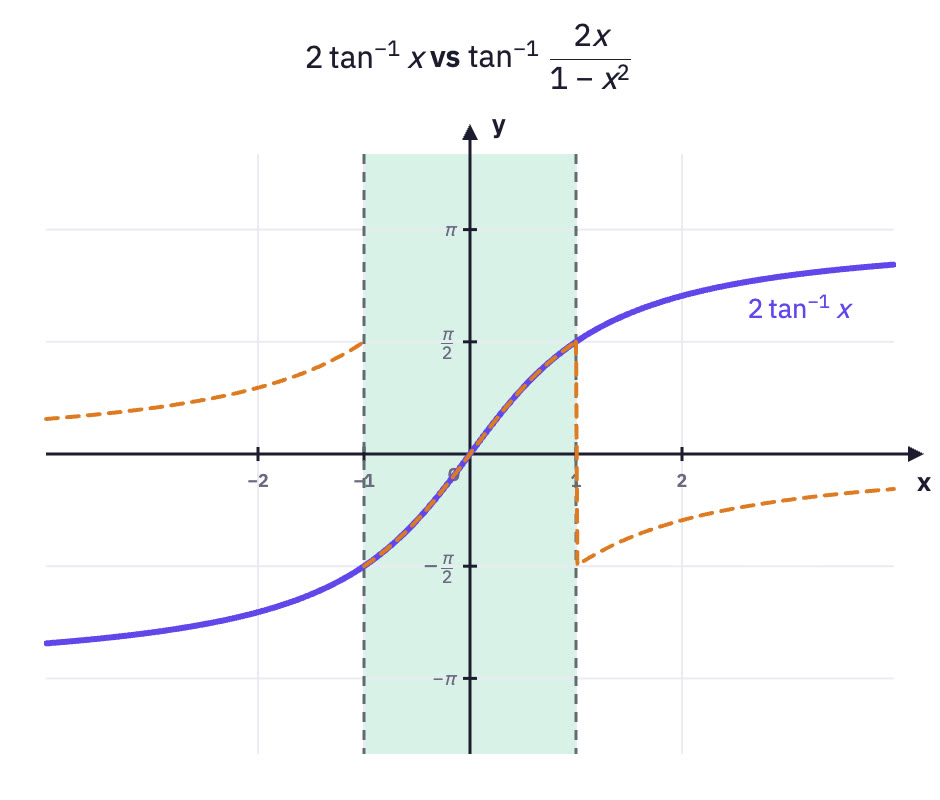
2tan⁻¹x, 3tan⁻¹x and tan⁻¹ Equations
Write 2tan⁻¹x and 3tan⁻¹x in tan⁻¹ form with their cases, and solve tan⁻¹ equations, rejecting the extra roots.
2tan⁻¹x with cut points ±1 · 3tan⁻¹x with cut points ±1/√3 · Rejecting extra roots · Integer solutions
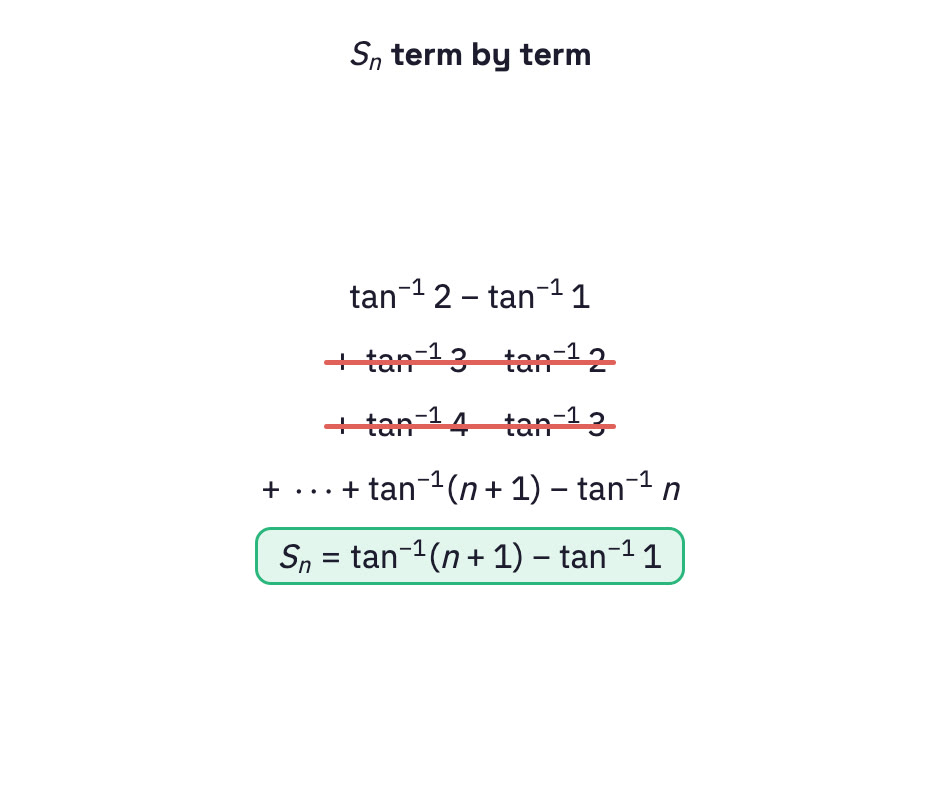
Telescoping tan⁻¹ Series
Write each term as tan⁻¹a − tan⁻¹b so the series collapses, then sum to n terms and to infinity.
tan⁻¹((a − b)/(1 + ab)) = tan⁻¹a − tan⁻¹b · cot⁻¹ terms as tan⁻¹ · Sum to infinity
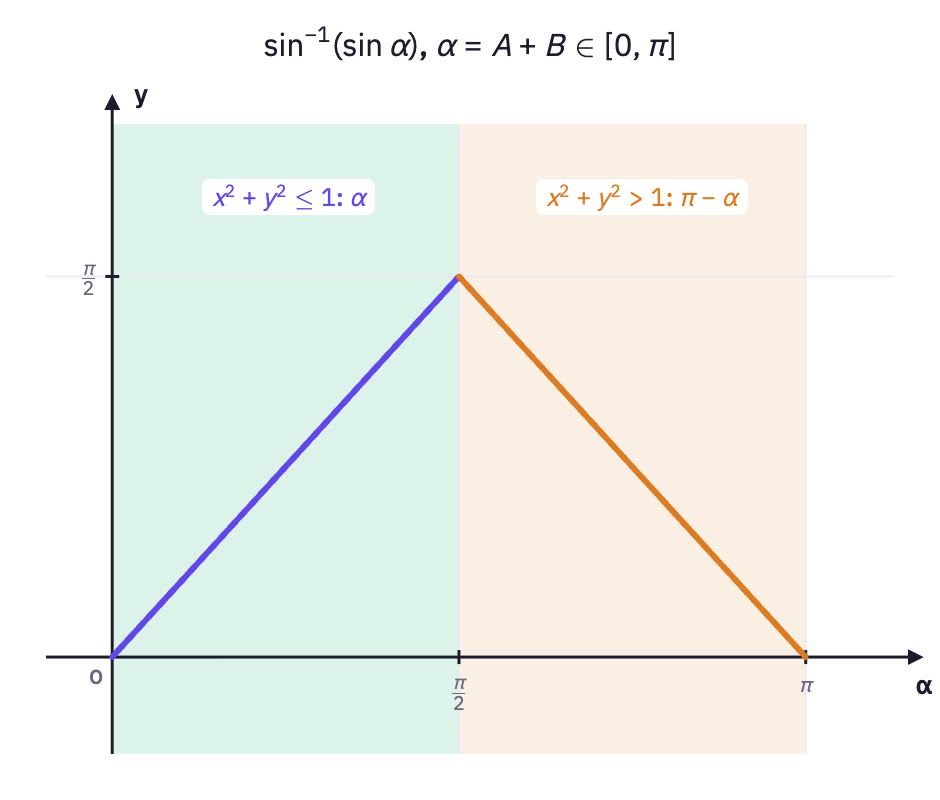
Sum and Difference of sin⁻¹ and cos⁻¹
Derive sin⁻¹x ± sin⁻¹y and cos⁻¹x ± cos⁻¹y with their conditions, then solve equations built on them.
sin⁻¹x + sin⁻¹y and the x² + y² ≤ 1 check · cos⁻¹x ± cos⁻¹y · Equations: isolate, square, check signs
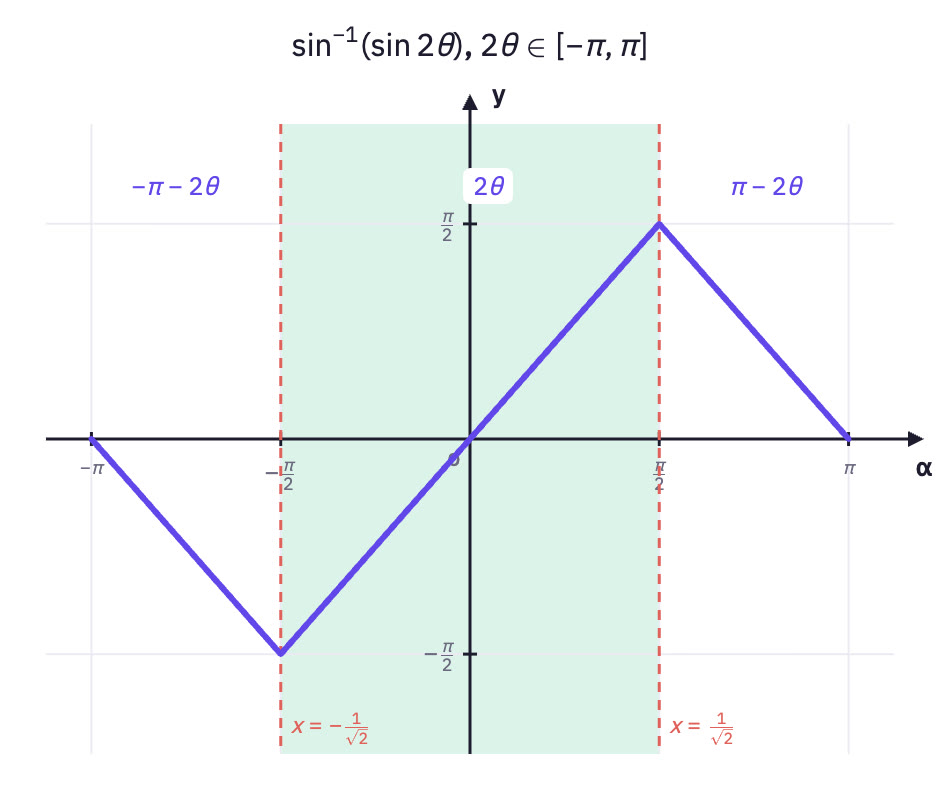
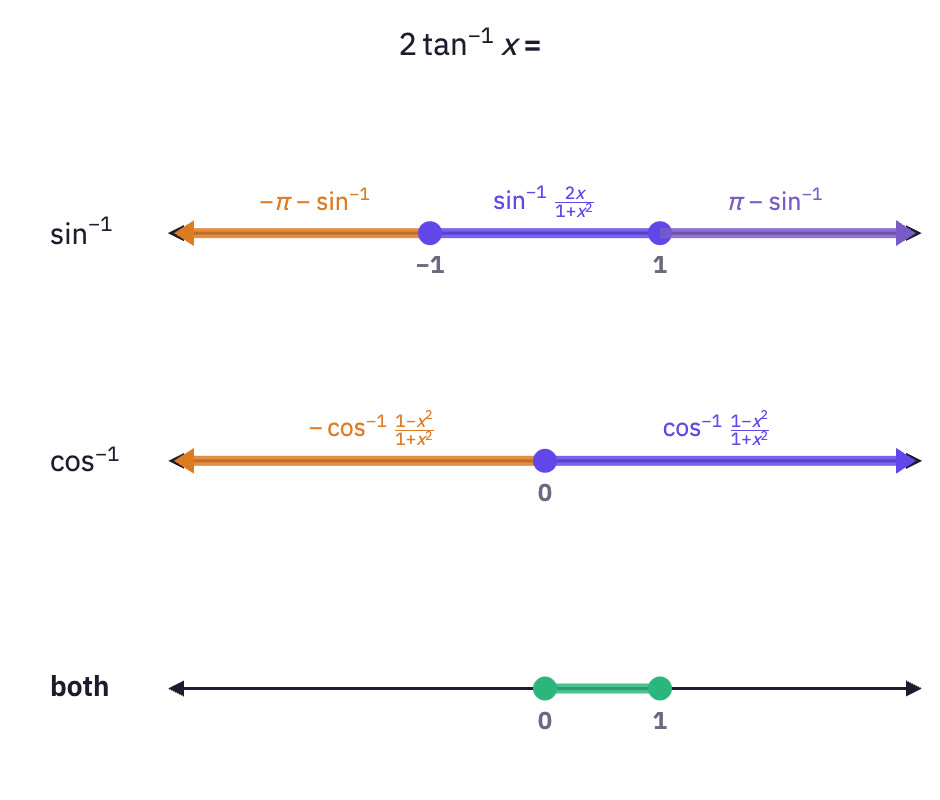
2sin⁻¹x, 3sin⁻¹x, 2cos⁻¹x, 2tan⁻¹x: Where Each Case Comes From
Derive the case-wise multiple-angle formulas from the sin⁻¹(sin α) and cos⁻¹(cos α) graphs and translate the cut points back to x.
2sin⁻¹x cut at ±1/√2 · 3sin⁻¹x cut at ±1/2 · 2cos⁻¹x cut at 0 · 2tan⁻¹x as sin⁻¹, cos⁻¹, tan⁻¹
Multiple-Angle Formulas: Evaluating and Solving
Pick the right case from the value of x, evaluate and simplify, and solve equations by spotting 2tan⁻¹x forms.
Choosing the case from x · Spotting 2tan⁻¹x forms · Valid x-range as part of the answer