 layrd.liveLayer by Layer
- 1. Electric Charge
- 2. Coulomb's Law
- 3. Equilibrium of Charges
- 4. Hanging Balls
- 5. Electric Field
- 6. Uniform Field
- 7. Ring of Charge
- 8. Line Charges
- 9. Arcs, Disks & Sheets
- 10. Field Lines
- 11. Electric Dipole
- 12. Dipole in a Field
- 13. Charged SHM
Electric Charge: Properties and Methods of Charging
Charge is the property that makes matter push and pull electrically. It comes in whole multiples of C, is conserved, and adds with its sign; bodies are charged by friction, conduction and induction, and a gold-leaf electroscope detects it.
 Video coming soon
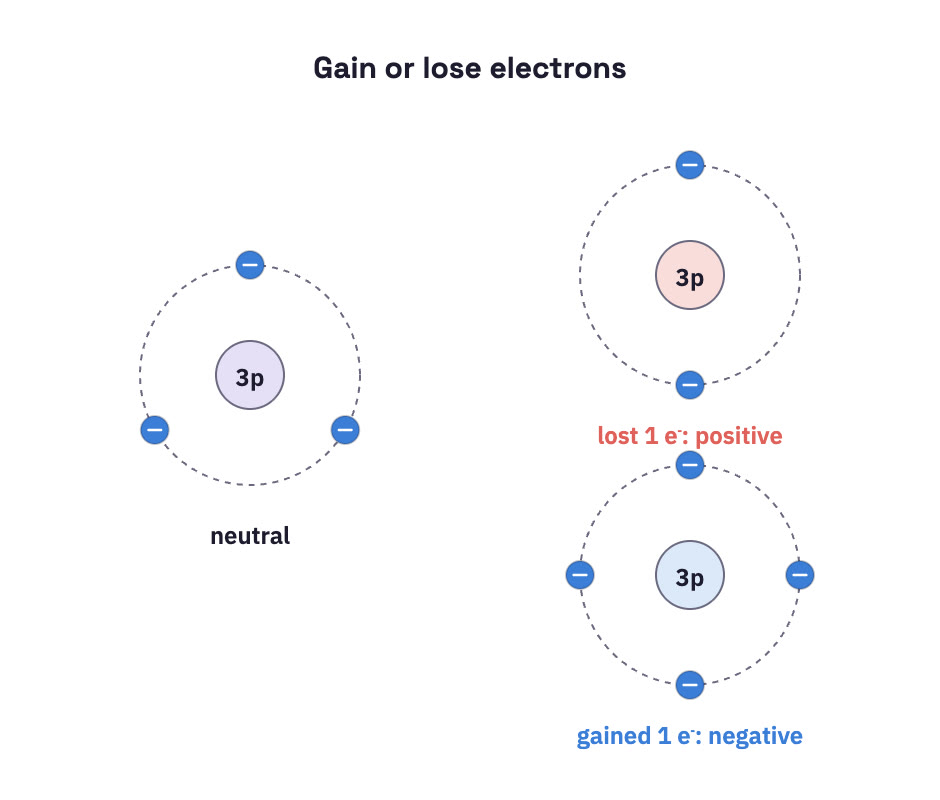
Gain or lose electrons
Losing electrons leaves a body positive; gaining them makes it negative. Its mass changes by .
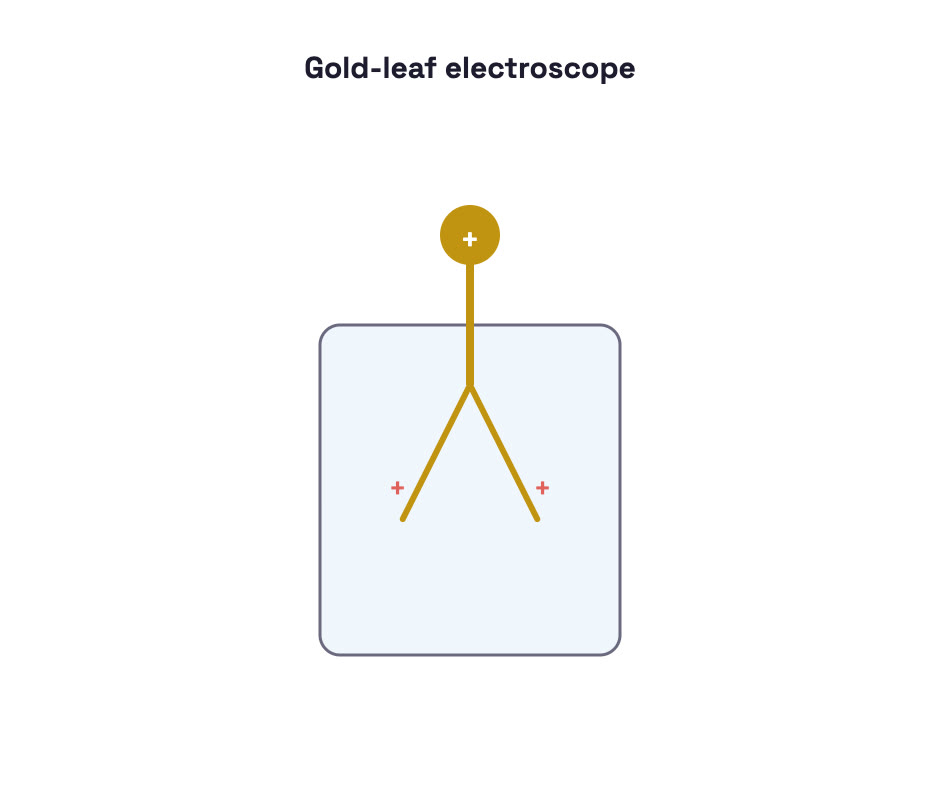
Gold-leaf electroscope
Like charges push the leaves apart; a like charge brought near spreads them further, an opposite one closes them.
Key formulas
From the video
1. A 2.7 g aluminium foil has Z = 13 and M = 27 g/mol. Find its total positive charge, and which of 3.2 × 10⁻¹⁹ C, 2.4 × 10⁻¹⁹ C and 0.8 × 10⁻¹⁹ C a body can carry.
- Moles , so atoms .
- Protons ; C.
- Charge must be a whole multiple of : , but and .
C; only C can exist.
Your turn
Which of the following charges cannot be present on a body?
Show the answer and the traps
Divide each by e: 10, 3, 1.5 and 5. 2.4 × 10⁻¹⁹ C is 1.5e, not a whole multiple: option c.
1.6 × 10⁻¹⁸ C is ten electrons' worth.
4.8 × 10⁻¹⁹ C is three electrons' worth.
And 8.0 × 10⁻¹⁹ C is five.
Common mistakes
Try these
1. How many electrons make up a charge of −3.2 μC?
.
2. Can a body carry a charge of 4.0 × 10⁻¹⁹ C?
No: it is , not a whole multiple of .
3. Identical spheres A (+6 μC) and B (−2 μC) touch and separate. What does each carry?
μC each.
4. A glass rod rubbed with silk gets +8 × 10⁻⁹ C. What charge does the silk get?
C, by conservation of charge.