 layrd.liveLayer by Layer
- 1. Electric Charge
- 2. Coulomb's Law
- 3. Equilibrium of Charges
- 4. Hanging Balls
- 5. Electric Field
- 6. Uniform Field
- 7. Ring of Charge
- 8. Line Charges
- 9. Arcs, Disks & Sheets
- 10. Field Lines
- 11. Electric Dipole
- 12. Dipole in a Field
- 13. Charged SHM
Equilibrium of Point Charges
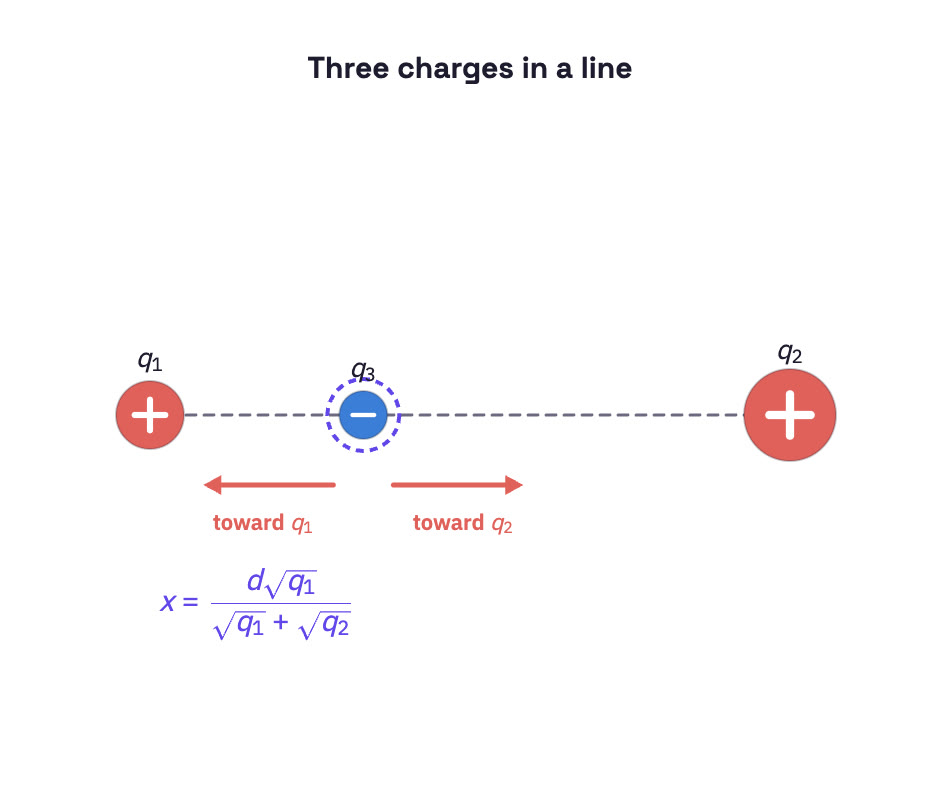
A charge is in equilibrium when the Coulomb forces on it cancel. In a line the balance point sits nearer the smaller charge; triangles and squares balance with an opposite charge at the centre. Check whether the balance is stable.
Builds on: Part 2 · Coulomb's Law and the Superposition Principle.
 Video coming soon
Three charges in a line
from ; for the whole system .
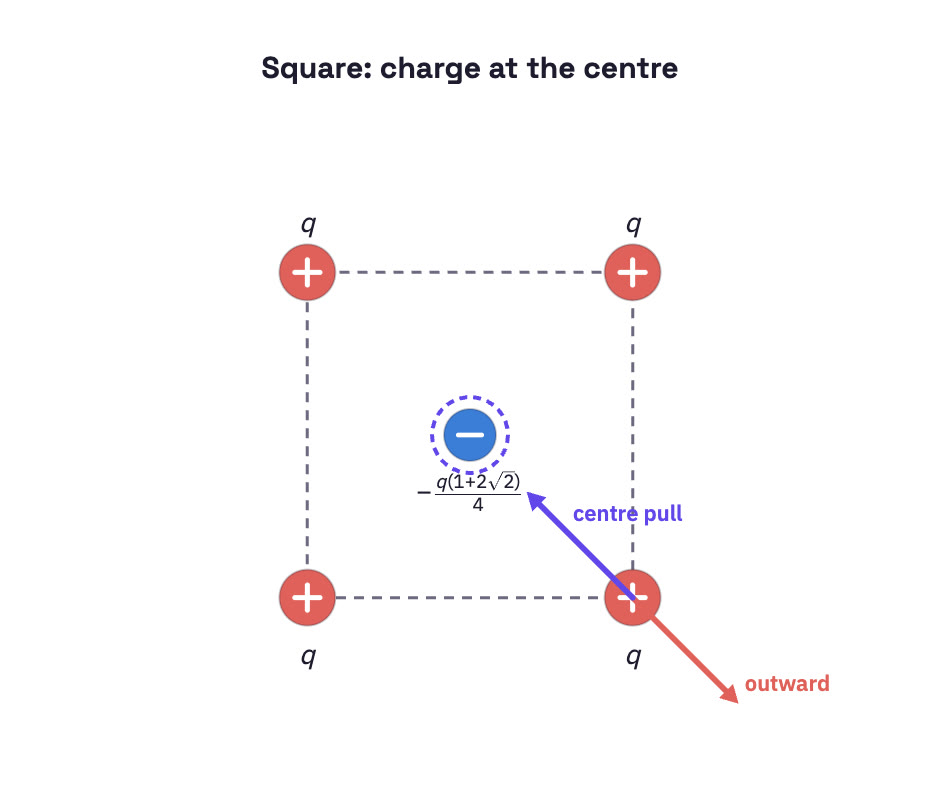
Charge at the centre
Each corner is pushed out by ; a centre charge balances it.
Key formulas
From the video
1. Charges +q and +9q are 40 cm apart. Find the charge, and its position, that puts the whole system in equilibrium.
- Between them, at from : cm.
- Balance on : .
, 10 cm from .
2. 4 nC is placed at each corner of a square. What charge at the centre holds them all in equilibrium?
- Outward force on a corner: .
- Centre charge at pulls with ; equal: .
nC (negative, to attract the corners).
Your turn
Two charges q and 4q are fixed 30 cm apart. A third charge will be in equilibrium at:
Show the answer and the traps
Between them, at x = 30 × √1/(√1 + √4) = 10 cm from q: option a.
20 cm from q is nearer the larger charge, which pushes harder.
The midpoint would balance only equal charges.
And outside, beyond q, both forces point the same way.
Common mistakes
Try these
1. Identical spheres with +8 μC and −2 μC are 30 cm apart. Find the force before and after they touch and return.
Before: 1.6 N attractive. After: 3 μC each, 0.9 N repulsive.
2. Charges +q and +16q are 50 cm apart. Where must a third charge be placed for equilibrium of the whole system, and what is it?
10 cm from ; .
3. Charges of 6 μC sit at the corners of an equilateral triangle. What charge at the centroid gives equilibrium?
μC.
4. A negative charge sits midway between two fixed positive charges. Is it stable along the line? Across it?
Unstable along the line; stable across it.