 layrd.liveLayer by Layer
- 1. Electric Charge
- 2. Coulomb's Law
- 3. Equilibrium of Charges
- 4. Hanging Balls
- 5. Electric Field
- 6. Uniform Field
- 7. Ring of Charge
- 8. Line Charges
- 9. Arcs, Disks & Sheets
- 10. Field Lines
- 11. Electric Dipole
- 12. Dipole in a Field
- 13. Charged SHM
Charged Particles in a Uniform Electric Field
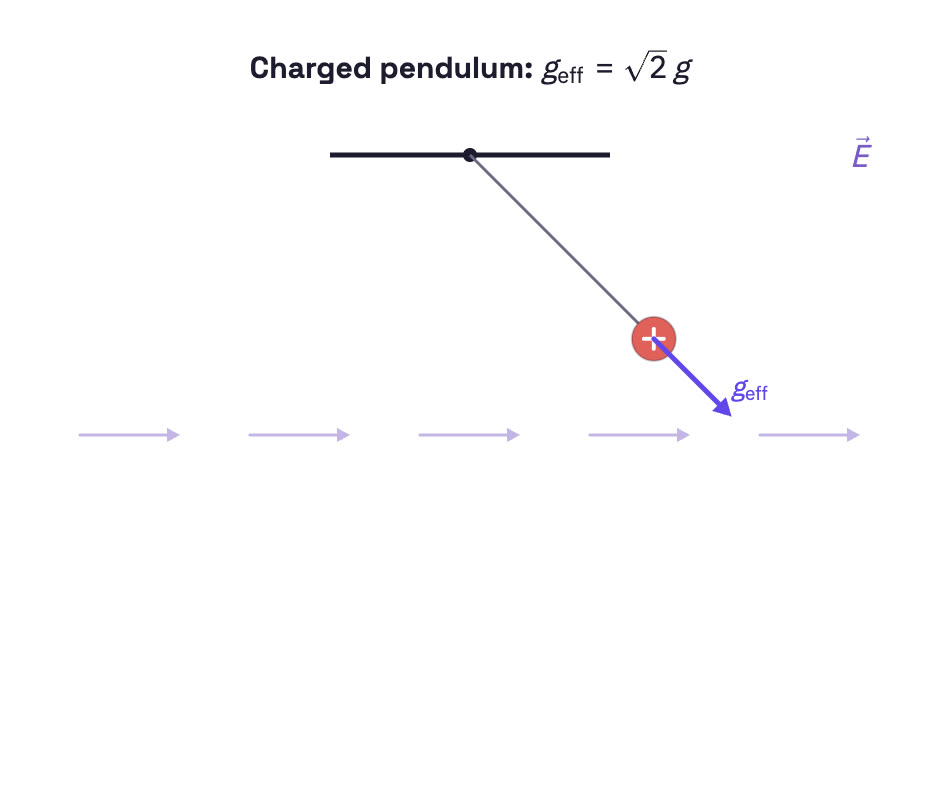
In a uniform field a charge feels a constant force . Add it to the mechanics: charged bodies balance, charged pendulums swing with an effective , and particles between plates follow parabolas.
Builds on: Part 5 · Electric Field of Point Charges.
 Video coming soon
Add to as vectors; a sideways field tilts the rest position.
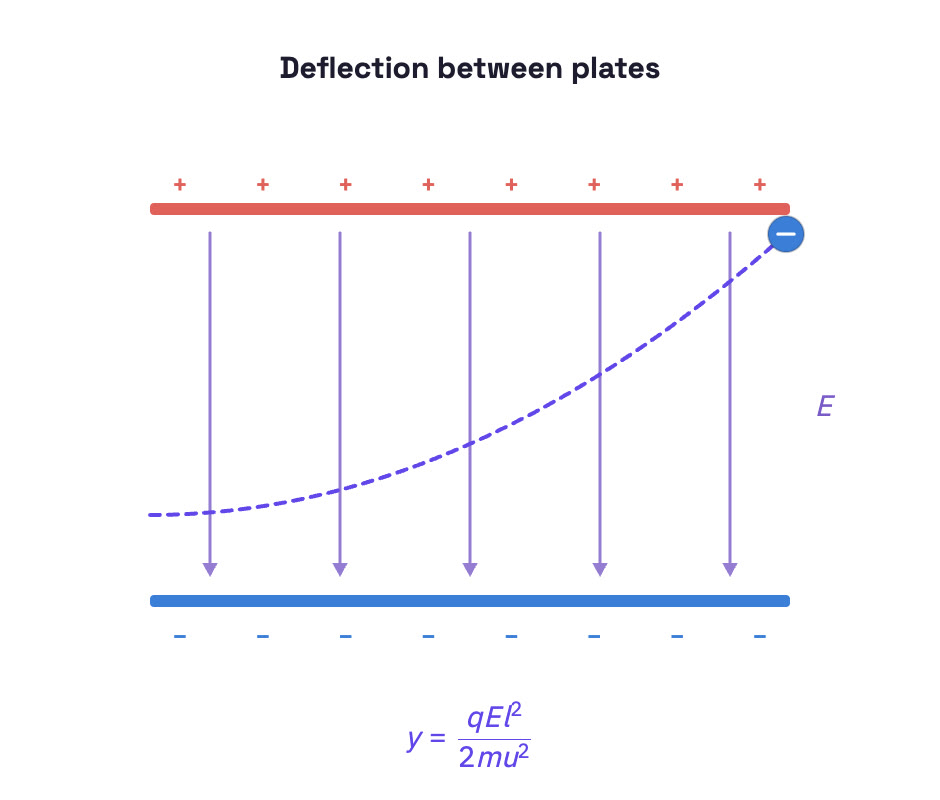
A parabolic path
is constant: entering parallel to the plates, the deflection is .
Key formulas
From the video
1. A 1 m pendulum has a 10 g bob with charge +5 μC. Find its period when E = 1.96 × 10⁴ N/C points down, up, and sideways (g = 9.8 m/s²).
- m/s² .
- Down: , s.
- Up: , no oscillation.
1.42 s; no oscillation; sideways , s.
2. An electron starts from rest at the negative plate. The plates are 2 cm apart with E = 5000 N/C. Find its speed at the other plate and the time taken.
- .
- .
m/s; ns.
Your turn
A simple pendulum has period T. Its bob is given a positive charge and a downward electric field is switched on so that qE = 3mg. The new period is:
Show the answer and the traps
geff = g + 3g = 4g, so T′ = T√(g/4g) = T/2: option a.
T/4 forgets the square root.
2T subtracts qE from g, as if the field pointed up.
And T/√3 uses 3g alone and forgets gravity.
Common mistakes
Try these
1. A proton starts from rest in a 10⁴ N/C field. Find its speed after 1 cm.
m/s.
2. A 3.2 × 10⁻¹⁵ kg drop is balanced by a 10⁵ N/C field (g = 10 m/s²). How many extra electrons does it carry?
C: 2 electrons.
3. A pendulum has period 2 s. Its bob is charged and an upward field gives qE = mg/2. New period?
: s.
4. An electron enters plates 5 cm long at 10⁷ m/s, parallel to them, with E = 500 N/C. Find its deflection.
mm.