 layrd.liveLayer by Layer
- 1. Electric Charge
- 2. Coulomb's Law
- 3. Equilibrium of Charges
- 4. Hanging Balls
- 5. Electric Field
- 6. Uniform Field
- 7. Ring of Charge
- 8. Line Charges
- 9. Arcs, Disks & Sheets
- 10. Field Lines
- 11. Electric Dipole
- 12. Dipole in a Field
- 13. Charged SHM
Small Oscillations of Charged Bodies
Displace a charged body slightly from equilibrium, write the force for the small displacement and read off the stiffness: near a ring's centre, above a line or a point charge, or for a hinged rod, the motion is simple harmonic.
Builds on: Part 6 · Charged Particles in a Uniform Electric Field, Part 7 · Continuous Charge and the Field of a Charged Ring, Part 8 · Line Charges, Rods and the Force Between Them.
 Video coming soon
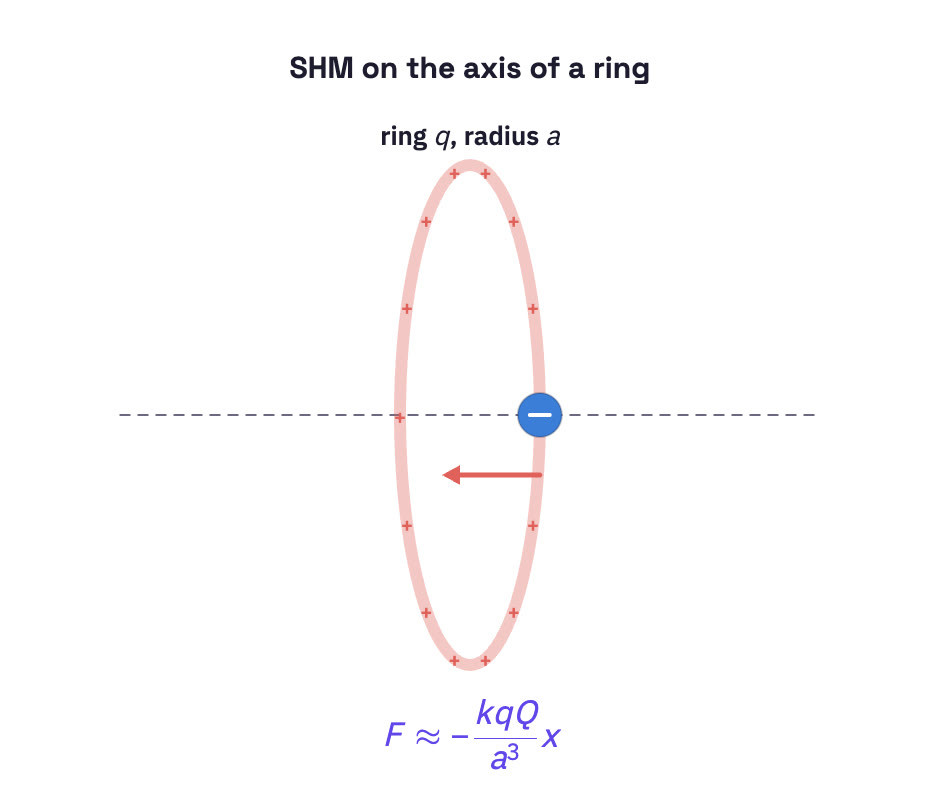
On the axis of a ring
Near the centre , so .
Key formulas
From the video
1. A ring of radius 10 cm carries +10 μC. A 10 g particle with −1 μC sits on the axis near the centre. Find the period of small oscillations.
- .
s (for ).
Your turn
A charged particle is in equilibrium at a height h above a long horizontal uniform line charge. The period of its small vertical oscillations is:
Show the answer and the traps
Equilibrium gives 2kqλ = mgh, so T = 2π√(mh²/2kqλ) = 2π√(h/g): option a.
2π√(2h/g) drops the factor 2 in the line's field.
2π√(h/2g) doubles it instead.
And 2π√(g/h) is upside down: a period needs seconds.
Common mistakes
Try these
1. A ring of radius 5 cm carries 20 μC. A 5 g particle with −2 μC oscillates near its centre along the axis. Find T.
ms.
2. A charged particle rests 10 cm above a long line charge. Find the period of small vertical oscillations.
s.
3. Charging two balls on a spring stretches it to 1.5 times its length. By what factor does the frequency change?
.