 layrd.liveLayer by Layer
- 1. Electric Charge
- 2. Coulomb's Law
- 3. Equilibrium of Charges
- 4. Hanging Balls
- 5. Electric Field
- 6. Uniform Field
- 7. Ring of Charge
- 8. Line Charges
- 9. Arcs, Disks & Sheets
- 10. Field Lines
- 11. Electric Dipole
- 12. Dipole in a Field
- 13. Charged SHM
Coulomb's Law and the Superposition Principle
Coulomb's law gives the force between two point charges: along the line joining them, reduced by in a medium. With several charges, the forces add as vectors.
Builds on: Part 1 · Electric Charge: Properties and Methods of Charging.
 Video coming soon
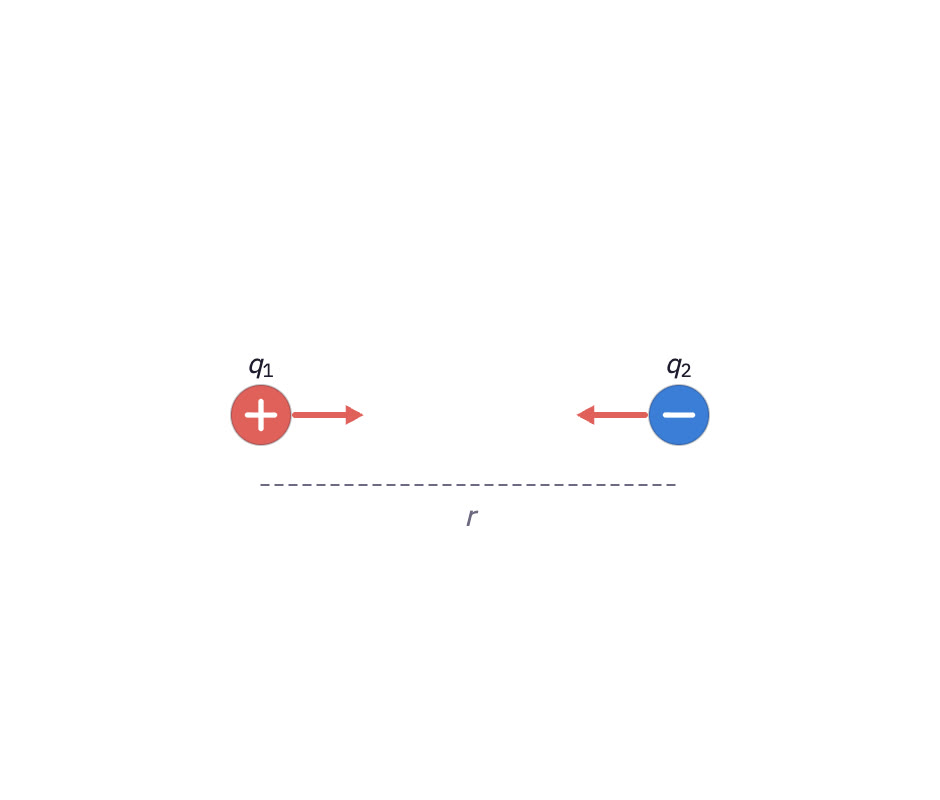
Equal and opposite forces along the line joining the charges; like charges repel, unlike attract.
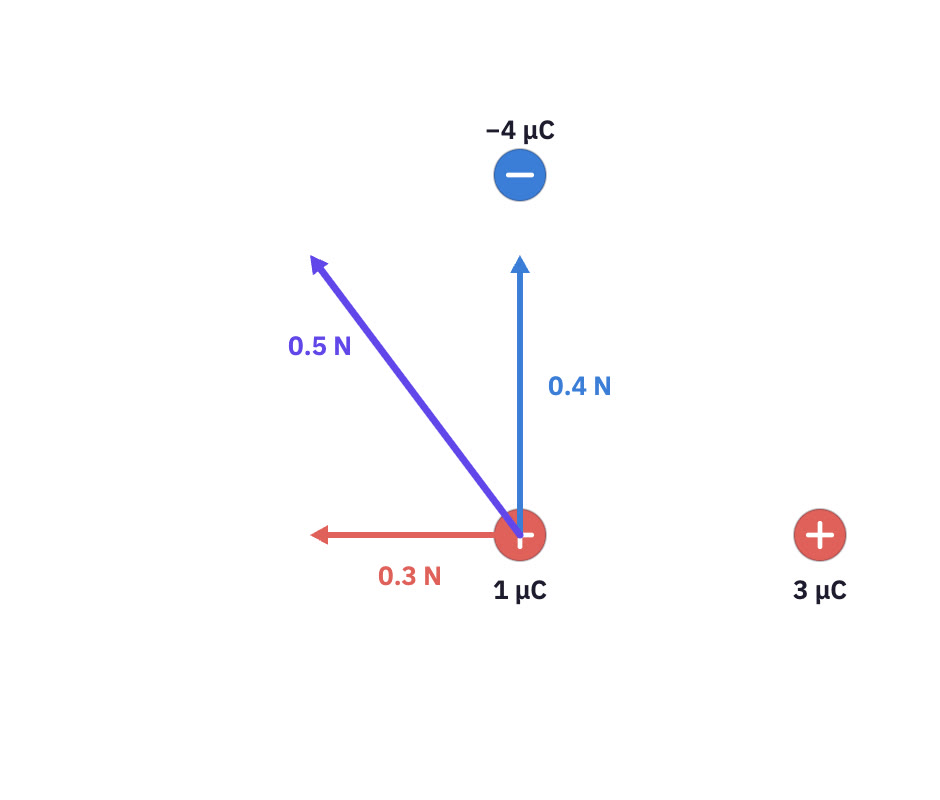
Add the forces as vectors
Forces of 0.3 N and 0.4 N at right angles give 0.5 N.
Key formulas
From the video
1. Charges of 2 μC and −3 μC are 30 cm apart. Find the force between them. Then both charges are doubled and the distance is tripled: find the new force.
- N, attractive.
- Doubling both charges: ; tripling : .
N, then N, still attractive.
2. A 1 μC charge is at the origin, 3 μC at (0.3 m, 0) and −4 μC at (0, 0.3 m). Find the net force on the 1 μC charge.
- From 3 μC: N along (repulsion).
- From −4 μC: N along (attraction).
- N.
N at from toward .
Your turn
Two point charges repel each other with a force of 40 N. If the distance between them is halved and one of the charges is tripled, the new force is:
Show the answer and the traps
F is proportional to q₁q₂/r²: × 3 for the charge, × 4 for half the distance. 40 × 12 = 480 N: option a.
240 N forgets to square the distance.
120 N changes only the charge.
And 60 N treats halving the distance as halving the force.
Common mistakes
Try these
1. Find the force between 5 μC and 2 μC placed 10 cm apart.
N, repulsive.
2. Two charges repel with 18 N in air. What is the force at the same distance in a medium with K = 6?
N.
3. The distance between two charges is increased by 50%. By what factor does the force change?
times.
4. A charge feels 0.3 N along +x from one charge and 0.4 N along +y from another. Find the net force.
N.