 layrd.liveLayer by Layer
- 1. Electric Charge
- 2. Coulomb's Law
- 3. Equilibrium of Charges
- 4. Hanging Balls
- 5. Electric Field
- 6. Uniform Field
- 7. Ring of Charge
- 8. Line Charges
- 9. Arcs, Disks & Sheets
- 10. Field Lines
- 11. Electric Dipole
- 12. Dipole in a Field
- 13. Charged SHM
Line Charges, Rods and the Force Between Them
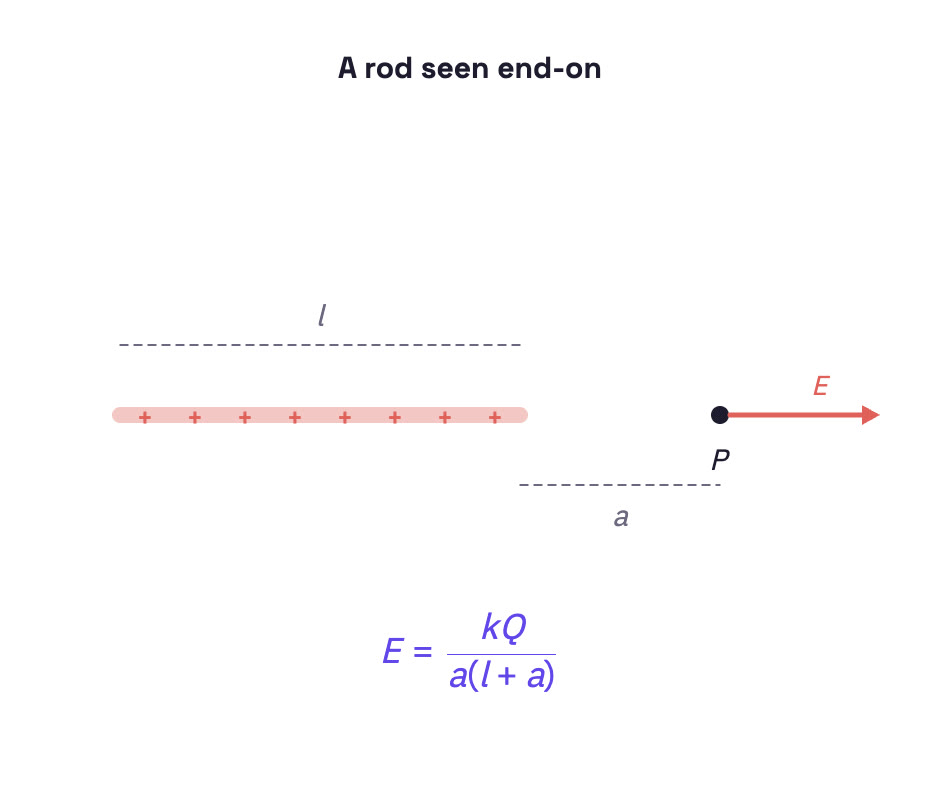
A long line charge makes ; a finite rod adds sines and cosines of the angles its ends subtend; on its own axis a rod gives . Forces between distributions come from .
Builds on: Part 7 · Continuous Charge and the Field of a Charged Ring.
 Video coming soon
Integrate over θ
Infinite: ; finite: .
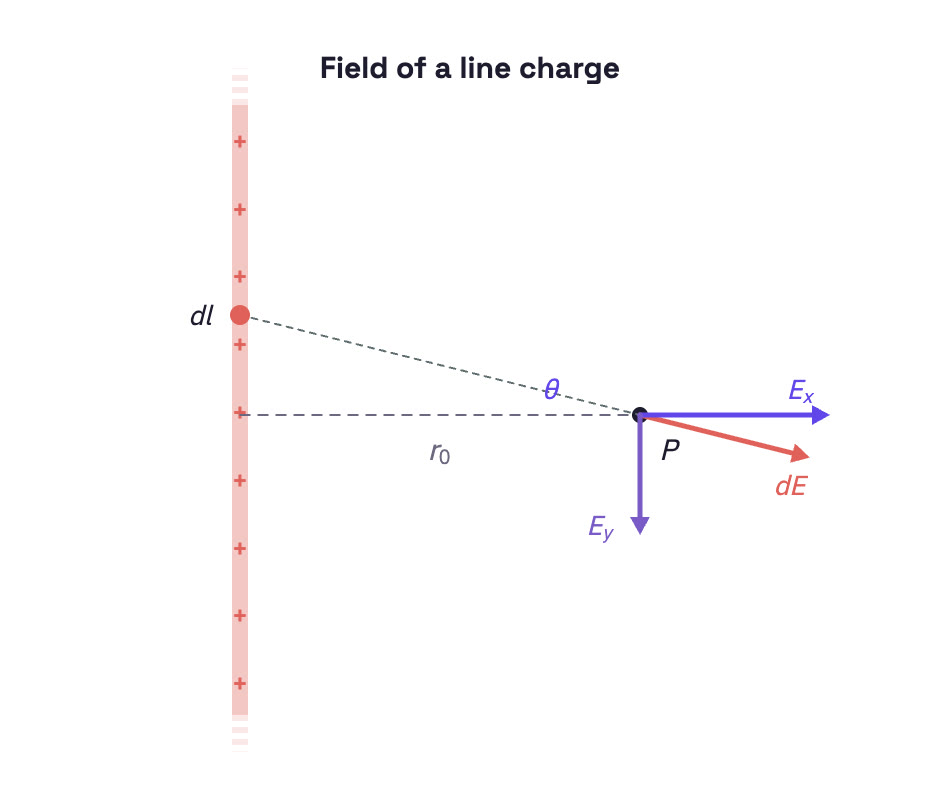
Every element pushes the same way: no components.
Key formulas
From the video
1. Find the field 15 cm from a long wire with λ = 3 μC/m, and 10 cm from the middle of a rod with λ = 1 μC/m whose ends subtend 30° on each side.
- Long wire: N/C.
- Rod: .
N/C; N/C, straight out from the rod.
Your turn
The electric field at a distance r from a long uniformly charged wire is E. At a distance 3r it is:
Show the answer and the traps
E is proportional to 1/r, so E/3: option a.
E/9 treats the line as a point charge.
E/√3 has no basis in the formula.
And 3E has the dependence upside down.
Common mistakes
Try these
1. Find the field 2 cm from a long wire carrying 4 nC/m.
N/C.
2. A 10 cm rod carries 2 nC. Find the field on its axis 10 cm beyond one end.
N/C.
3. The field 1 m from a long line charge is 400 N/C. What is it at 4 m?
100 N/C.
4. What is the field at a point opposite the end of a semi-infinite wire, a distance r from it?
at 45°.