 layrd.liveLayer by Layer
- 1. Electric Charge
- 2. Coulomb's Law
- 3. Equilibrium of Charges
- 4. Hanging Balls
- 5. Electric Field
- 6. Uniform Field
- 7. Ring of Charge
- 8. Line Charges
- 9. Arcs, Disks & Sheets
- 10. Field Lines
- 11. Electric Dipole
- 12. Dipole in a Field
- 13. Charged SHM
Dipole in Uniform and Non-uniform Fields
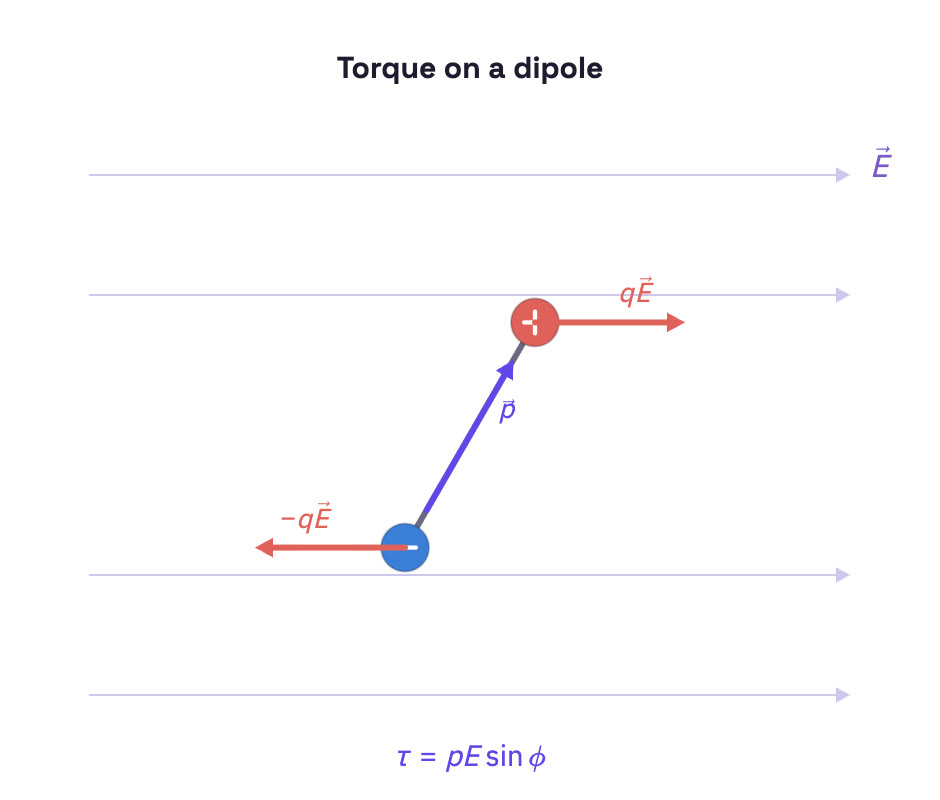
In a uniform field a dipole feels a torque but no net force, and oscillates about the field direction. In a non-uniform field it also feels , which is why charged bodies pick up paper.
Builds on: Part 11 · Electric Dipole and Its Field.
 Video coming soon
and form a couple that turns toward .
Key formulas
From the video
1. A dipole with p = 10⁻¹¹ C m makes 30° with a field of 2 × 10⁵ N/C. Find the torque, and the angles where it is half the maximum.
- .
- N m.
N m; half the maximum at 30° and 150°.
Your turn
The torque on an electric dipole in a uniform electric field is half its maximum value when the angle between the dipole moment and the field is:
Show the answer and the traps
pE sin φ = ½pE gives sin φ = ½: φ = 30°: option a.
60° uses cos φ instead of sin φ.
45° gives 1/√2 of the maximum, not half.
And 90° is the maximum itself.
Common mistakes
Try these
1. Find the maximum torque on a dipole of 3 × 10⁻⁹ C m in a 2 × 10⁴ N/C field.
N m.
2. At what angle is the torque √3/2 of its maximum?
60° (or 120°).
3. A dumbbell of two 2 g masses on a 4 cm rod carries ±2 μC in a 10³ N/C field. Find its period of small oscillations.
s.
4. A dipole p = 10⁻⁸ C m points along +z where dE/dz = 2 × 10⁵ N/C/m. Find the force.
N along .