 layrd.liveLayer by Layer
- 1. Conduction & Steady State
- 2. Thermal Conductivity
- 3. Rods in Series
- 4. Parallel & Networks
- 5. Radial Conduction & Ice
- 6. Heating Through a Rod
- 7. Convection
- 8. Radiation & Kirchhoff
- 9. Stefan's Law
- 10. Solar Constant
- 11. Newton's Cooling
- 12. Method of Cooling
- 13. Wien's Law
- 14. Planck & Kirchhoff
Heat Conduction: Mechanism and Steady State
Heat moves by conduction, convection and radiation. This part looks inside a solid to see how conduction works (vibrating atoms, and free electrons in metals), then follows a rod from the variable state to steady state, where its temperature falls in a straight line.
 Video coming soon
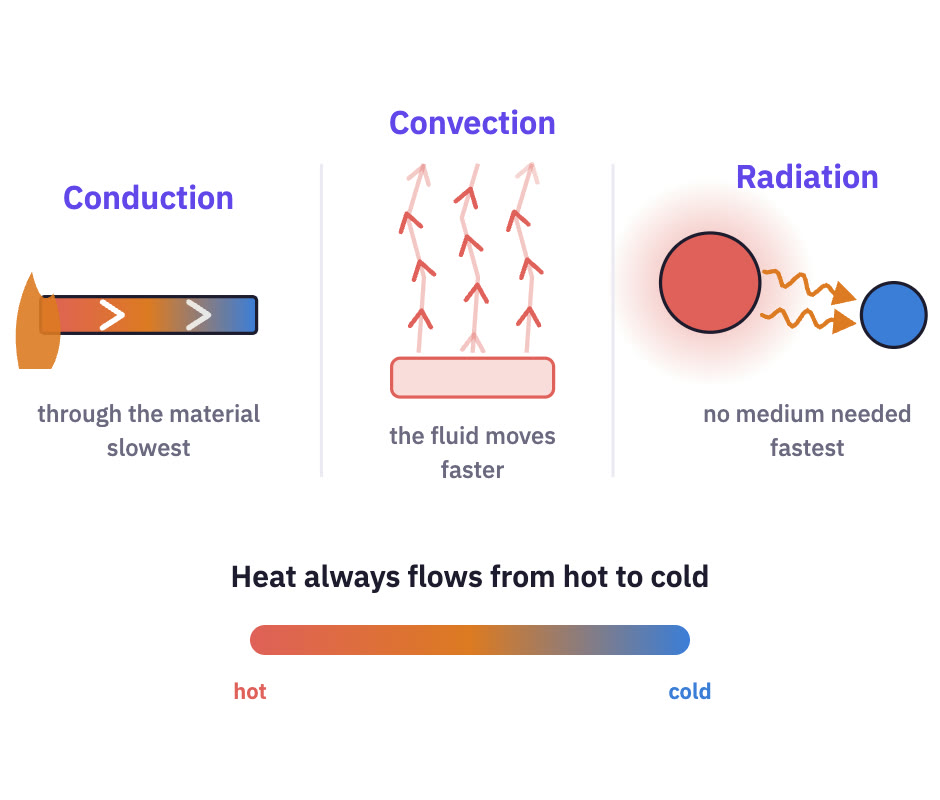
Conduction, convection, radiation
Conduction passes energy through a material that stays put; convection carries heat with a moving fluid; radiation needs no medium at all. Heat always flows from hot to cold.
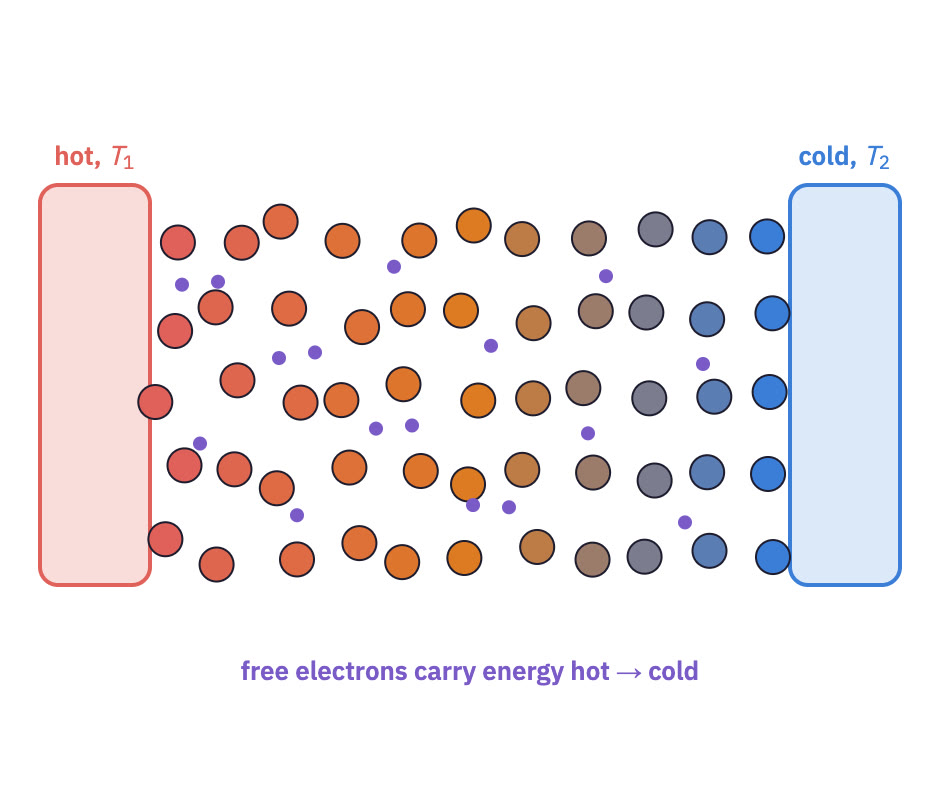
Energy moves, atoms stay
Atoms at the hot end vibrate harder and pass energy to their neighbours by collisions. In metals, free electrons carry energy quickly from hot to cold, which is why metals conduct well.
= constant
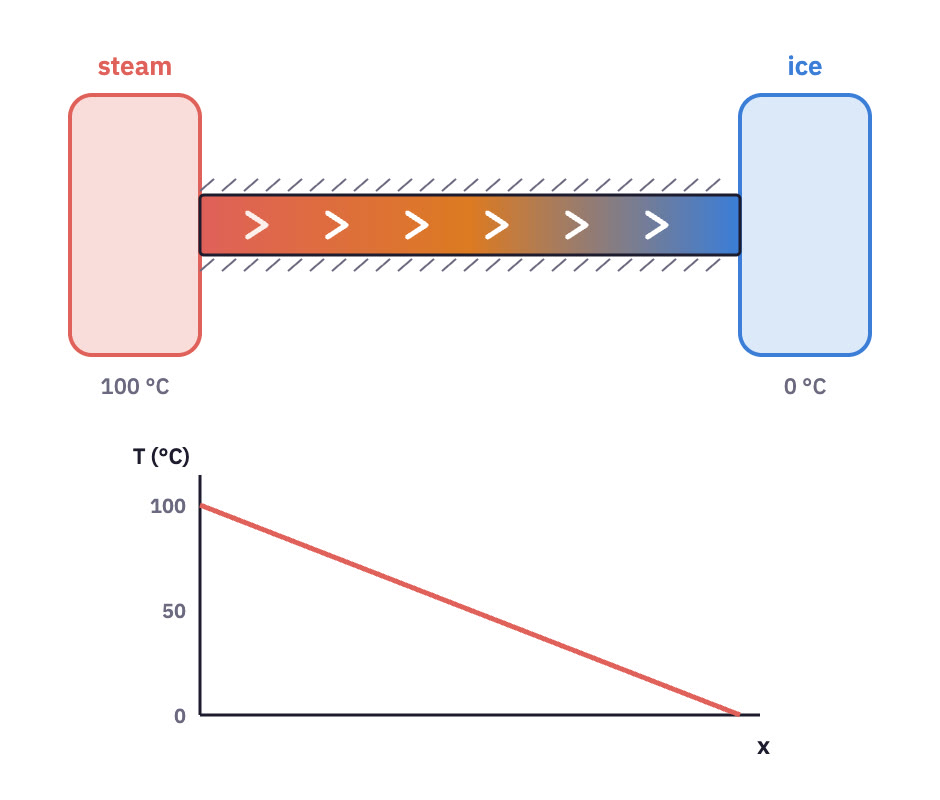
In the variable state each segment keeps some heat and warms. In steady state no segment stores heat: every temperature is constant and a uniform rod's temperature falls linearly from the hot end to the cold end.
Key formulas
One for every idea
1. Name the mode: a spoon's handle heating up in tea, warm air rising from a heater, the Sun warming your face.
- Spoon: heat passes through the solid metal itself.
- Heater: the warm air moves up and carries the heat.
- Sun: the energy crosses empty space with no medium.
Conduction, convection and radiation.
2. Why are metals good conductors of heat, unlike wood or glass?
- Metals have free electrons that move through the lattice and carry energy quickly from hot to cold.
- That adds to the slower transfer by lattice vibrations.
- Wood and glass have no free electrons and conduct only by vibrations.
Free electrons make metals good conductors; wood and glass are poor ones.
3. In steady state, the ends A and B of a 20 cm uniform, lagged rod are at 100 °C and 0 °C. What is the temperature 6 cm from A?
- Steady state: the temperature falls linearly, °C/cm.
- .
°C.
Your turn
A uniform rod 30 cm long is in steady state with its ends at 100 °C and 10 °C. The temperature 10 cm from the hot end is:
Show the answer and the traps
Gradient = 90/30 = 3 °C per cm, so T = 100 − 3 × 10 = 70 °C: option b.
55 °C is the average of the ends, true only at the midpoint.
66.7 °C forgets that the cold end is at 10 °C, not 0 °C.
And 40 °C measures the 10 cm from the cold end.
Common mistakes
Try these
1. A 50 cm lagged rod in steady state has its ends at 120 °C and 20 °C. Find the temperature 20 cm from the hot end.
Gradient °C/cm, so °C.
2. Name the mode of heat transfer: (a) warming your hands near a fire, (b) a metal ladle getting hot in soup, (c) a sea breeze.
(a) Radiation, (b) conduction, (c) convection.