 layrd.liveLayer by Layer
- 1. Conduction & Steady State
- 2. Thermal Conductivity
- 3. Rods in Series
- 4. Parallel & Networks
- 5. Radial Conduction & Ice
- 6. Heating Through a Rod
- 7. Convection
- 8. Radiation & Kirchhoff
- 9. Stefan's Law
- 10. Solar Constant
- 11. Newton's Cooling
- 12. Method of Cooling
- 13. Wien's Law
- 14. Planck & Kirchhoff
Convection of Heat
In convection the material itself moves and carries the heat. Only fluids can do it, either pushed by a fan or pump (forced) or driven by density differences (natural). The heat current is found by experiment, .
Builds on: Part 1 · Heat Conduction: Mechanism and Steady State.
 Video coming soon
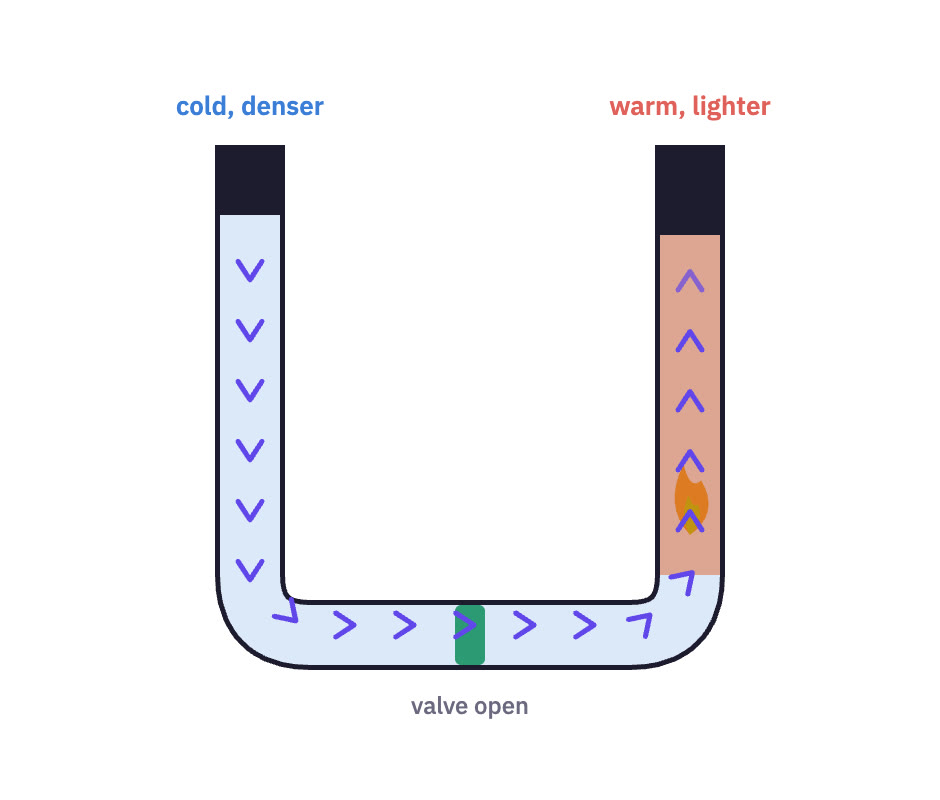
A U-tube circulates
Heating one arm makes its water lighter; open the valve and cold water flows into the hot arm at the bottom, carrying heat around the loop.
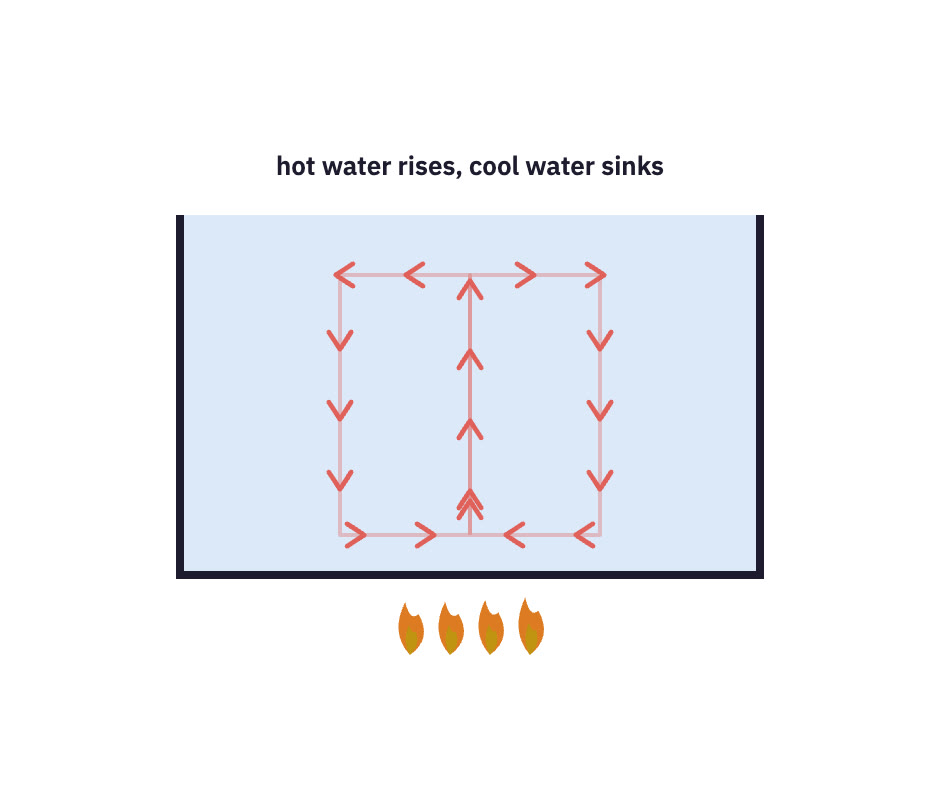
Hot rises, cool sinks
Water heated at the bottom of a pot rises, cools at the top and sinks again: two convection cells.
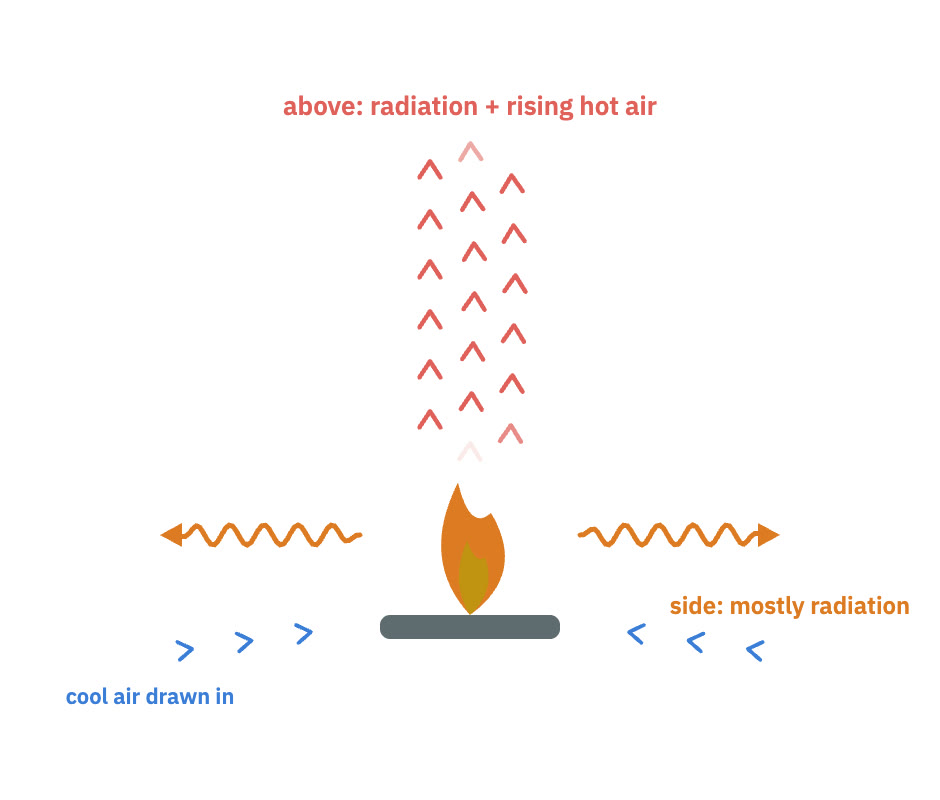
Above vs beside a fire
Above the fire you receive radiation plus the rising hot air; beside it, mostly radiation.
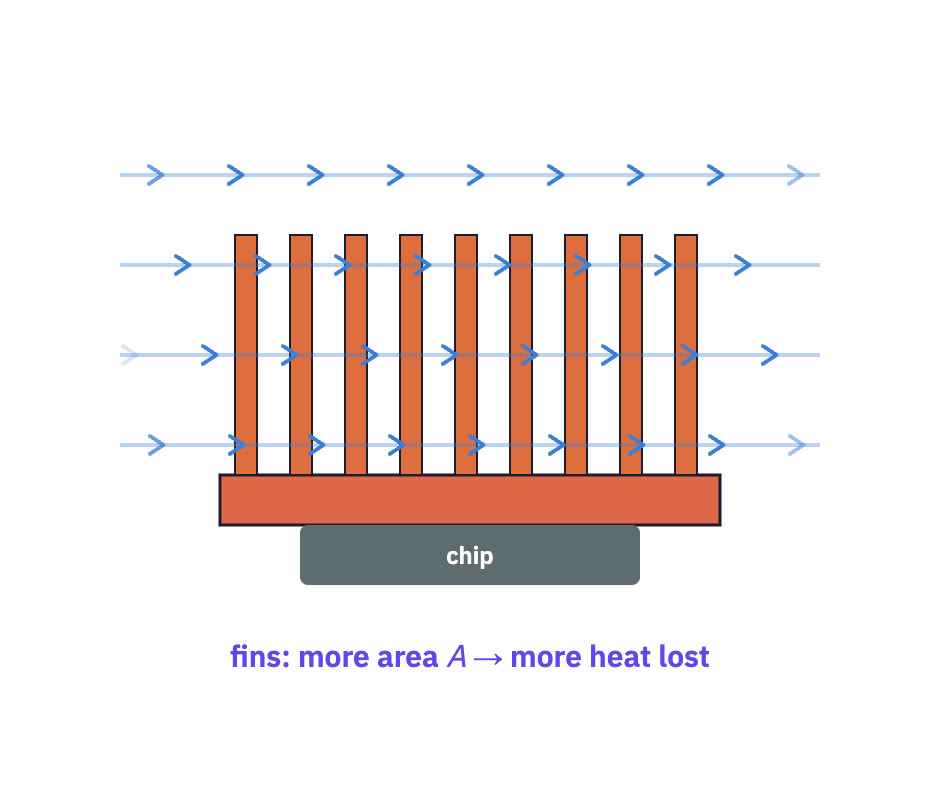
The loss grows with the contact area, which is why heat sinks, radiators and transformers have fins.
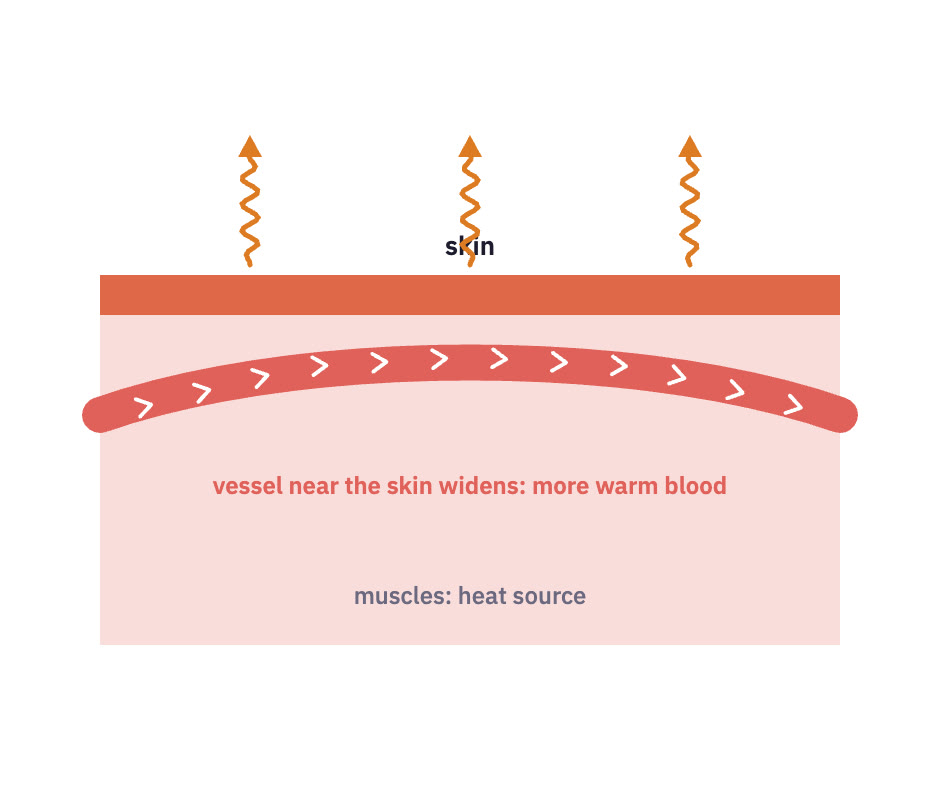
Blood carries heat
Tissue conducts poorly, so blood carries heat by convection to just under the skin, where it is lost.
Key formulas
One for every idea
1. Why does it feel hotter above a campfire than beside it at the same distance?
- Hot air above the fire is less dense and rises, carrying heat upward; cooler air is drawn in from the sides.
- Above the fire you receive radiation and the rising hot air; beside it, mainly radiation.
Above: radiation + convection. Beside: mostly radiation.
2. A plate of area 0.5 m² at 60 °C loses heat to air at 20 °C with = 10 W m⁻² K⁻¹. Find the convective heat loss per second.
- .
200 W.
3. Your skin turns red during hard exercise. Why?
- The muscles produce extra heat.
- Blood vessels near the skin widen so more warm blood reaches the surface.
- Blood carries the heat by convection to the skin, where it is lost; tissue alone conducts too poorly.
Widened vessels let blood carry more heat to the skin.
Your turn
A plate loses 300 W by convection when it is 30 °C hotter than the surrounding air. Assuming the same convection coefficient, its loss when it is 50 °C hotter is about:
Show the answer and the traps
dQ/dt ∝ ΔT: 300 × 50/30 = 500 W, option b.
300 W ignores the larger temperature difference.
833 W squares the ratio; the loss is roughly linear in ΔT.
And 180 W turns the ratio upside down.
Common mistakes
Try these
1. A wall of area 10 m² at 30 °C loses heat to air at 20 °C with = 5 W m⁻² K⁻¹. Find the convective loss.
W.
2. Why do car radiators and transformers have fins?
Fins increase the area in contact with air; grows with .
3. Why is a room heater placed near the floor and an air conditioner near the ceiling?
Warm air rises and cool air sinks, so natural convection then mixes the whole room.