 layrd.liveLayer by Layer
- 1. Conduction & Steady State
- 2. Thermal Conductivity
- 3. Rods in Series
- 4. Parallel & Networks
- 5. Radial Conduction & Ice
- 6. Heating Through a Rod
- 7. Convection
- 8. Radiation & Kirchhoff
- 9. Stefan's Law
- 10. Solar Constant
- 11. Newton's Cooling
- 12. Method of Cooling
- 13. Wien's Law
- 14. Planck & Kirchhoff
Stefan–Boltzmann Law and Net Radiation
A black body radiates per unit area, and any body , with in kelvin. In surroundings at the net loss is , and dividing by the heat capacity gives the rate of cooling.
Builds on: Part 8 · Thermal Radiation, Prevost's Theory and Kirchhoff's Law.
 Video coming soon
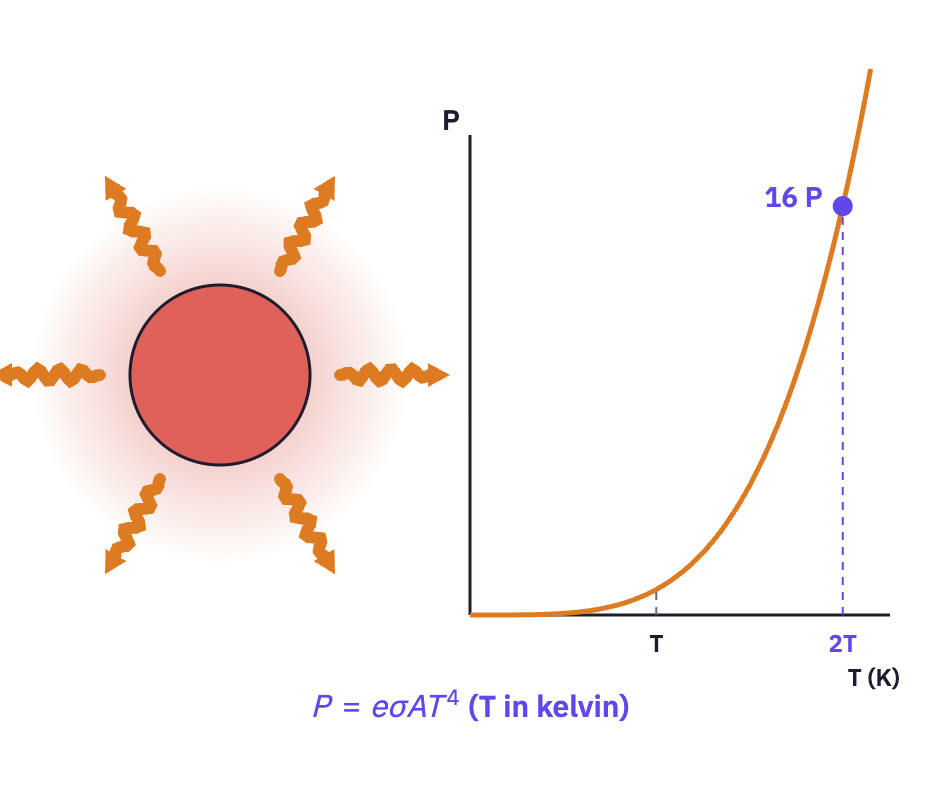
Power rises as the fourth power of the absolute temperature: doubling multiplies the power by 16. W m⁻² K⁻⁴.
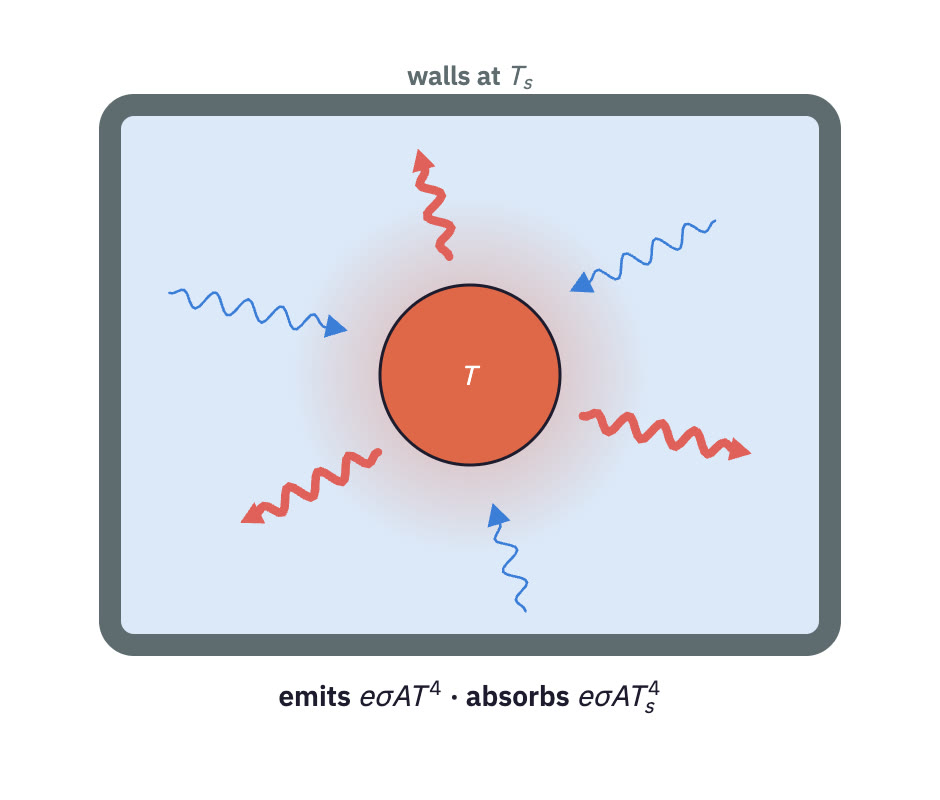
A body emits and absorbs . Rate of cooling ∝ : small and hollow bodies cool faster.
A heater element
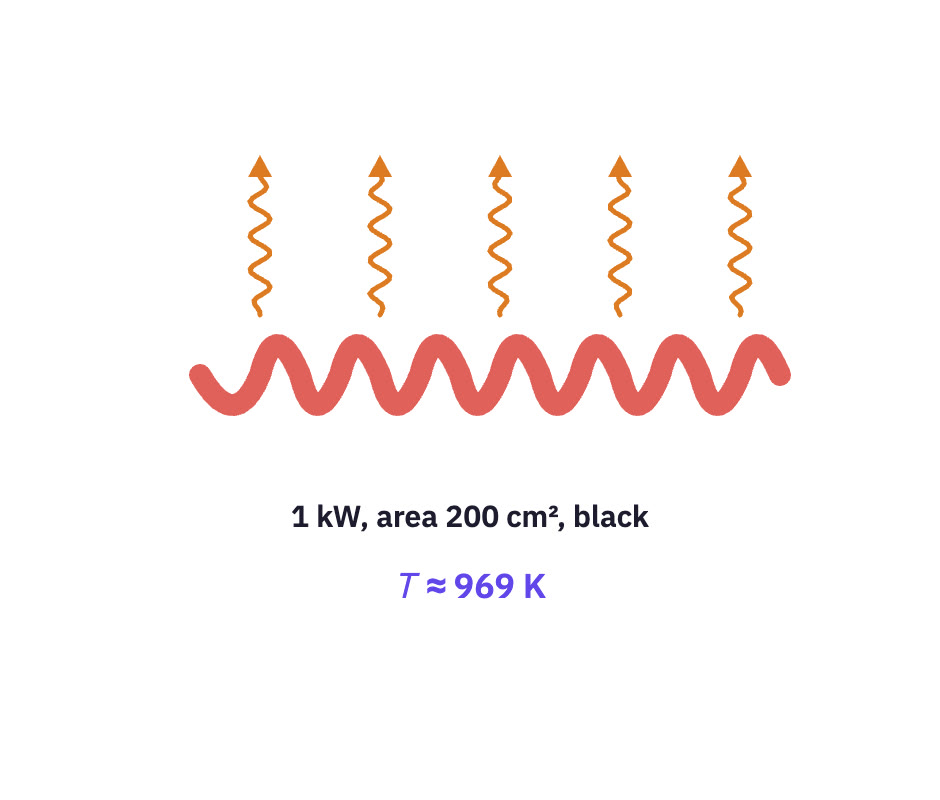
Much hotter than its surroundings, the element's absorption can be ignored: .
Key formulas
One for every idea
1. An electric heater of power 1 kW has a heating element of surface area 200 cm². Treating it as a black body much hotter than its surroundings, find its surface temperature.
- : .
- .
K (the book gives 969.3 K).
2. A solid metallic sphere of diameter 20 cm and mass 10 kg at 327 °C hangs in a box kept at 27 °C. Specific heat 420 J kg⁻¹ °C⁻¹. Find the rate at which its temperature falls.
- , K, K.
- W.
°C/s.
3. A ball of radius 1 cm with emissivity 0.3 is held at 1000 K in a vacuum chamber with walls at 300 K. Find the electrical power needed to keep its temperature constant.
- Power in = net radiation: .
- .
≈ 21.2 W (the book gives 21.1 W).
Your turn
The radius of a black sphere is doubled and its absolute temperature is halved. The power it radiates becomes:
Show the answer and the traps
P ∝ r²T⁴ = 4 × 1/16 = 1/4: option b.
1/8 takes the area as proportional to r instead of r².
1 uses T² instead of T⁴.
And 4 counts only the bigger area and forgets the temperature.
Common mistakes
Try these
1. A black sphere of radius 5 cm is at 500 K in empty space (neglect absorption). Find the power it radiates.
W.
2. A black body is heated from 27 °C to 327 °C. By what factor does its radiated power increase?
.
3. Two solid spheres of the same material, radii 1 cm and 2 cm, are at the same temperature. Find the ratio of their rates of heat loss by radiation.
∝ : 1 : 4 (their rates of cooling are 2 : 1).
4. (Book, PE 4.2 i) A 500 W lamp loses all its energy by radiation from a filament of area 2.0 cm² and emissivity 0.5 ( = 5.7 × 10⁻⁸). Estimate the filament's temperature.
K.
5. (Book, PE 4.2 ii) A white-hot wire at 3000 K has radius 0.075 cm and emissivity 0.35 ( = 5.7 × 10⁻⁸). Find the power radiated per unit length.
W/m (the book gives 7611 W/m).
6. (Book, PE 4.2 iii) A 60 W tungsten filament at 2000 K has emissivity 0.30 ( = 5.7 × 10⁻⁸). Find its surface area.
m².
7. (Book, PE 4.2 iv) A black sphere of radius 12 cm radiates 450 W at 500 K. If the radius is halved and the temperature doubled, find the power radiated.
: W.
8. (Book, PE 4.2 v) A block at 500 K in 300 K surroundings needs 210 W to stay at 500 K; a black body of the same size needs 700 W. Find the block's emissivity.
.
9. (Book, PE 4.2 vi) A solid copper sphere of radius and a hollow copper sphere of outer radius are heated to the same temperature and cool in the same surroundings. Which cools faster?
The hollow sphere: same area, less mass.