 layrd.liveLayer by Layer
- 1. Conduction & Steady State
- 2. Thermal Conductivity
- 3. Rods in Series
- 4. Parallel & Networks
- 5. Radial Conduction & Ice
- 6. Heating Through a Rod
- 7. Convection
- 8. Radiation & Kirchhoff
- 9. Stefan's Law
- 10. Solar Constant
- 11. Newton's Cooling
- 12. Method of Cooling
- 13. Wien's Law
- 14. Planck & Kirchhoff
Law of Heat Conduction and Thermal Conductivity
How much heat flows through a rod each second? It grows with the temperature difference and the area and falls with the length: . This part builds that law, meets the thermal conductivity , and shows how a rod warms before it reaches steady state.
Builds on: Part 1 · Heat Conduction: Mechanism and Steady State.
 Video coming soon
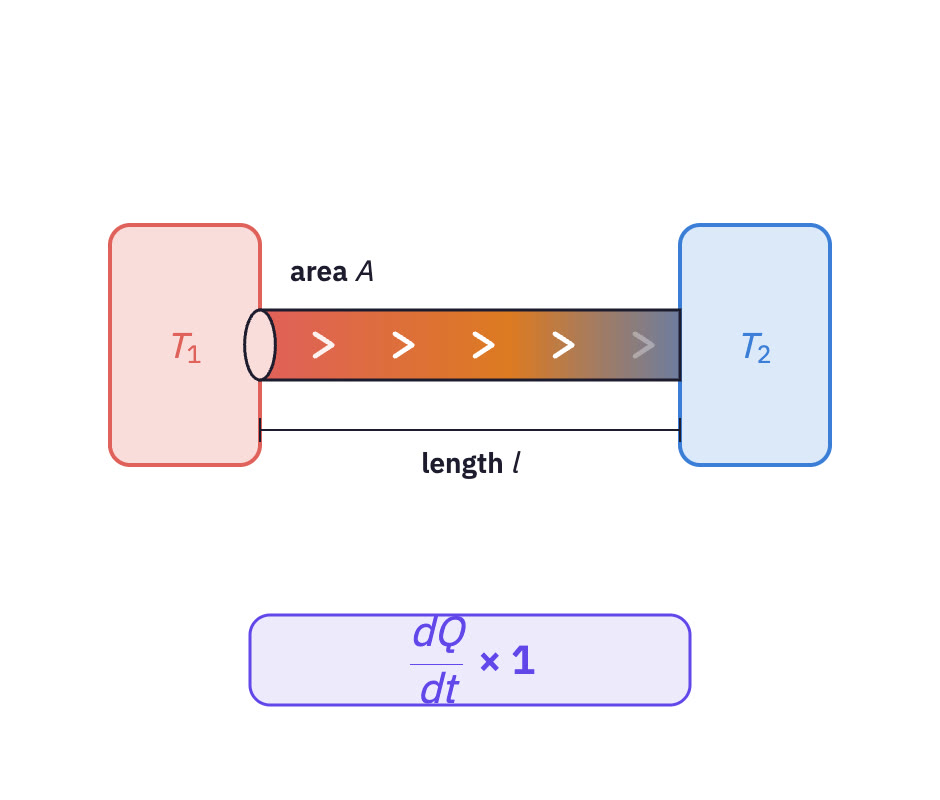
Doubling the temperature difference or the area doubles the heat current; doubling the length halves it. In differential form, .
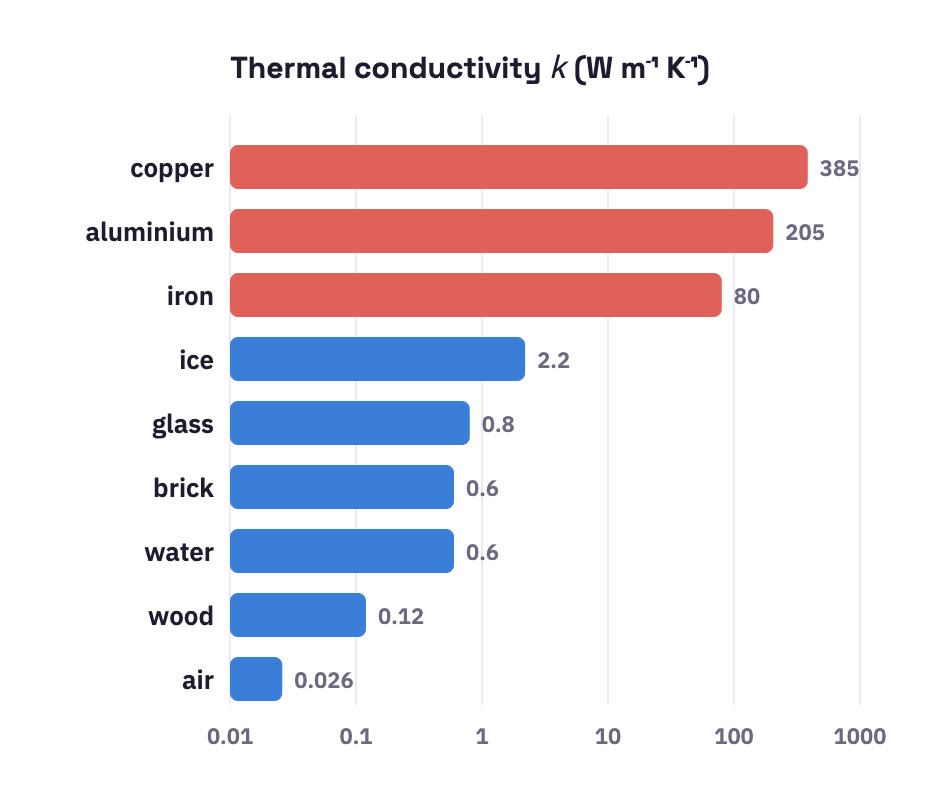
from copper to air
is a property of the material, in W m⁻¹ K⁻¹: about 385 for copper, 0.8 for glass, 0.026 for air. A good insulator needs small , small area and a long path.
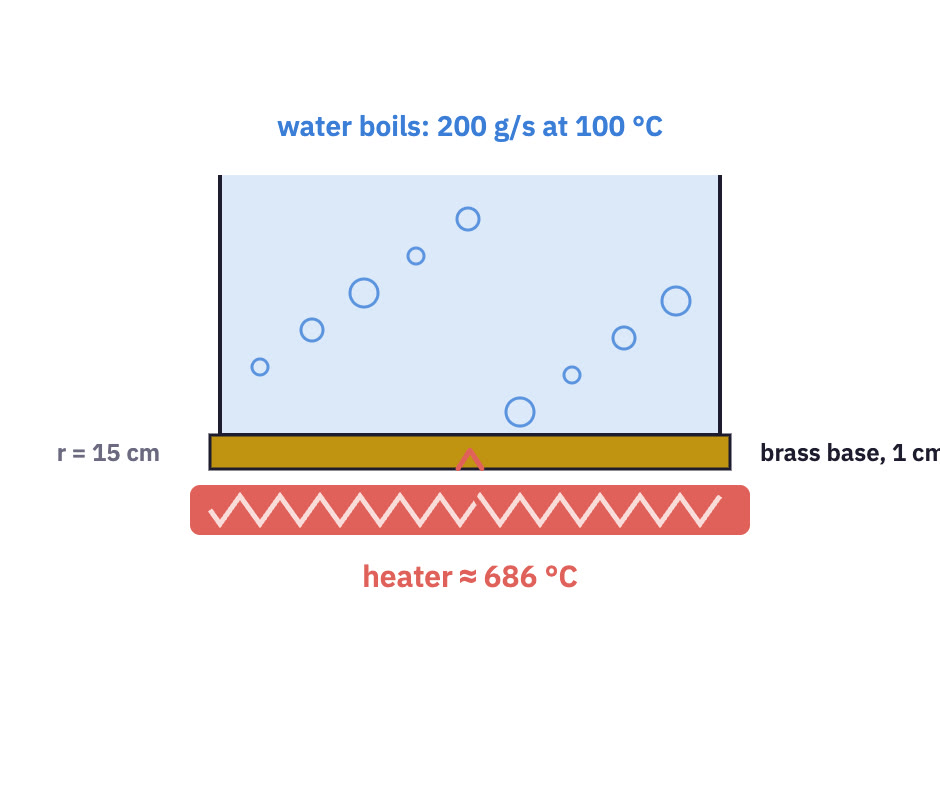
Heater under a boiler
Heat conducted through the brass base boils the water: .
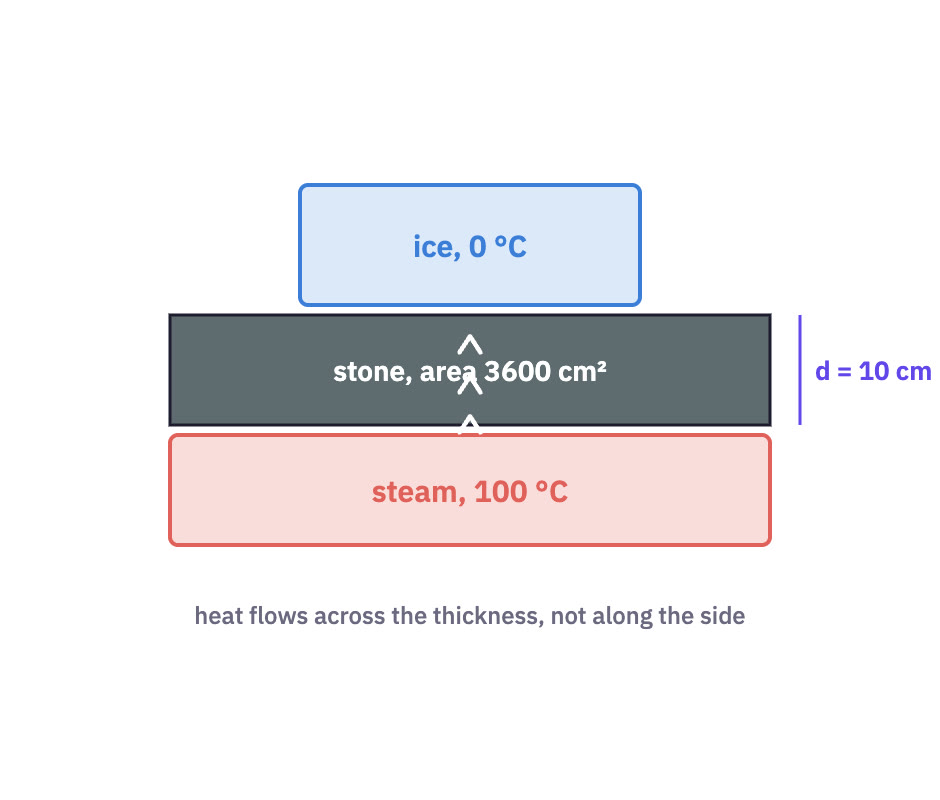
Stone between steam and ice
The heat conducted across the slab's thickness melts the ice: .
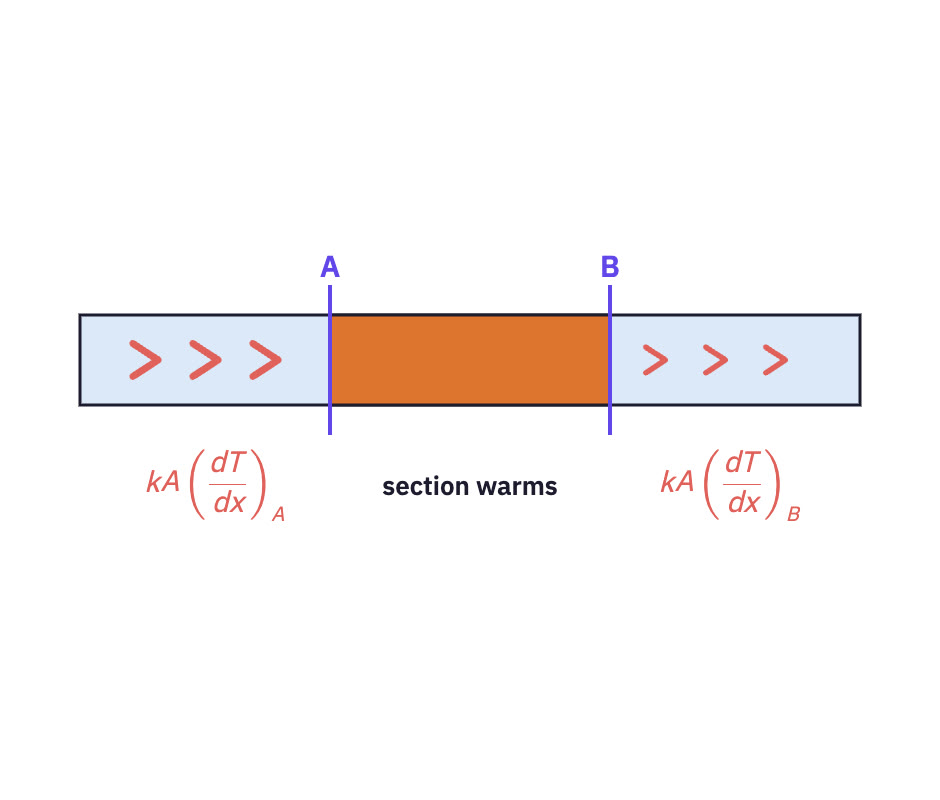
Heat in > heat out
A section of rod absorbs the difference and warms: .
Key formulas
One for every idea
1. A cylindrical brass boiler of radius 15 cm and thickness 1.0 cm is filled with water and placed on an electric heater. If the water boils at 200 g/s, estimate the temperature of the heater. (brass) = 109 W m⁻¹ °C⁻¹, = 2256 J/g.
- Heat needed per second: J/s.
- m², m.
- .
°C (the book gives 685.5 °C).
2. A slab of stone of area 3600 cm² and thickness 10 cm has steam at 100 °C on its lower face and ice at 0 °C on its upper face. 4.8 kg of ice melts in one hour. Find the thermal conductivity of the stone ( = 3.36 × 10⁵ J/kg).
- .
- .
W m⁻¹ K⁻¹.
3. Before steady state, 5 J/s enters a short section of a rod and 3 J/s leaves it. The section's heat capacity is 10 J/°C. How fast is its temperature rising?
- It keeps J/s.
- .
0.2 °C/s; in steady state this becomes zero.
Your turn
Two rods of the same material connect the same two heat reservoirs. Rod 2 is twice as long as rod 1 and has twice its radius. The ratio of heat currents H₂/H₁ is:
Show the answer and the traps
Area goes as r², so ×4; length doubles, so ×½. H₂/H₁ = 4 × ½ = 2: option b.
1 assumes the two doublings cancel, but the area goes as r squared.
4 forgets that the longer rod carries less.
And ½ turns the law upside down: the heat current goes as A/l, not l/A.
Common mistakes
Try these
1. A glass window 1.5 m² in area and 2 cm thick has its faces at 20 °C and 5 °C. = 0.8 W m⁻¹ K⁻¹. Find the heat current.
W.
2. A copper rod 50 cm long with cross-section 4 cm² ( = 385 W m⁻¹ K⁻¹) has its ends at 100 °C and 0 °C. Find the heat current.
W.
3. (Book, PE 4.1 ii) A 100 W heater is placed in a cubical container of edge 6 cm with walls 1 mm thick. In steady state the inside is at 30 °C and the outside at 25 °C. Find the thermal conductivity of the walls.
Area of 6 faces m²: W m⁻¹ °C⁻¹.
4. (Book, PE 4.1 iii) One end of a 1 m metal rod of area 10 cm² is in boiling water and the other in an ice chamber. = 92 cal m⁻¹ s⁻¹ °C⁻¹, = 80 cal/g. How much ice melts in one minute?
cal/s; in 60 s: 552 cal ÷ 80 = 6.9 g.
5. (Book, PE 4.1 xi) A room is kept at 20 °C by a 20 Ω heater on 200 V mains. All heat leaves through a 1 m² glass window 0.2 cm thick ( = 0.2 cal s⁻¹ m⁻¹ °C⁻¹, J = 4.2 J/cal). Find the outside temperature.
Heater: W = 476.2 cal/s; °C, so outside ≈ 15.24 °C.