 layrd.liveLayer by Layer
- 1. Conduction & Steady State
- 2. Thermal Conductivity
- 3. Rods in Series
- 4. Parallel & Networks
- 5. Radial Conduction & Ice
- 6. Heating Through a Rod
- 7. Convection
- 8. Radiation & Kirchhoff
- 9. Stefan's Law
- 10. Solar Constant
- 11. Newton's Cooling
- 12. Method of Cooling
- 13. Wien's Law
- 14. Planck & Kirchhoff
Thermal Radiation, Prevost's Theory and Kirchhoff's Law
Radiation needs no medium. Every body above 0 K radiates and absorbs at the same time (Prevost), incident energy splits into reflected, absorbed and transmitted parts, and Kirchhoff's law says a good absorber is a good emitter: , with the black body at .
Builds on: Part 1 · Heat Conduction: Mechanism and Steady State.
 Video coming soon
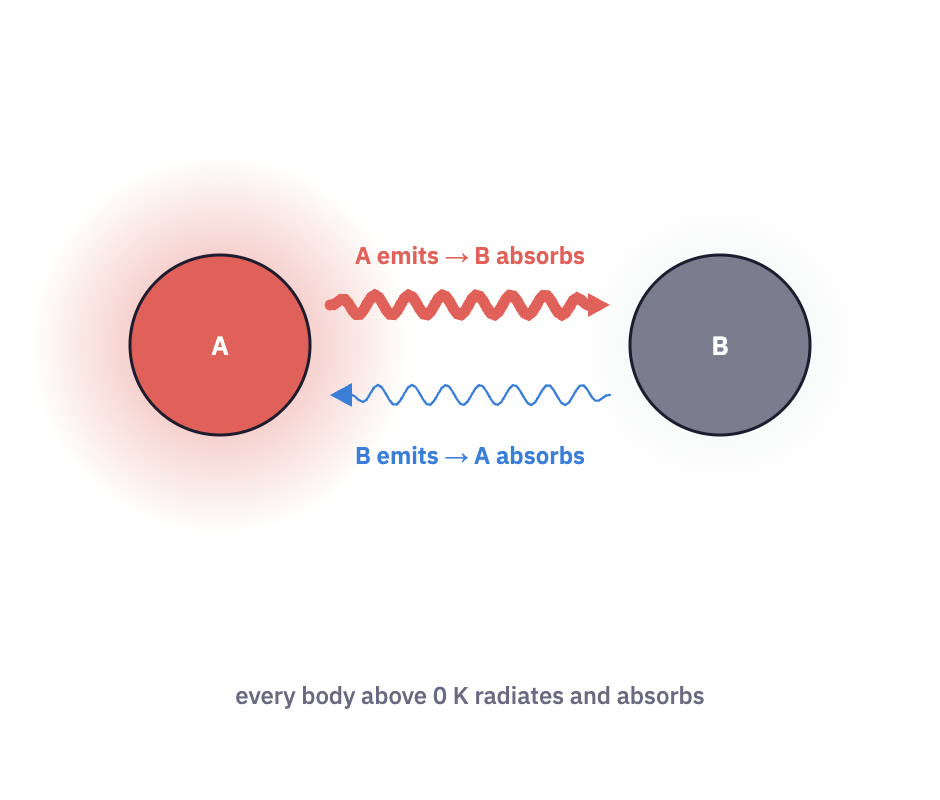
Every body radiates and absorbs
A hotter body emits more than it absorbs from a colder one, so the net flow is from hot to cold. At equal temperatures the exchange balances: a dynamic equilibrium.
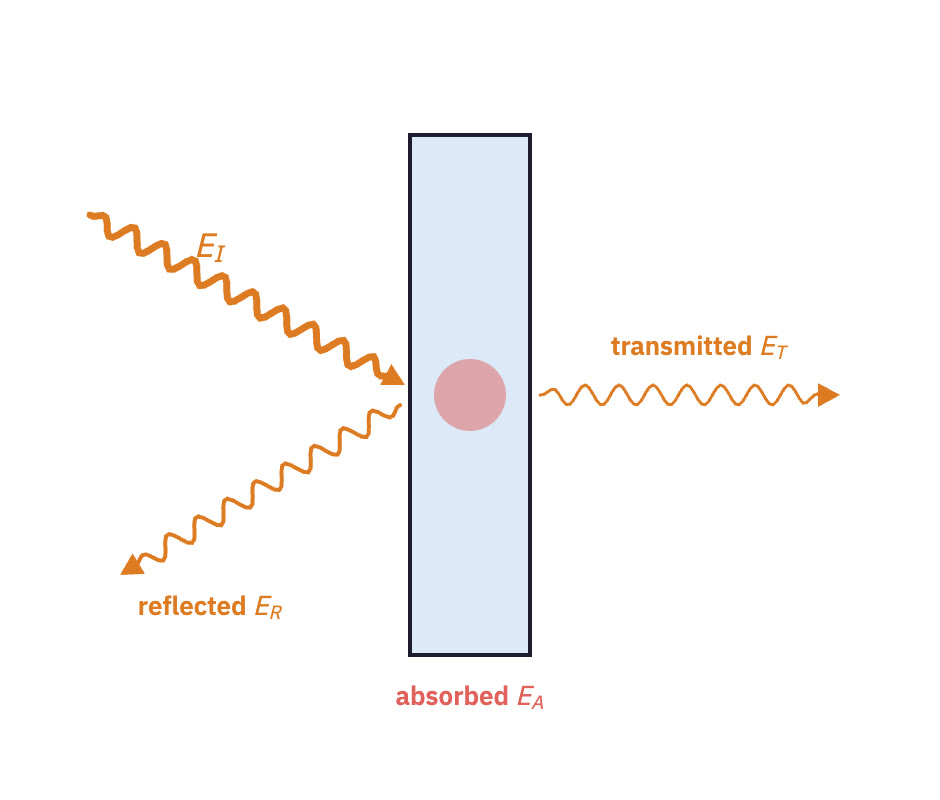
Incident energy splits into reflected, absorbed and transmitted parts: .
From polished steel to lamp black
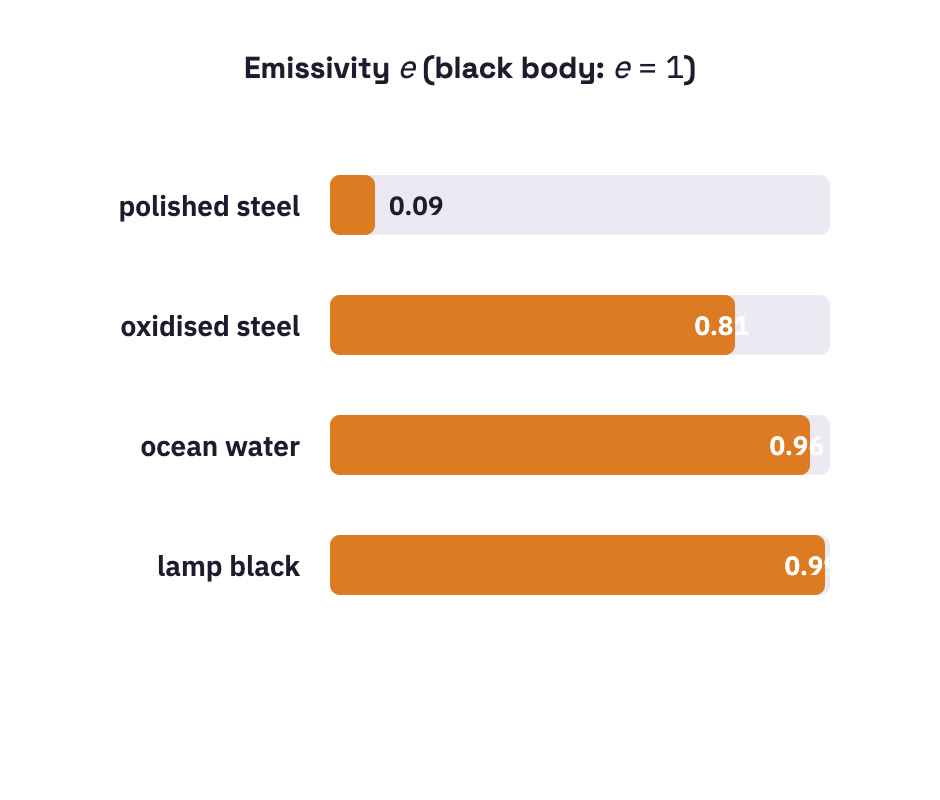
= power radiated / power of a black body of the same size at the same temperature: polished steel 0.09, oxidised steel 0.81, ocean water 0.96, lamp black almost 1.
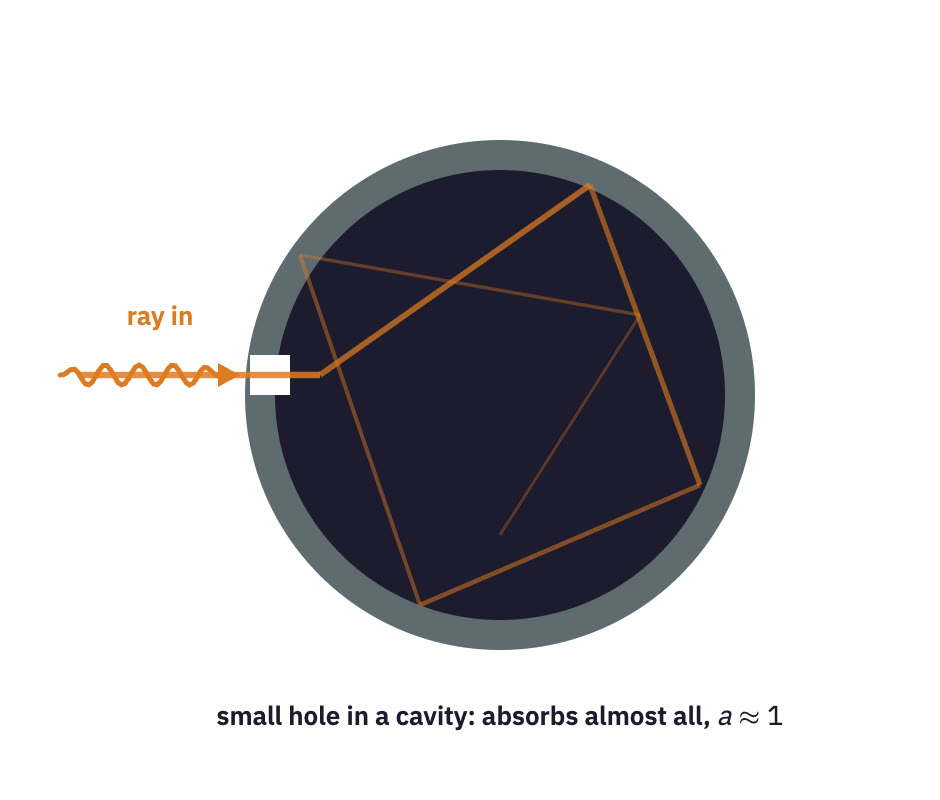
A cavity with a small hole
Radiation entering a small hole bounces around inside and is almost entirely absorbed, whatever the walls are made of: a practical black body.
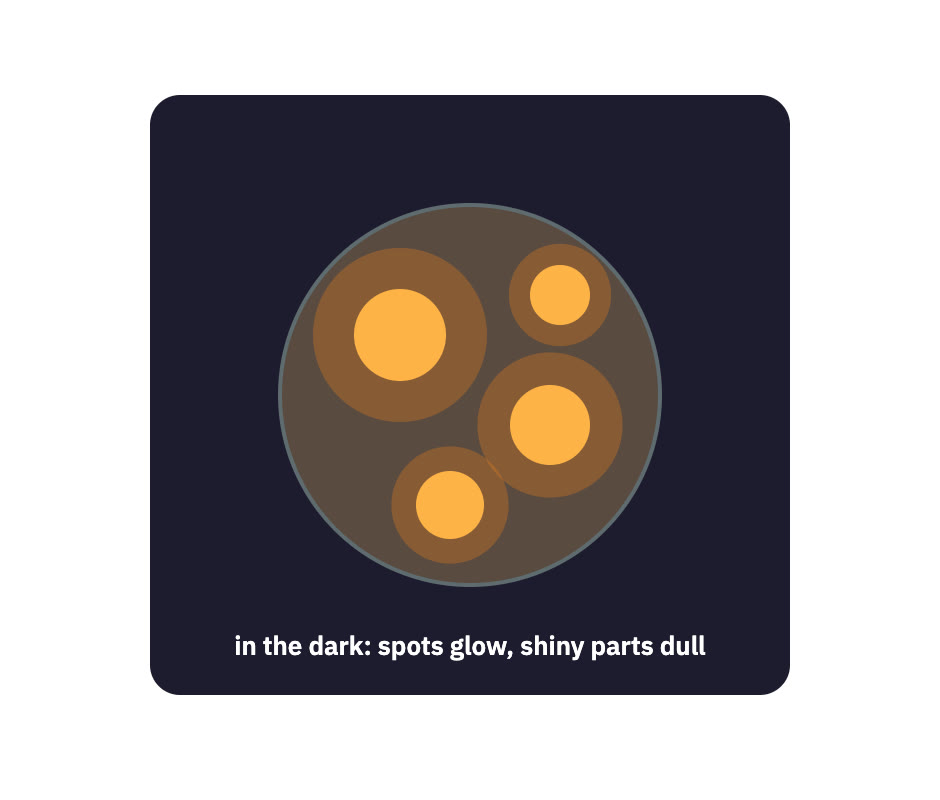
Spots that glow
Black spots absorb well, so by Kirchhoff's law they also emit well and glow brightly in the dark; the shiny parts look dull.
Key formulas
One for every idea
1. Two bodies at the same temperature are kept close together. Does either stop radiating? Explain with Prevost's theory.
- Both are above 0 K, so both radiate.
- Each absorbs as much as it emits.
No: the net transfer is zero, but the equilibrium is dynamic.
2. Of the radiation falling on a body, joules are incident and joules are reflected and transmitted. Find its absorption coefficient.
- Absorbed .
.
3. A shiny metal ball with black spots is heated to a high temperature and taken into a dark room. Which parts glow brightly, and why?
- Black spots are good absorbers, so by Kirchhoff's law good emitters.
- Shiny parts reflect most radiation, absorb little and emit little.
The black spots glow brightly; the shiny parts look dull.
Your turn
A body reflects 30% and transmits 10% of the thermal radiation falling on it. Its emissivity is:
Show the answer and the traps
a = 1 − 0.3 − 0.1 = 0.6, and by Kirchhoff e = a = 0.6: option b.
0.3 is its reflectivity, not its absorptivity.
0.7 forgets the transmitted 10%.
And 0.9 forgets the reflected 30%.
Common mistakes
Try these
1. A surface reflects 25% and absorbs 70% of the radiation falling on it. Find its transmittance and its emissivity.
; .
2. Why does a black body look black at room temperature but glow brightest when heated?
It absorbs all visible light (black); by Kirchhoff's law it is also the best emitter when hot.
3. Two bodies at different temperatures in a closed box reach the same temperature. Do they stop radiating?
No; each emits and absorbs equally: dynamic equilibrium.