 layrd.liveLayer by Layer
- 1. Conduction & Steady State
- 2. Thermal Conductivity
- 3. Rods in Series
- 4. Parallel & Networks
- 5. Radial Conduction & Ice
- 6. Heating Through a Rod
- 7. Convection
- 8. Radiation & Kirchhoff
- 9. Stefan's Law
- 10. Solar Constant
- 11. Newton's Cooling
- 12. Method of Cooling
- 13. Wien's Law
- 14. Planck & Kirchhoff
Planck's Law and Kirchhoff's Law in Action
Planck's radiation law fits the whole black-body curve and contains Rayleigh's long-wavelength formula, Wien's displacement law and Stefan's law. Kirchhoff's law (good absorbers are good emitters) then explains desert nights, the Fraunhofer lines in sunlight and glass that glows the 'wrong' colour.
Builds on: Part 8 · Thermal Radiation, Prevost's Theory and Kirchhoff's Law, Part 13 · Black-Body Spectrum and Wien's Law.
 Video coming soon
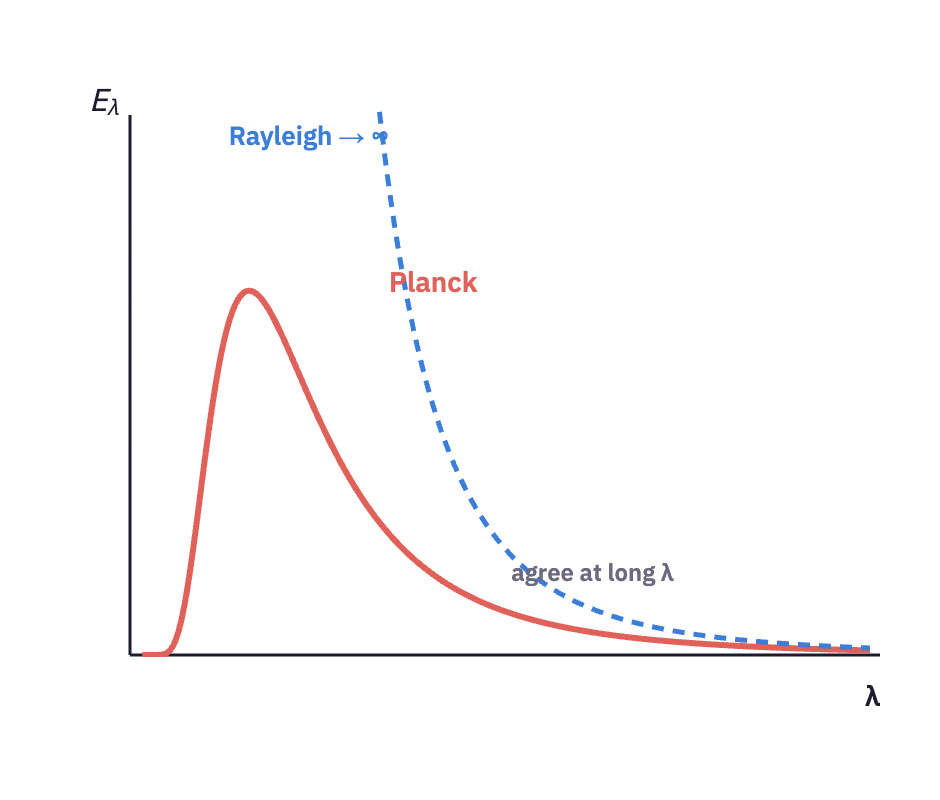
Rayleigh vs Planck
Rayleigh's matches at long wavelengths but blows up at short ones. Planck's fits the whole curve.
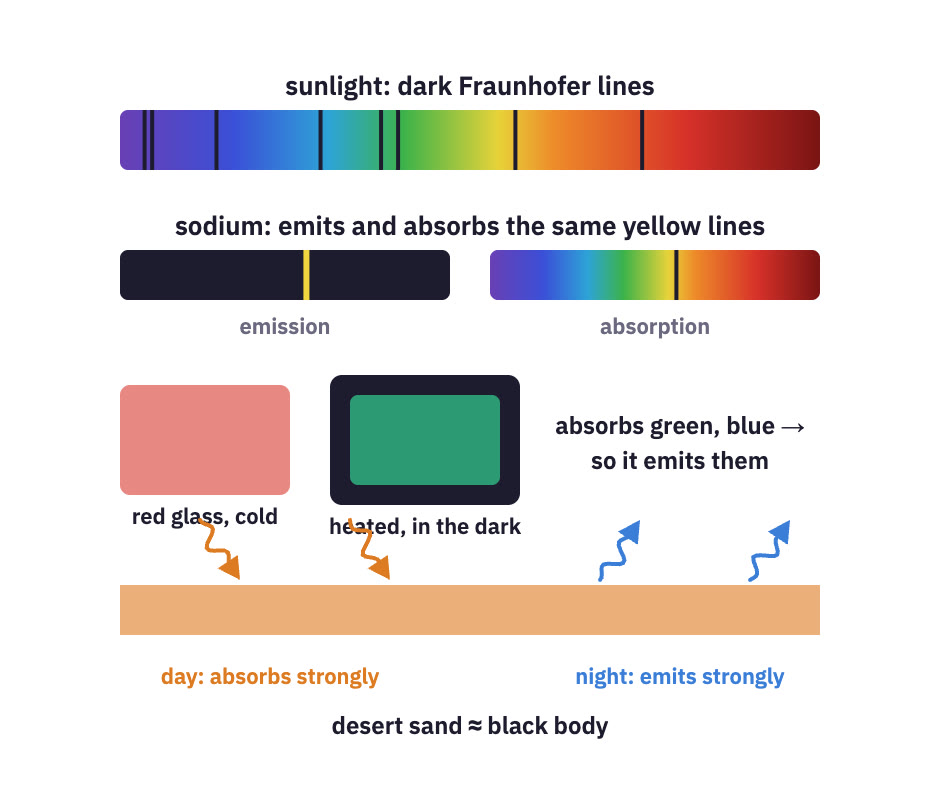
Good absorbers emit well
Fraunhofer lines: cooler gases in the Sun's outer layer absorb what they would emit. Sodium absorbs the same yellow lines it emits. Red glass heated in the dark glows green. Desert sand absorbs strongly by day and emits strongly by night.
Key formulas
One for every idea
1. Show that Planck's law reduces to Rayleigh's formula at long wavelengths.
- For large λ, , so .
- .
, Rayleigh's formula.
2. Why are days in a desert very hot and nights very cold?
- Rough, dark sand is almost a black body: a good absorber, so it heats up strongly by day.
- By Kirchhoff's law it is also a good emitter, so it radiates its heat away quickly at night.
Good absorber by day, good emitter by night.
Your turn
A piece of red glass is heated in a dark room until it glows. It glows:
Show the answer and the traps
It absorbs green and blue strongly, so by Kirchhoff's law it emits them: it glows green, option b.
Red is the colour it transmits, not the one it absorbs, so it emits little red.
White would need it to absorb all colours equally, like a black body.
And every hot body glows; the question is only which colours.
Common mistakes
Try these
1. A sodium flame looks bright yellow, yet sunlight shows dark lines at the same yellow wavelengths. Explain.
Hot sodium emits those lines; cooler sodium in the Sun's atmosphere absorbs the same lines (Kirchhoff), leaving them dark.
2. Why does a greenhouse stay warm?
Glass lets visible sunlight in but blocks the longer infrared that the warm inside radiates back.
3. (Book, PE 4.4 ii) A black body radiates power with its peak at λ. Its temperature changes so that the peak is at 3λ/4. By what factor does the power increase?
rises by 4/3, so rises by .
4. (Book, PE 4.4 iv) A black body at 2880 K. is the energy it emits between 4990 Å and 5000 Å, between 9990 Å and 10 000 Å. Find .
Planck's law for equal 10 Å bands: .