 layrd.liveLayer by Layer
- 1. Conduction & Steady State
- 2. Thermal Conductivity
- 3. Rods in Series
- 4. Parallel & Networks
- 5. Radial Conduction & Ice
- 6. Heating Through a Rod
- 7. Convection
- 8. Radiation & Kirchhoff
- 9. Stefan's Law
- 10. Solar Constant
- 11. Newton's Cooling
- 12. Method of Cooling
- 13. Wien's Law
- 14. Planck & Kirchhoff
Comparing Cooling Bodies: Specific Heat and Steady Temperature
With the same surface and the same temperature range, a body that stores more heat cools more slowly: the cooling time is proportional to its heat capacity. That is the method of cooling for specific heats, and the same law gives the power a heater needs to hold a steady temperature.
Builds on: Part 11 · Newton's Law of Cooling.
 Video coming soon
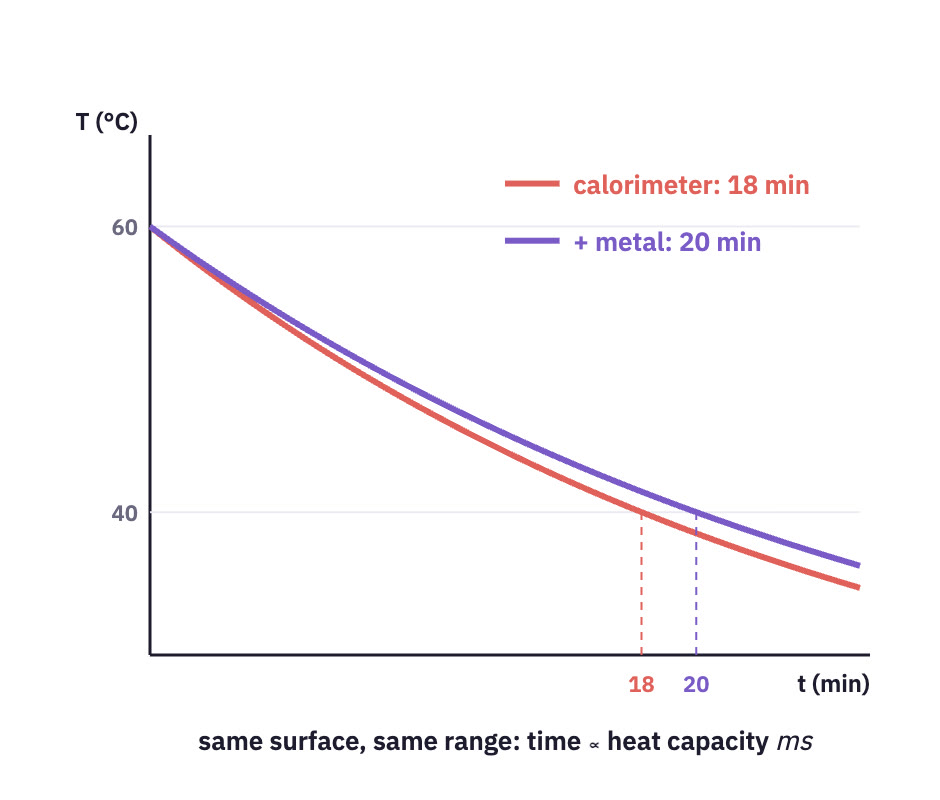
Time ∝ heat capacity
A calorimeter cools from 60 °C to 40 °C in 18 minutes; with a metal block inside, in 20 minutes. The extra time gives the metal's specific heat.
Heater power = heat loss
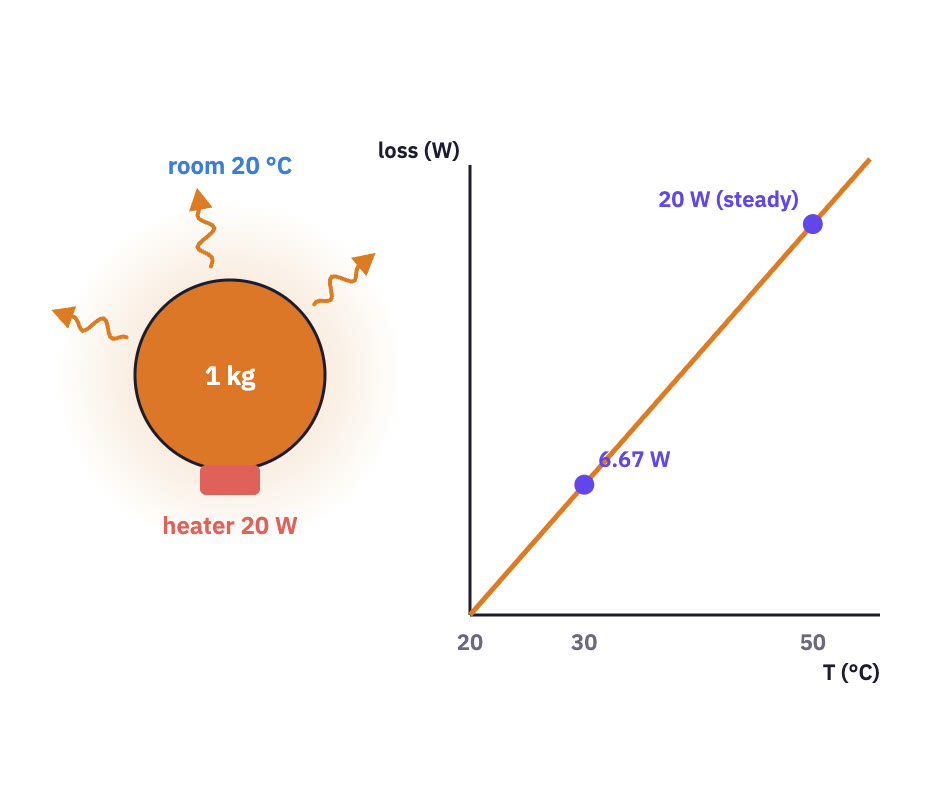
At a steady temperature the heater's power equals the rate of heat loss, which is proportional to .
Key formulas
One for every idea
1. A calorimeter of water equivalent 100 g cools from 60 °C to 40 °C in 18 minutes. With a 60 g metal block at 60 °C inside, the system cools over the same range in 20 minutes. Find the specific heat of the metal.
- Same surface and range: time ∝ heat capacity, .
- .
cal g⁻¹ °C⁻¹.
2. A 1 kg metal ball is heated by a 20 W heater in a room at 20 °C until its temperature is steady at 50 °C. Find its rate of heat loss at 50 °C and at 30 °C.
- Steady at 50 °C: loss = heater power = 20 W.
- W/°C.
At 50 °C: 20 W. At 30 °C: W.
Your turn
Two solid spheres of the same material, of radii r and 2r, are at the same temperature in the same surroundings. The ratio of their initial rates of cooling (smaller : larger) is:
Show the answer and the traps
Rate of cooling ∝ A/m ∝ r²/r³ = 1/r. The small one cools twice as fast: 2 : 1, option b.
1 : 4 is the ratio of the rates of heat loss, which go as area.
1 : 2 turns the answer upside down.
And 1 : 1 forgets that the mass grows faster than the area.
Common mistakes
Try these
1. Two liquids of equal mass in identical containers cool over the same range in 6 and 9 minutes (neglect the containers). Find the ratio of their specific heats.
Time ∝ : .
2. A heater keeps a body at 60 °C in a room at 20 °C using 40 W. What power keeps it at 40 °C?
Loss ∝ : W.
3. (Book, PE 4.3 v) 100 g of water at 40 °C in a calorimeter of negligible heat capacity cools to 35 °C in 5 min. The same volume of a liquid (2100 J/kg °C) cools over the same range in 2 min. Find the liquid's density (water 4200 J/kg °C).
Time ∝ : kg in 100 cm³, so 800 kg/m³.