 layrd.liveLayer by Layer
- 1. Conduction & Steady State
- 2. Thermal Conductivity
- 3. Rods in Series
- 4. Parallel & Networks
- 5. Radial Conduction & Ice
- 6. Heating Through a Rod
- 7. Convection
- 8. Radiation & Kirchhoff
- 9. Stefan's Law
- 10. Solar Constant
- 11. Newton's Cooling
- 12. Method of Cooling
- 13. Wien's Law
- 14. Planck & Kirchhoff
Radiation with Conduction, and the Solar Constant
In steady state the heat conducted to a surface equals the net heat it radiates, . The same balance of radiation, spread over a sphere, turns the solar constant and the Sun's angular size into the temperature of the Sun's surface.
Builds on: Part 2 · Law of Heat Conduction and Thermal Conductivity, Part 9 · Stefan–Boltzmann Law and Net Radiation.
 Video coming soon
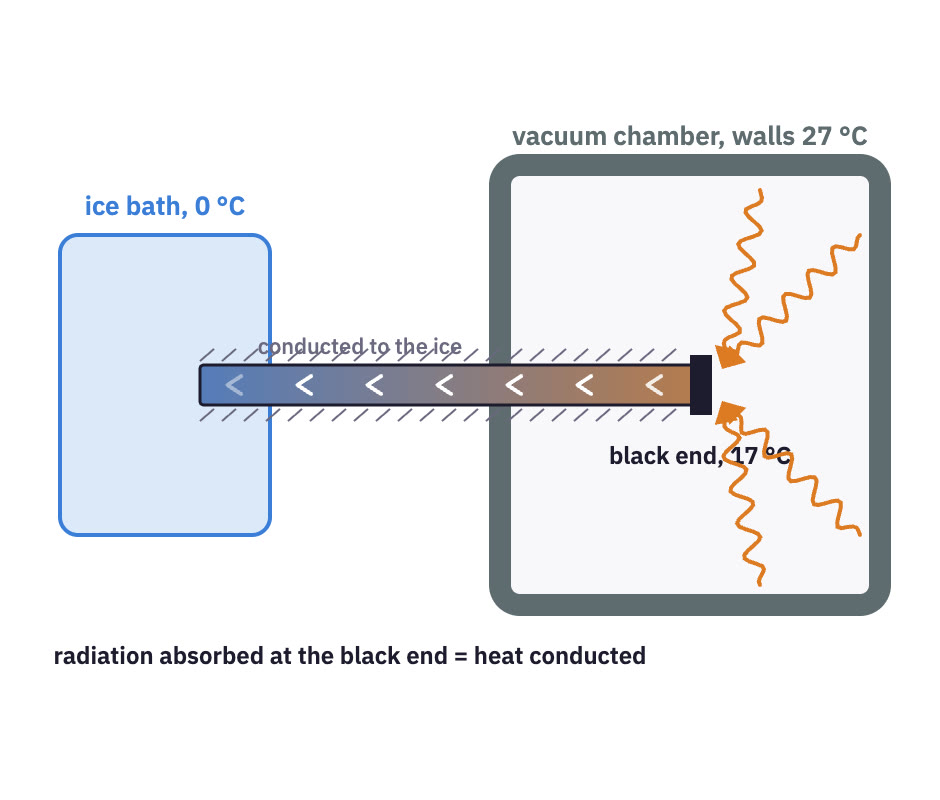
Conducted = radiated
The black end inside the warmer chamber absorbs radiation, which is conducted along the rod to the ice bath and melts ice at .
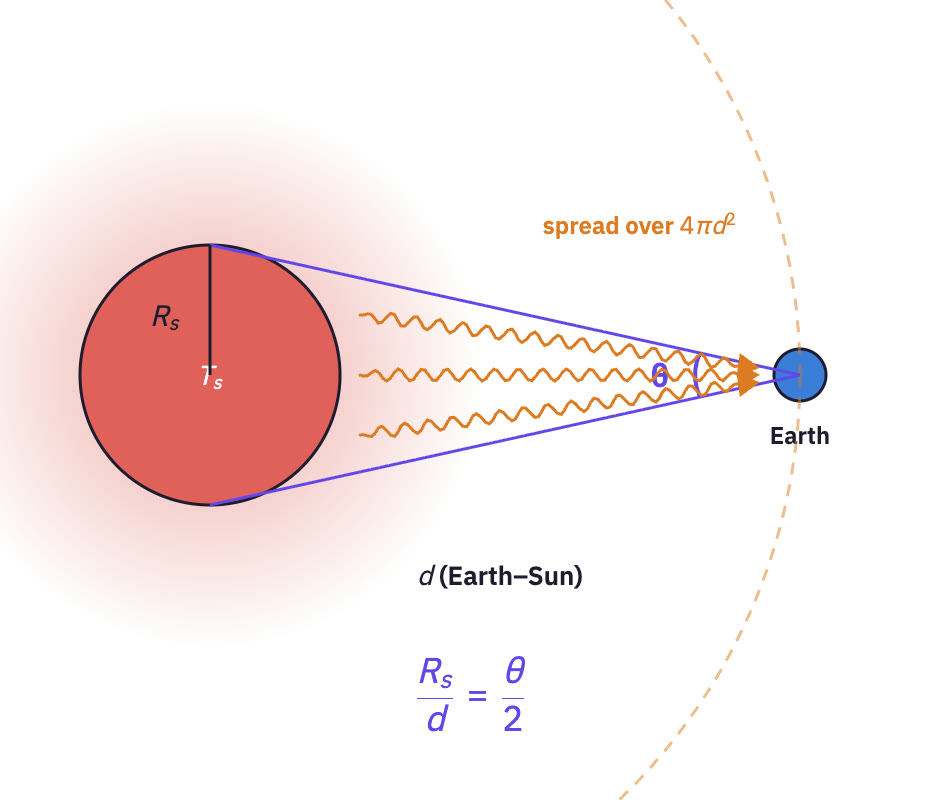
The Sun's power spreads over ; with the solar constant gives the Sun's temperature.
Key formulas
One for every idea
1. A cylindrical rod 50 cm long with cross-section 1 cm² connects an ice bath at 0 °C to a vacuum chamber at 27 °C. Its end inside the chamber behaves as a black body and is at 17 °C in steady state. Find the thermal conductivity of the rod and the rate at which ice melts ( = 3.35 × 10⁵ J/kg).
- W m⁻¹ °C⁻¹.
- W.
Ice melts at kg/s.
2. The Earth receives solar energy at 2 cal cm⁻² per minute. Treating the Sun as a black body with an angular diameter of 32 minutes of arc, estimate its surface temperature ( = 5.67 × 10⁻⁸).
- W/m².
- rad.
- .
K.
Your turn
If the surface temperature of the Sun were doubled and the Earth–Sun distance were also doubled, the solar constant S would become:
Show the answer and the traps
S ∝ T⁴/d² = 16/4 = 4 times: option b.
S assumes the two changes cancel, but T⁴ beats d².
8S treats the intensity as falling like 1/d.
And 16S forgets the larger distance.
Common mistakes
Try these
1. The solar constant at the Earth is 1400 W/m². Mars is 1.52 times farther from the Sun. Find the solar constant at Mars.
W/m².
2. If the Sun looked 10% larger in angular diameter at the same surface temperature, by how much would the solar constant change?
: × 1.21, a 21% increase.
3. (Book, PE 4.2 vii) A space station's blackened spherical shell is kept at 500 K by its appliances. A thin black screen of nearly the same radius is put around it. Find the new temperature of the shell.
The appliances' power is unchanged: . The screen radiates from both faces, , and , so the screen is at 500 K and the shell at K.