 layrd.liveLayer by Layer
- 1. Electric Charge
- 2. Coulomb's Law
- 3. Equilibrium of Charges
- 4. Hanging Balls
- 5. Electric Field
- 6. Uniform Field
- 7. Ring of Charge
- 8. Line Charges
- 9. Arcs, Disks & Sheets
- 10. Field Lines
- 11. Electric Dipole
- 12. Dipole in a Field
- 13. Charged SHM
Hanging Charged Balls and Mechanical Equilibrium
A charged ball on a string balances tension, weight and the Coulomb force: with . In a liquid both the force and the weight drop, which gives the dielectric constant.
Builds on: Part 2 · Coulomb's Law and the Superposition Principle.
 Video coming soon
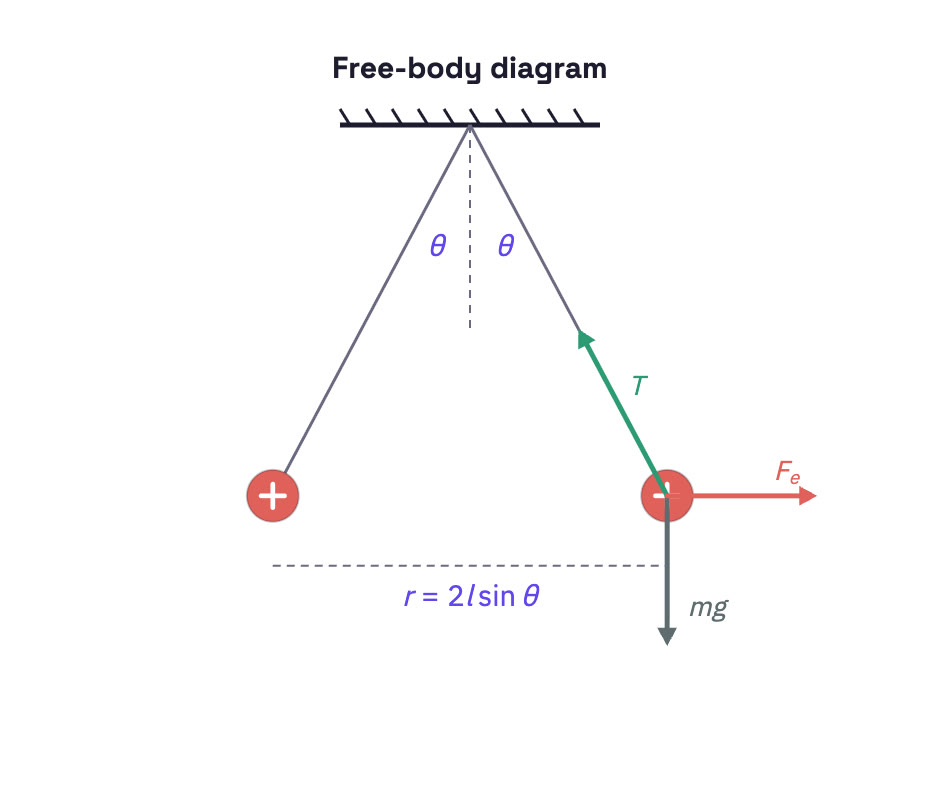
Free-body diagram
, , so ; the balls are apart.
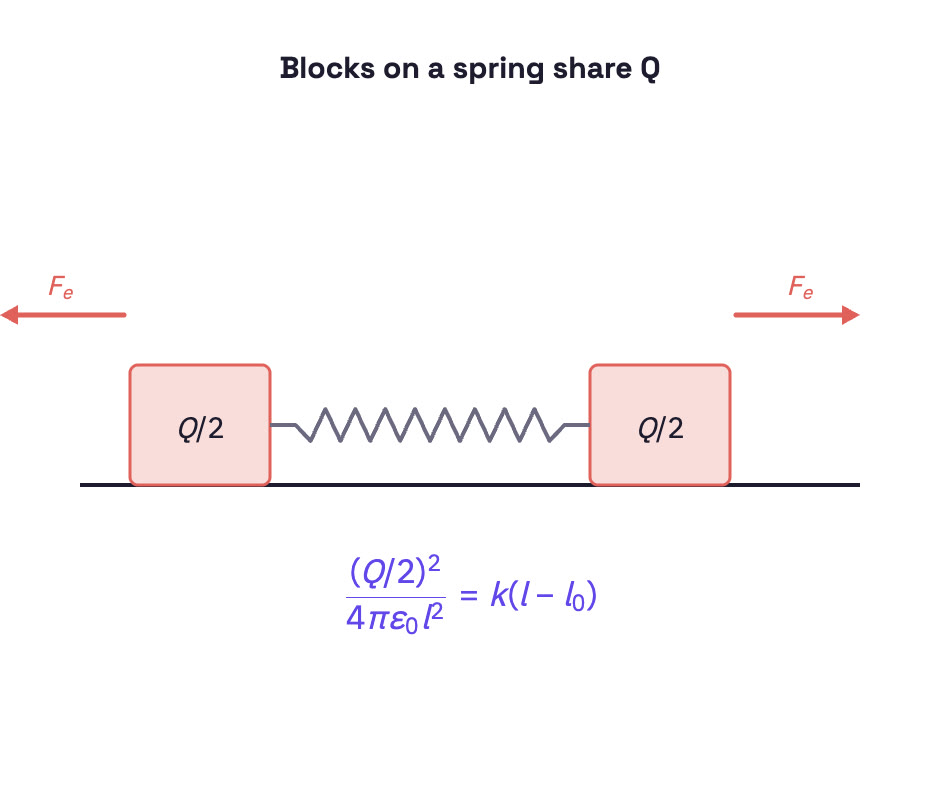
Shared charge Q
, so .
Key formulas
From the video
1. Two 10 g balls with equal charges hang from one point on 50 cm strings, each at 30° to the vertical. Find the charge on each ball.
- N.
- m; gives .
μC.
2. Charged balls of density 2.4 g/cm³ hang at an angle in air. In kerosene of density 0.8 g/cm³ the angle stays the same. Find the dielectric constant of kerosene.
- Same angle: with the apparent weight .
- .
.
Your turn
Two identical charged balls hang from a common point with a small separation x. If the charge on each ball is doubled, the new separation is about:
Show the answer and the traps
x³ is proportional to q², so x′ = x × 4^(1/3) ≈ 1.59x: option a.
2x treats x as proportional to q.
4x treats x as proportional to the force.
And 1.41x uses a square root instead of a cube root.
Common mistakes
Try these
1. Two 20 g balls on 1 m strings hang at 45° each. Find the charge on each.
N, m, μC.
2. Balls of density 1.8 g/cm³ keep the same angle in a liquid of density 0.9 g/cm³. Find K.
.
3. For small angles, by what factor does the separation change if the string length is doubled?
: times.
4. A 1 g ball with 0.5 μC is held 5 cm above a fixed charge Q. Find Q.
C.