 layrd.liveLayer by Layer
- 1. Electric Charge
- 2. Coulomb's Law
- 3. Equilibrium of Charges
- 4. Hanging Balls
- 5. Electric Field
- 6. Uniform Field
- 7. Ring of Charge
- 8. Line Charges
- 9. Arcs, Disks & Sheets
- 10. Field Lines
- 11. Electric Dipole
- 12. Dipole in a Field
- 13. Charged SHM
Electric Field Lines and Electrostatic Shielding
Field lines show the field at a glance: their tangent gives the direction and their density the strength. They start on positive charges, end on negative ones, never cross, and an earthed conductor shields the region behind it.
Builds on: Part 5 · Electric Field of Point Charges.
 Video coming soon
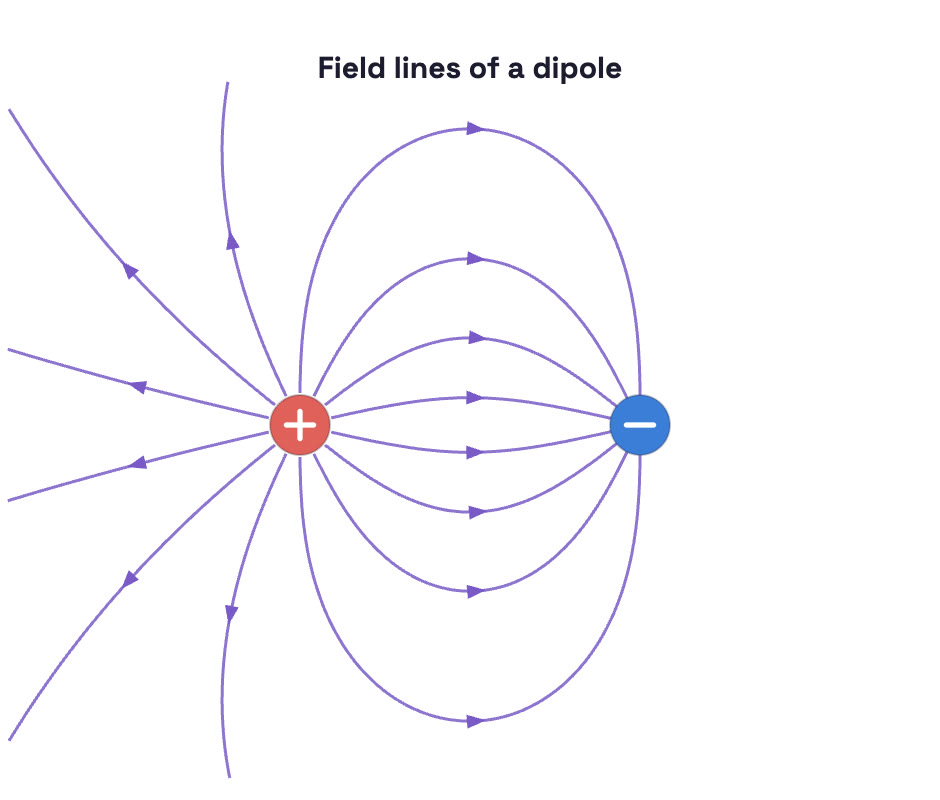
A dipole
Lines leave and end on ; they are dense near the charges.
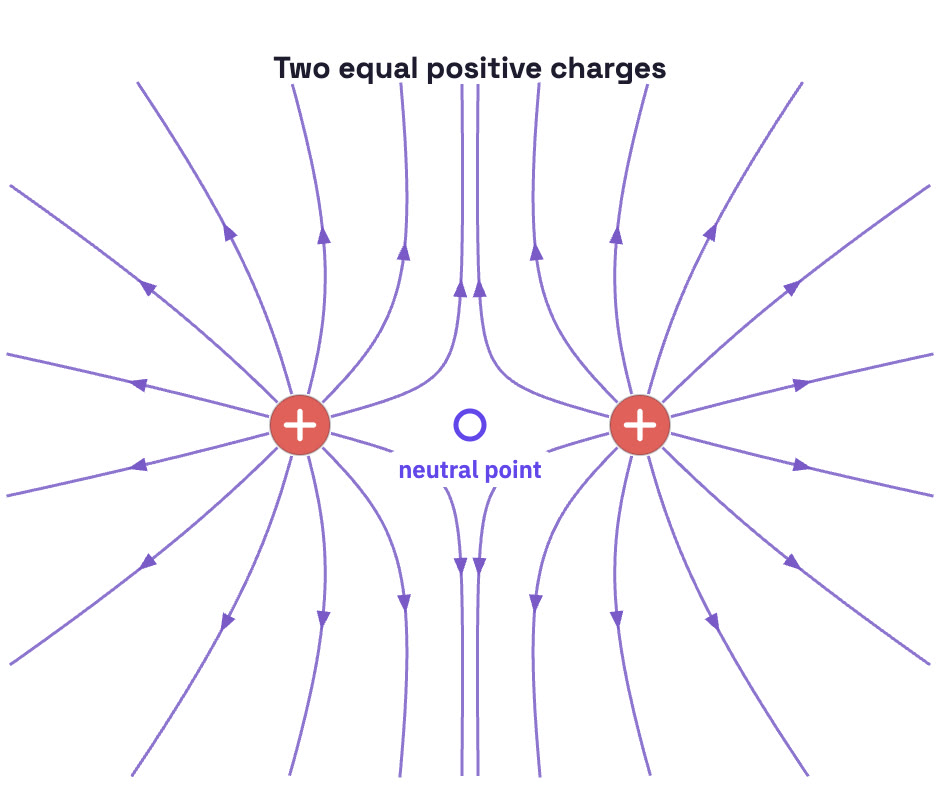
Two equal positive charges
Lines bend away from each other; the field is zero at the neutral point midway.
Key formulas
From the video
1. Charges +4q and −q are a distance d apart. Where is the neutral point, and what do the field lines look like?
- Unlike charges: outside, beyond the smaller : .
- .
A distance beyond ; only a quarter of the lines leaving end on .
Your turn
30 electric field lines leave a charge A and 10 field lines end on a charge B, with no other lines ending on B. The ratio qA/qB is:
Show the answer and the traps
Line count is proportional to charge, and B is negative: qA/qB = −3: option a.
+3 misses that lines ending on B make it negative.
−1/3 has the ratio upside down.
And +1/3 makes both mistakes.
Common mistakes
Try these
1. 20 lines cross each square metre where E = 5 N/C. Where 60 lines cross, what is E?
15 N/C.
2. Charges +9q and −q are a distance d apart. Where is the neutral point?
beyond .
3. Can two field lines cross?
No: the field would have two directions at one point.
4. For q₁ = q₂, a line leaves q₁ at 50° to the joining line. At what angle does it reach −q₂?
50°.