 layrd.liveLayer by Layer
- 1. Conduction & Steady State
- 2. Thermal Conductivity
- 3. Rods in Series
- 4. Parallel & Networks
- 5. Radial Conduction & Ice
- 6. Heating Through a Rod
- 7. Convection
- 8. Radiation & Kirchhoff
- 9. Stefan's Law
- 10. Solar Constant
- 11. Newton's Cooling
- 12. Method of Cooling
- 13. Wien's Law
- 14. Planck & Kirchhoff
Thermal Resistance and Rods in Series
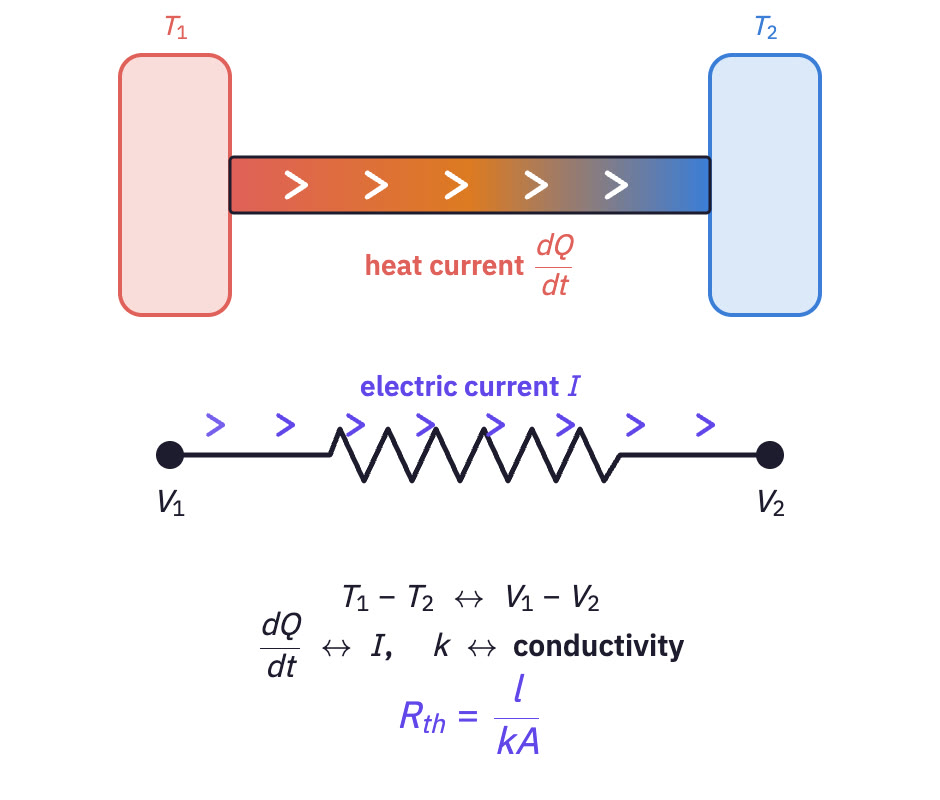
Rewrite the law of conduction as with , and a rod becomes a resistor. Rods joined end to end then behave like resistors in series: one heat current, resistances that add, and a junction temperature you can find in one line.
Builds on: Part 2 · Law of Heat Conduction and Thermal Conductivity.
 Video coming soon
Temperature difference plays the role of potential difference, heat current the role of electric current, and the role of electrical conductivity. Valid when the cross-section is uniform.
Same heat current, adds
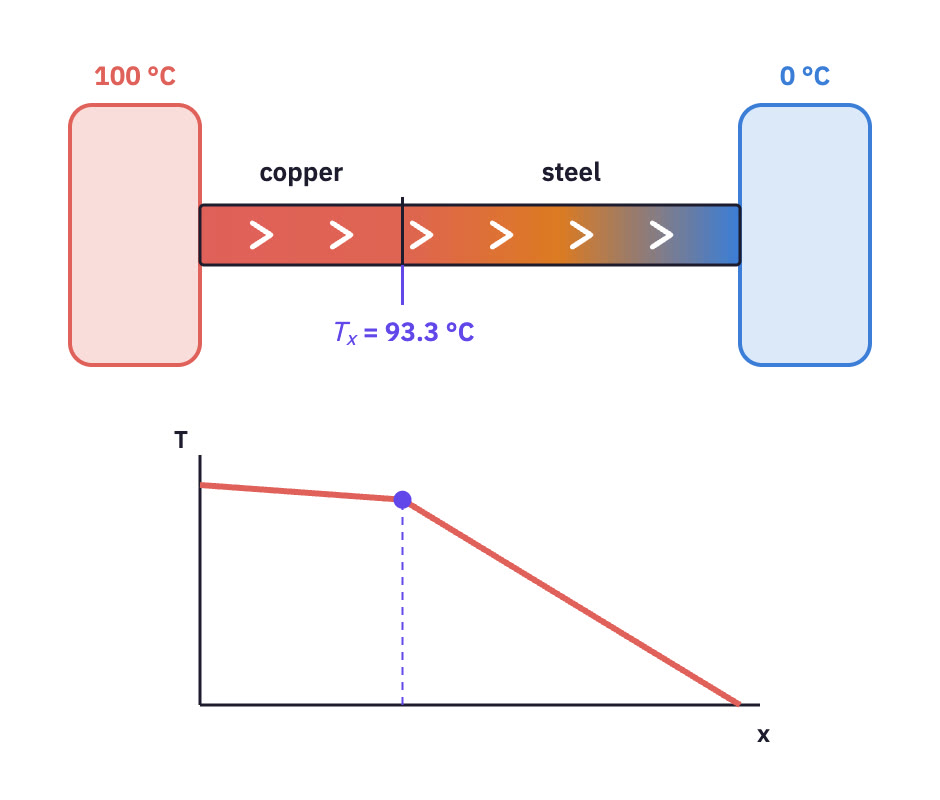
End to end, the same current flows through both rods, so and each temperature drop is proportional to its resistance. The T–x graph has a kink at the junction, steeper in the poorer conductor.
Key formulas
One for every idea
1. The thermal conductivities of two materials are in the ratio 1 : 2. Rods of these materials have lengths in the ratio 1 : 2 and areas in the ratio 1 : 2. Find the ratio of their thermal resistances.
- .
.
2. A copper bar 75 cm long and a steel bar 125 cm long, both 2 cm in diameter, are joined end to end with free ends at 100 °C and 0 °C and insulated sides. : copper 9.2 × 10⁻², steel 1.1 × 10⁻² kcal m⁻¹ s⁻¹ °C⁻¹. Find the junction temperature and the heat current.
- Equal currents: .
- °C.
- with m².
°C, kcal/s.
Your turn
Two slabs of equal thickness are joined face to face. The thermal conductivity of slab 1 is three times that of slab 2. The outer face of slab 1 is at 100 °C and that of slab 2 at 20 °C. In steady state the interface temperature is:
Show the answer and the traps
R₁ is a third of R₂, so slab 1 takes a quarter of the 80 °C drop, 20 °C. Interface: 80 °C, option b.
60 °C is the average, true only for equal resistances.
40 °C gives the bigger drop to the better conductor. It's the other way round.
And 73.3 °C divides the drop by the conductivity ratio instead of sharing it by resistance.
Common mistakes
Try these
1. Two rods of equal length and area ( = 200, = 50 W m⁻¹ K⁻¹) are joined end to end, rod 1 at 100 °C and rod 2 at 0 °C. Find the junction temperature.
: rod 1 takes of the drop, so °C.
2. Find the equivalent conductivity of the pair in the previous question.
W m⁻¹ K⁻¹.
3. (Book, PE 4.1 i) A wall has two layers of equal thickness; . The temperature difference across the wall is 36 °C. Find the difference across layer A.
Drop ∝ R ∝ 1/k: A takes of 36, so 12 °C.
4. (Book, PE 4.1 v) A 50 cm steel rod ( = 0.11 cal cm⁻¹ s⁻¹ °C⁻¹) has a 0.2 mm water film ( = 1.5 × 10⁻³) at each end; the ends are at 0 °C and 100 °C. Find the temperature gradient in the steel.
Resistances per unit area: ; current ; gradient °C/cm. (The book prints 0.945 °C/cm, half this value.)
5. (Book, PE 4.1 vi) Two plates of equal area and thickness with conductivities and are placed one on the other. Show that the composite conductivity is .
.