 layrd.liveLayer by Layer
- 1. Conduction & Steady State
- 2. Thermal Conductivity
- 3. Rods in Series
- 4. Parallel & Networks
- 5. Radial Conduction & Ice
- 6. Heating Through a Rod
- 7. Convection
- 8. Radiation & Kirchhoff
- 9. Stefan's Law
- 10. Solar Constant
- 11. Newton's Cooling
- 12. Method of Cooling
- 13. Wien's Law
- 14. Planck & Kirchhoff
Rods in Parallel and Networks of Rods
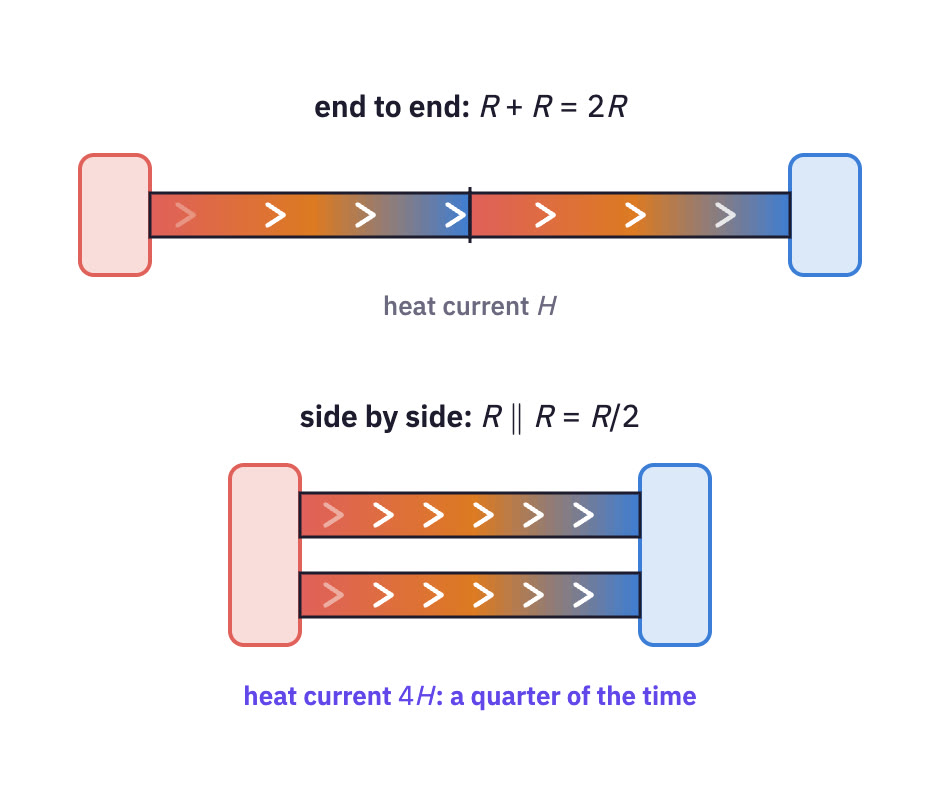
Side by side, rods share the temperature difference and their heat currents add. For any network of rods, the steady-state junction rule (heat in = heat out at every junction) turns the problem into a few linear equations.
Builds on: Part 3 · Thermal Resistance and Rods in Series.
 Video coming soon
Two identical rods give end to end and side by side: four times the heat current, a quarter of the time.
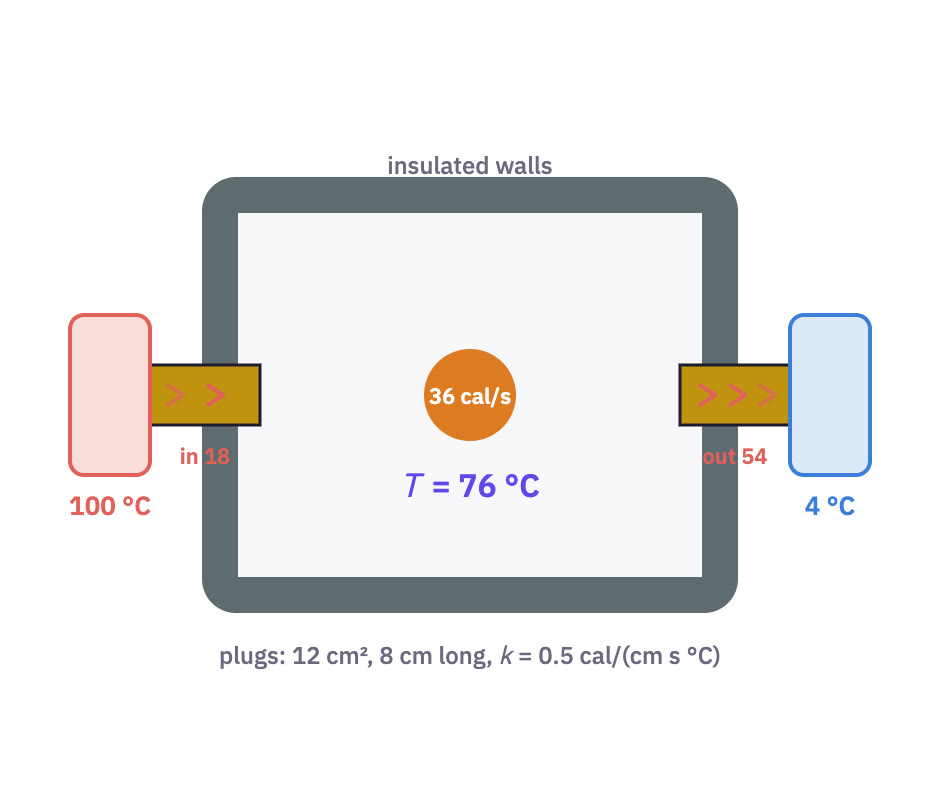
Source inside a box
In steady state the power of the source equals the total heat conducted out through the plugs.
Heat in = heat out
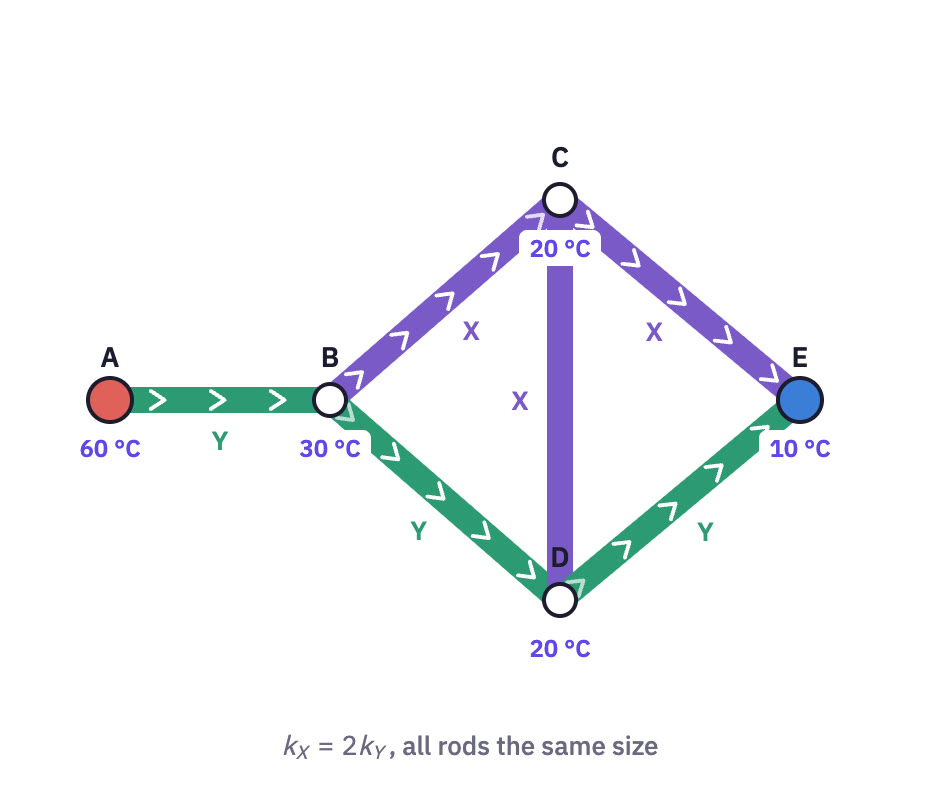
Write one equation per unknown junction. Here C and D come out at the same temperature, so the rod between them carries no heat.
Key formulas
One for every idea
1. Two identical rods transfer a certain amount of heat in 12 s when joined end to end. How long do they take side by side, between the same temperatures?
- End to end: . Side by side: , a quarter of .
- The heat current is 4 times larger.
s.
2. A closed box of insulating material has two metal plugs (area 12 cm², length 8 cm, = 0.5 cal cm⁻¹ s⁻¹ °C⁻¹) in opposite walls. Their outer ends are at 100 °C and 4 °C. A 36 cal/s source is inside. Find the equilibrium temperature of the inner surface.
- with .
- .
°C.
3. Three rods of material X and three of material Y, all of the same size, are connected as in figure 4.17. A is at 60 °C and E at 10 °C; . Find , , .
- B: .
- C: .
- D: .
°C, °C.
Your turn
Three identical rods are arranged so that two of them, side by side, are in series with the third. The free ends are at 100 °C and 0 °C (the pair on the hot side). In steady state the temperature of the junction is:
Show the answer and the traps
The pair is R/2 and the single rod R: total 1.5R. The pair takes a third of the drop, so 66.7 °C: option b.
50 °C splits the drop equally, ignoring that the pair has half the resistance.
33.3 °C gives the bigger drop to the pair.
And 80 °C treats the pair as R/4.
Common mistakes
Try these
1. Two rods of the same length, one with area and conductivity , the other with area and conductivity , are placed side by side. Find the equivalent conductivity.
.
2. Three identical rods conduct a certain heat in 10 s when side by side. How long when end to end, between the same temperatures?
Parallel , series : 9 times the resistance, so 90 s.
3. A rod of resistance joins A (100 °C) to junction B; from B two rods, each of resistance , go to points at 0 °C. Find .
°C.
4. (Book, PE 4.1 ix) Three identical rods form an isosceles triangle ABC right-angled at B. A and B are at and . Find the temperature of C.
AB = BC = , AC = : .
5. (Book, PE 4.1 x) In a T-shaped joint, BC = BD = and AB = (same rod material). A, C, D are at , , . Find .
.